15.7P-15.12P - Pressure in fluids
A pressure sensor reads differently on a mountain because the air above it is part of the measurement. Statements 15.7P and 15.8P connect atmospheric pressure with height and show that pressure in a fluid includes contributions from the fluid and the atmosphere. Statements 15.9P and 15.10P link pressure to normal force and area, while 15.11P turns that relationship into a calculation and 15.12P compares the effects of depth and density.
Why atmospheric pressure changes with height
The atmosphere is the layer of gases around Earth. A gas can flow, so it is a fluid. Gravity acts on the atmosphere, giving the air weight. That weight helps explain why the atmosphere exerts pressure on every surface it touches.
Use a simple model: imagine a vertical column of air above an equal-area patch. Near Earth's surface, the column contains a large mass of air. Its weight produces a force on the patch, so there is atmospheric pressure.
[DIAGRAM: asset_name: 61_1PH0-P2-15B_15.7P-15.12P - Pressure in fluids - diagram 01; asset_slug: 61_1ph0-p2-15b_15-7p-15-12p-pressure-in-fluids_diagram_01; recommended_method: image_gen; description: a monochrome two-panel simple column model comparing equal-area low- and high-altitude points, particle spacing, overlying air weight and atmospheric pressure]
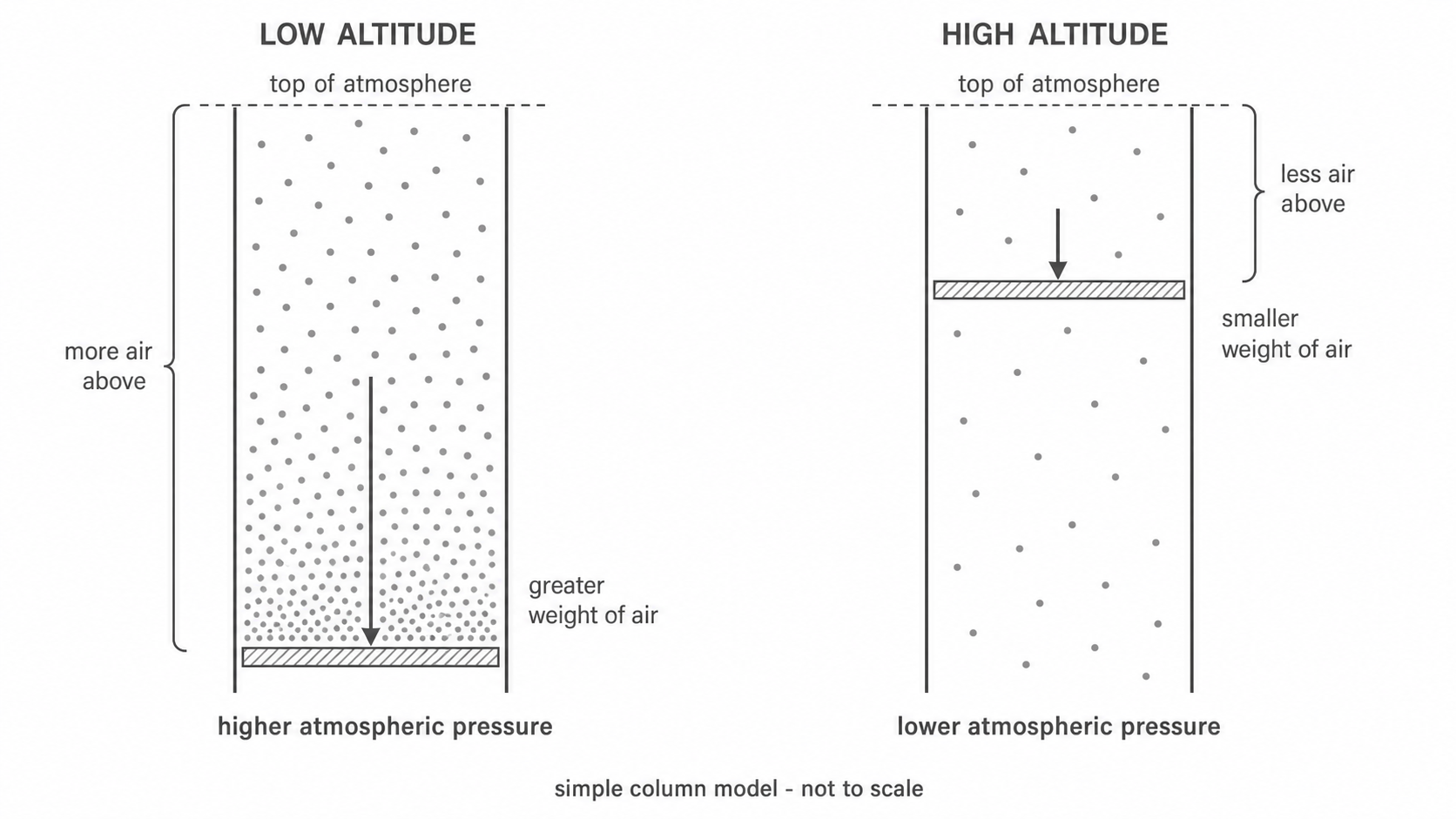
At greater height, there is less air above the chosen patch. The overlying air therefore has less mass and weight, so it produces a smaller force per unit area. Atmospheric pressure decreases as height above Earth's surface increases. Air is also less dense higher in the atmosphere: the model shows fewer particles in the same volume.
This is a model, not a scale drawing of a sharp-topped atmosphere. Real pressure also changes with weather and temperature. For the height trend, the useful GCSE explanation is the smaller amount and weight of air above the higher point, not a claim that gravity suddenly becomes much weaker.
How fluids press on surfaces
A fluid is a substance that can flow, so both liquids and gases are fluids. In an open tank, the atmosphere presses on the liquid surface. At a point below the surface, the total pressure is due to both the atmospheric pressure at the surface and the additional pressure due to the liquid.
Pressure is a scalar quantity: it has a size but no single direction. However, the force caused by pressure on a particular surface does have a direction. That force acts normal to the surface, which means at right angles to the surface at the point where the force acts.
[DIAGRAM: asset_name: 61_1PH0-P2-15B_15.7P-15.12P - Pressure in fluids - diagram 02; asset_slug: phy-g-fluid-pressure-repaired; recommended_method: matplotlib; description: a precise fluid-pressure comparison showing atmospheric contribution, normal wall forces, and greater pressure at increased depth and density with controlled variables]
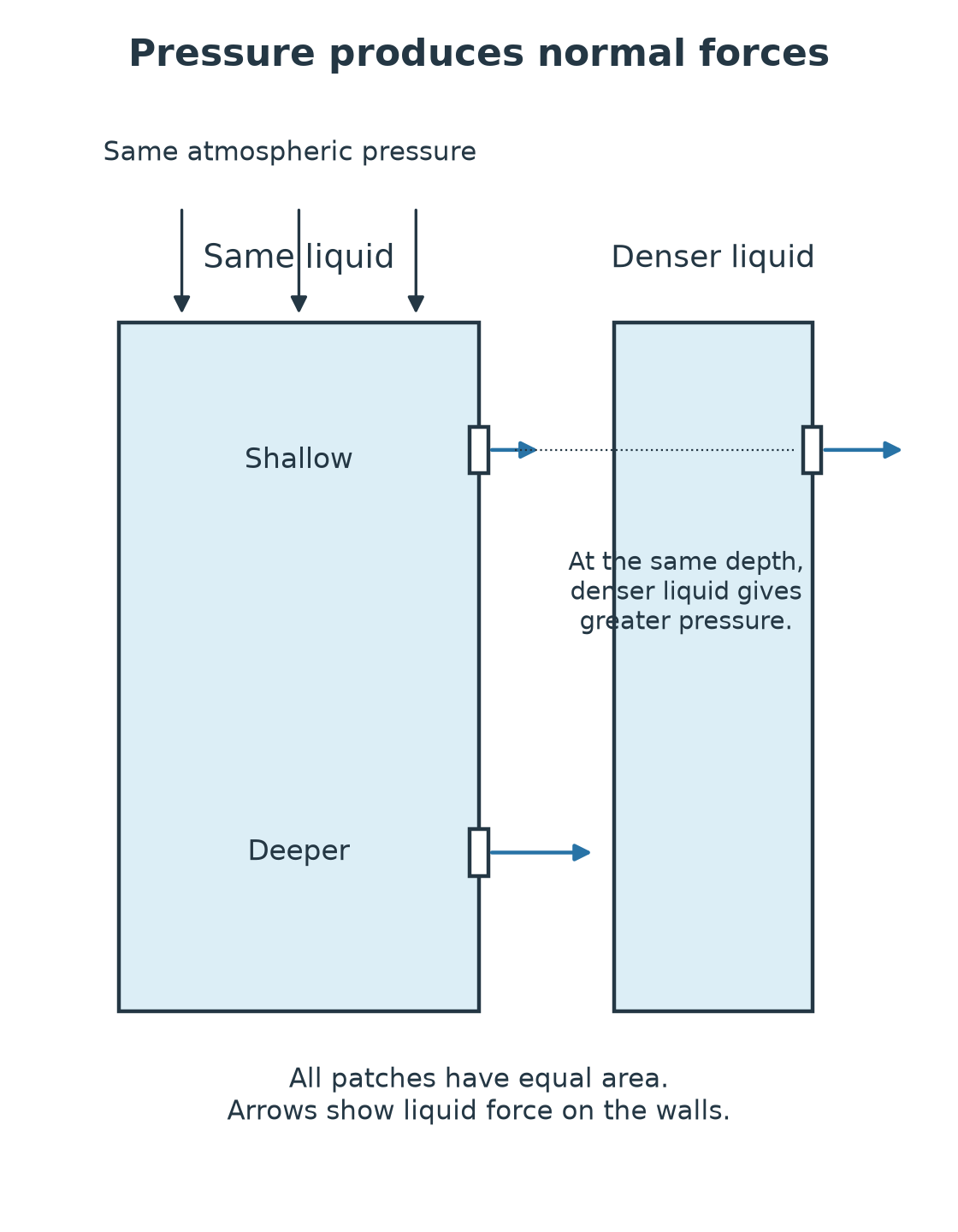
In the left panel, the labelled arrows show force on the wall by the liquid. Each arrow begins at an equal-area wall patch and points outward from the liquid, perpendicular to the vertical wall. A horizontal wall would have a vertical pressure-force arrow; on a sloping surface, the arrow would turn so that it remained perpendicular to that local surface.
The arrows are representations, not paths followed by liquid. Their directions show the pressure forces on the named wall patches, and their lengths compare force only because the patch areas are the same.
Separating force, area and pressure
Pressure measures how concentrated a normal force is over an area. The same force can create different pressures when it acts over different areas.
- A drawing pin produces a large pressure at its sharp point because the force is concentrated over a very small area.
- A wide snowshoe produces a smaller pressure on snow than a narrow shoe carrying the same weight because the force is spread over a larger area.
These comparisons keep force constant. If the quantity held constant changes, so does the conclusion:
Continue this lesson.
You’re previewing NovaLearn without an account. Create a free account to read the rest.
Create free account