6.10-6.16 - Nuclear radiation and background
Identify radiation from unstable nuclei, compare how it interacts with matter and explain the counts a detector records even without a laboratory source.
Random emissions from unstable nuclei
Imagine listening to a detector beside a radioactive source. It clicks, pauses, clicks twice quickly, then pauses again. Holding the source still and keeping the apparatus unchanged does not make the clicks evenly spaced.
A nucleus is unstable if it can change by emitting radiation. The emission is a random process: it is impossible to predict exactly when one particular unstable nucleus will emit. Random does not mean that a cause is being switched on and off, and it does not mean that every nucleus emits at the same instant. It means that the timing of each individual nuclear event is unpredictable, so repeated counts over equal time intervals fluctuate.
Unstable nuclei can emit several kinds of radiation:
| Emission | What it is | Charge |
|---|---|---|
| Alpha | Two protons and two neutrons bound together; equivalent to a helium nucleus | +2 |
| Beta-minus | An electron produced in a nuclear change and emitted from the nucleus | -1 |
| Beta-plus | A positron, the positively charged counterpart of an electron | +1 |
| Gamma | Electromagnetic radiation emitted from the nucleus | 0 |
| Neutron radiation | Neutrons emitted from the nucleus | 0 |
An alpha particle is a helium nucleus, not a complete helium atom: it has no orbiting electrons. A beta-minus particle is not an electron from the atom's electron shells being knocked loose; it is emitted from the nucleus. In an alpha/beta/gamma comparison, the shorter name beta particle normally refers to this beta-minus electron. Gamma radiation consists of electromagnetic photons with no electric charge and no rest mass.
Alpha, beta-minus, beta-plus and gamma are ionising radiations. Their energy can remove electrons from atoms or molecules, leaving charged particles called ions. Pearson's required alpha/beta/gamma property comparison is developed in the next part; neutron radiation is not included in that three-way ranking.
Ionisation and penetration
Ionising ability describes how readily radiation makes ions as it travels through matter. Penetrating ability describes how far radiation can travel through a material before being absorbed or reduced greatly.
These properties are linked. Radiation that interacts strongly makes many ions in a short distance and loses its energy quickly, so it is less penetrating. Radiation that interacts less often makes fewer ions along a given path and can travel farther.
| Radiation | Relative ionising ability | Relative penetrating ability | Typical material that stops or greatly reduces it |
|---|---|---|---|
| Alpha | Highest | Lowest | A sheet of paper, the outer layer of skin, or a few centimetres of air |
| Beta | Intermediate | Intermediate | A thin sheet of aluminium or plastic |
| Gamma | Lowest | Highest | Thick lead or concrete reduces its intensity |
Alpha has a charge of +2 and is relatively massive, so it interacts strongly with nearby atoms, causes dense ionisation and quickly loses energy. Beta is much smaller and produces less dense ionisation, so it usually travels farther. Gamma has no charge and interacts less frequently, so it is the most penetrating and least ionising of the three.
[DIAGRAM: asset_name: 25_1PH0-P1-06B_6.10-6.16 - Nuclear radiation and background - diagram 01; asset_slug: 25_1ph0-p1-06b_6-10-6-16-nuclear-radiation-background_diagram_01; recommended_method: image_gen; description: monochrome three-lane comparison showing alpha stopped by paper, beta stopped by thin aluminium, and gamma attenuated by thick lead alongside the inverse ionisation ranking]
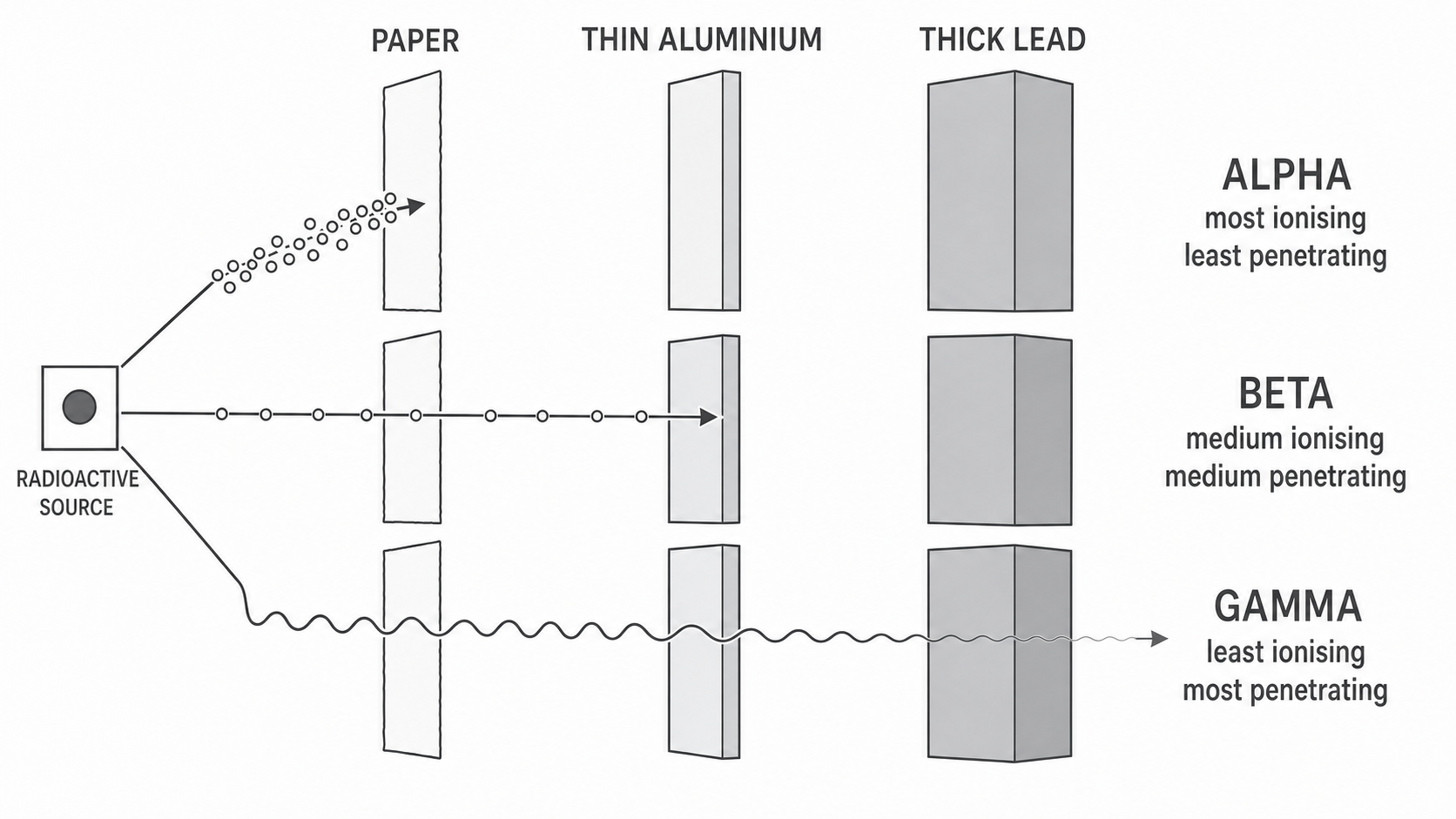
The circles along the alpha and beta tracks represent ionisation events, not visible beads carried by the radiation. The thinner gamma trace represents reduced intensity: fewer photons are transmitted, not a lower energy for every transmitted photon. The drawn barrier thicknesses are schematic. Real absorption also depends on the radiation's energy and the material thickness, so stopped by is a useful GCSE comparison rather than a claim that every possible particle has exactly the same range. Thick lead reduces gamma intensity; a thicker shield gives a greater reduction, but the diagram does not imply that one block guarantees zero gamma transmission.
Continue this lesson.
You’re previewing NovaLearn without an account. Create a free account to read the rest.
Create free account