13.1P-13.3P - Electromagnetic induction and generators
Moving a magnet relative to a coil can produce an electrical output. Learn the conditions for induction, explain its opposing magnetic effect, and compare the connections that give alternating or direct current. This lesson is Higher-tier content.
Producing a current by relative motion
Connect a coil of insulated wire to a sensitive centre-zero voltmeter. Push one pole of a bar magnet into the coil: the meter deflects. Hold the magnet still inside the coil: the reading returns to zero. Pull the magnet out: the meter deflects in the opposite direction.
[DIAGRAM: asset_slug: phy-f-induction-meter-v2; description: induction meter;]
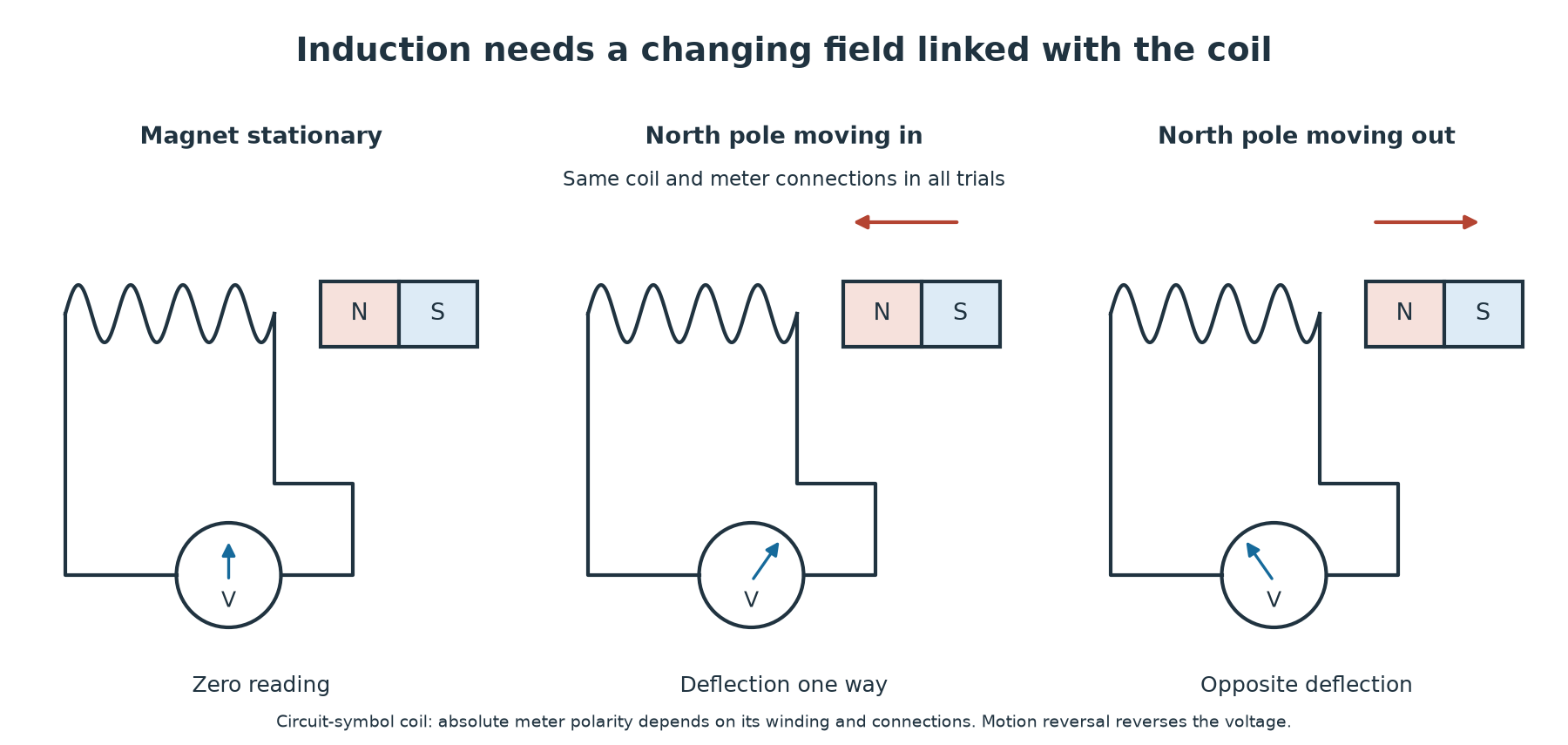
In this experiment, relative movement changes the magnetic field linked with the coil. It does not matter whether the magnet moves and the coil stays still, or the coil moves and the magnet stays still. For this coil, what matters is a change in the magnetic field linked with it.
This process is electromagnetic induction. The changing magnetic field induces a potential difference across the conductor. If the conductor is part of a complete circuit, that potential difference drives an induced current. If the circuit is open, an induced potential difference can still exist, but there is no continuous path for a current.
Electromagnetic induction is the production of a potential difference when a conductor moves across a magnetic field, or when the magnetic field linked with a coil changes. An induced current flows only if the conductor is in a complete circuit.
To show an induced current directly, connect the coil into a complete circuit with a sensitive centre-zero ammeter (or galvanometer). Moving the magnet gives a current; stopping it gives no sustained current. Keep the same connections while comparing opposite motions. A high-resistance voltmeter is used for the voltage comparisons here, so the effect of increased coil resistance is not confused with a change in induced voltage.
A coil is useful because every turn of wire experiences the change. A single straight conductor moving across a magnetic field can also have a potential difference induced across it. Movement must cut across the field in the relevant direction: moving a wire along field lines does not do this. Likewise, merely translating a whole coil within an unchanged uniform field does not change the field linked with it.
Magnetic field lines in a diagram are a representation of field direction and relative strength; they are not material threads. Saying that the field through a coil changes describes a change in the magnetic conditions at the coil, not physical lines being swept into the wire.
Controlling size and direction
For comparisons below, use the same high-resistance voltmeter and the same motion path. The size of the induced potential difference depends on how quickly the magnetic field linked with the conductor changes.
| Change | Effect on induced potential difference | Reason |
|---|---|---|
| Move the magnet and coil faster relative to each other | larger | the field through the coil changes more each second |
| Use a stronger magnetic field | larger | a greater field change occurs for the same movement |
| Use a coil with more turns | larger | the induced effects from more turns combine |
The potential difference is zero when the magnet and coil are stationary relative to each other and the field through the coil is unchanging. A strong stationary magnet does not by itself produce a continuous potential difference.
The direction of the induced potential difference, and therefore the current in a complete circuit, can be reversed in either of two ways:
- reverse the relative motion, such as changing from pushing the north pole in to pulling it out;
- reverse the magnetic field, such as pushing the south pole in instead of the north pole.
If both changes are made together, the two reversals cancel and the induced direction is unchanged from the original case.
When an induced current flows, it produces its own magnetic field. This field acts to oppose the original change that caused the current. It does not simply oppose the original field in every situation.
For example, as a north pole approaches a complete coil, the near face of the coil behaves like a north pole and repels the magnet, opposing its approach. As the north pole is pulled away, the near face behaves like a south pole and attracts it, opposing its departure. This opposition is why mechanical work must be done to keep producing electrical output.
Connecting a generator to a suitable lamp completes a circuit with a much lower resistance than a voltmeter alone, allowing a larger current. The induced current produces a magnetic field whose interaction opposes the motion, so the person or turbine must apply a greater force and do more work. The lamp has not created a special "mechanical resistance" in the handle: mechanical energy is being transferred into the electrical circuit and then to the lamp.
Continue this lesson.
You’re previewing NovaLearn without an account. Create a free account to read the rest.
Create free account