14.16P-14.20P - Gas laws and work on gases
A sealed syringe resists being pushed because changing gas volume changes how the trapped gas presses on its surroundings. Statements 14.16P and 14.17P connect compression and expansion to the force produced by gas pressure, while 14.18P explains the change using particle collisions. Statement 14.19P turns that relationship into a calculation, and Higher-only statement 14.20P explains why doing work on gas in a bicycle pump can make it warmer.
How gas pressure moves a surface
Imagine air trapped in a sealed cylinder by a piston that can slide. The gas particles move randomly and collide with every inner surface. When particles rebound from a small patch of surface, their motion changes and they exert forces on that patch. Across many random collisions, sideways effects cancel, leaving the gas pressure's resultant force at right angles to the surface.
This direction follows the surface. On the flat end of a piston the force is along the cylinder, but on a sloping wall it is perpendicular to that slope. The pressure force is not a stream of particles travelling permanently in one direction; it is the combined effect of many collisions.
Whether the piston moves depends on the competing pressures on its two sides:
- if the external pressure produces the greater opposing force, the piston moves inward and the gas is compressed, so its volume decreases;
- if the trapped gas produces the greater outward force, the piston moves outward and the gas expands, so its volume increases;
- if the opposing effects balance, the piston stays in place.
A pressure change can alter the volume only when a boundary can move or deform. A rigid sealed container keeps the same volume even if its gas pressure changes. During compression, the spaces between gas particles become smaller; the particles themselves are not crushed or made smaller.
Why a smaller volume raises pressure
Now compare two states of the same sealed sample of gas. The mass is fixed, so the model contains the same number of particles. The temperature is also constant, so the particles have the same average kinetic energy and the same average speed before and after the volume change.
[DIAGRAM: asset_name: 59_1PH0-P2-14F_14.16P-14.20P - Gas laws and work on gases - diagram 01; asset_slug: 59_1ph0-p2-14f-gas-compression_diagram_01; recommended_method: image_gen; description: a monochrome paired piston-and-particle model showing the same fixed mass and temperature at larger and smaller volumes, with more frequent wall collisions after compression]
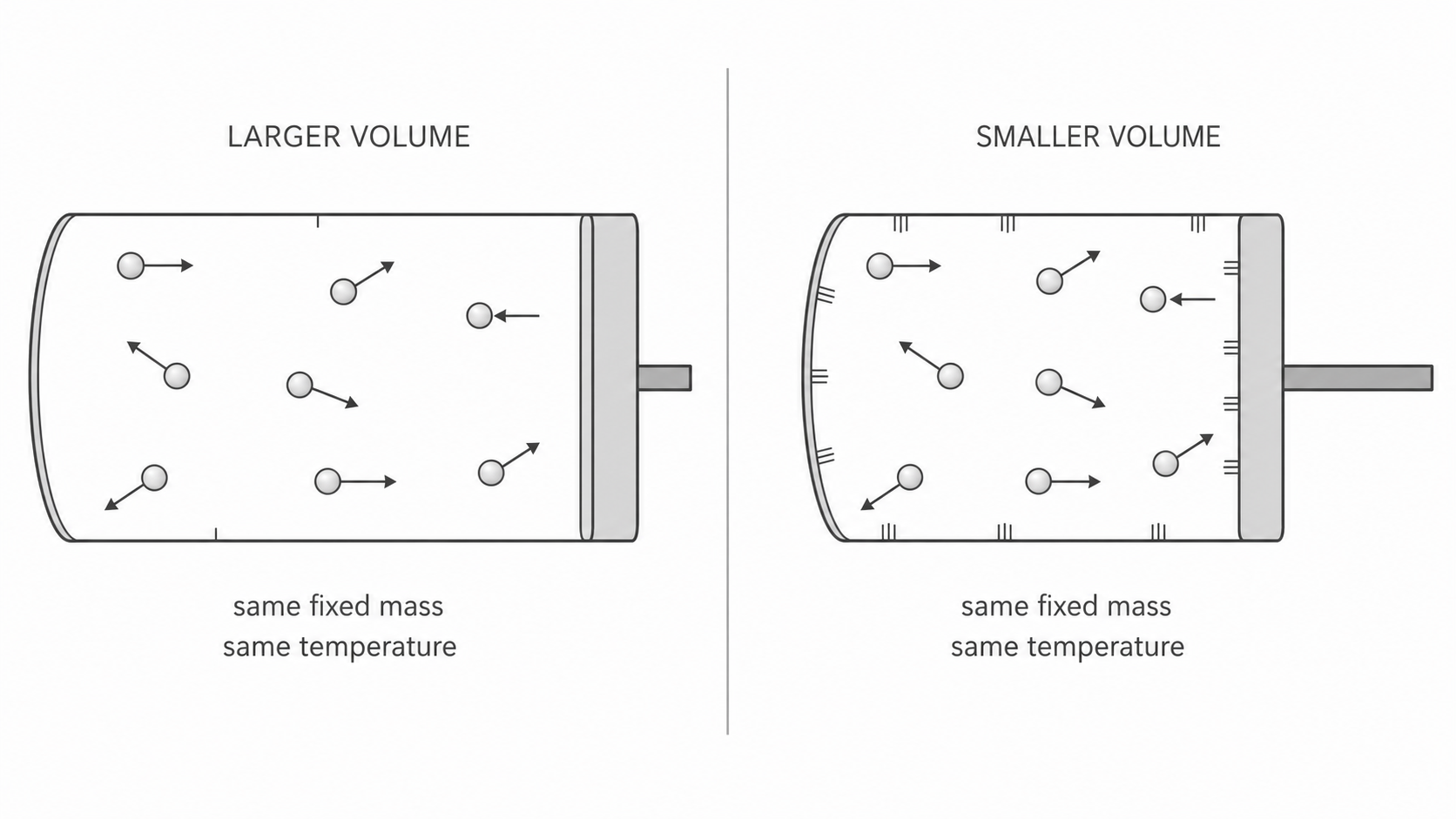
When the piston moves inward, each particle has a shorter average distance to travel before reaching a wall. The particles therefore collide with the container walls more often each second. More impacts occur per second on each unit area, producing a greater average force per unit area and hence a greater pressure. Compare an equal-area wall patch rather than the total force on a changing total wall area.
Expansion reverses the chain. In a larger volume, particles travel farther between wall collisions, so the wall-collision rate and pressure decrease. At constant temperature, the explanation is not that the particles slow down during expansion or speed up during compression; it is the change in collision rate.
The inverse pressure-volume relationship
For a fixed mass of gas at constant temperature, pressure and volume are inversely proportional. If the volume is halved, the pressure doubles; if the volume is multiplied by three, the pressure becomes one third as large. In each case, pressure multiplied by volume stays constant.
[DIAGRAM: asset_name: 59_1PH0-P2-14F_14.16P-14.20P - Gas laws and work on gases - diagram 02; asset_slug: 59_1ph0-p2-14f-pressure-volume-curve_diagram_02; recommended_method: matplotlib; description: an exact pressure-against-volume plot with labelled axes, selected coordinate points and a smooth inverse curve for a fixed mass of gas at constant temperature]
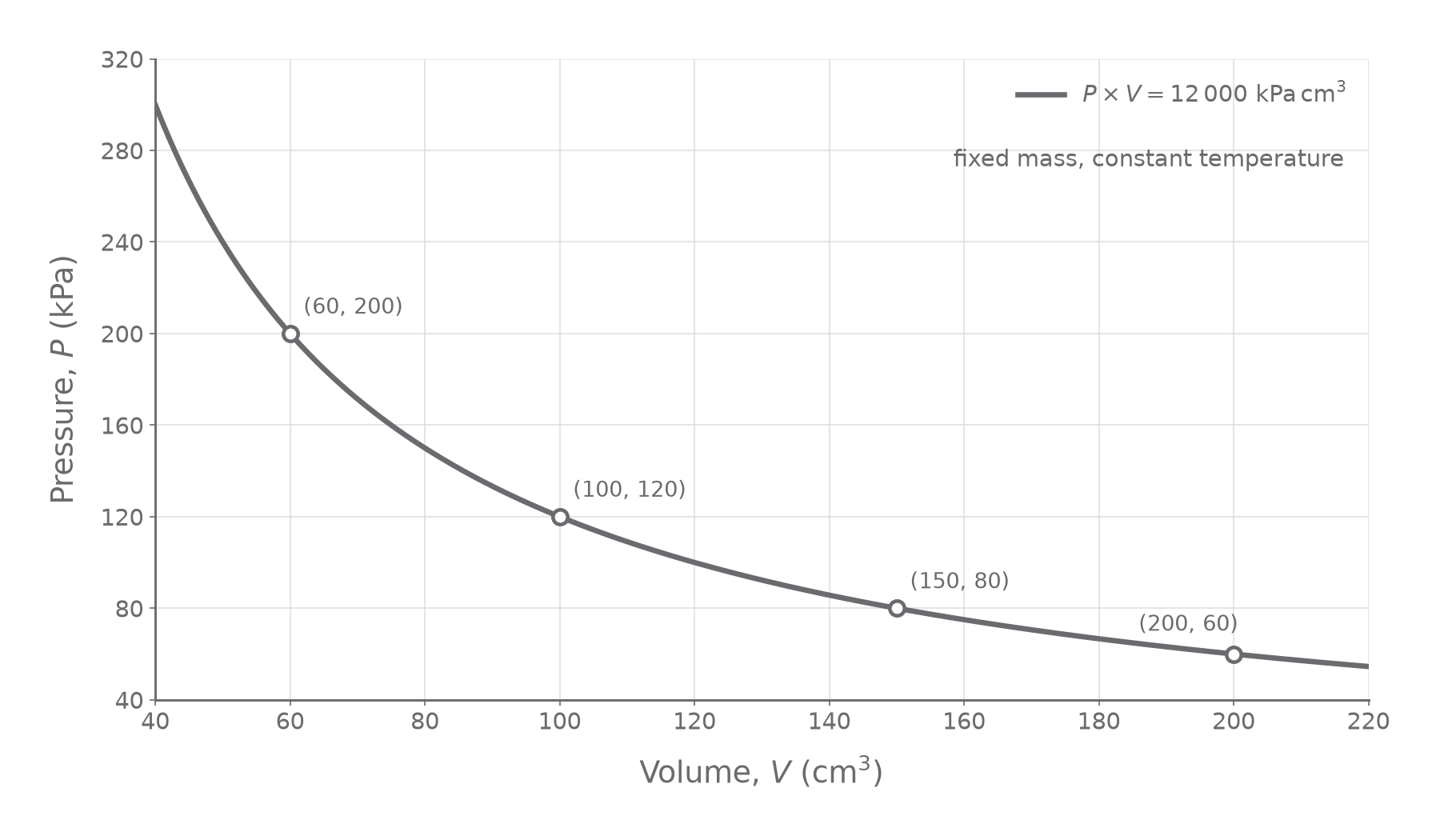
On this plot, volume is on the horizontal axis and pressure is on the vertical axis. The curve represents : for example, , and all have the same pressure-volume product. The curve is not a straight line, even though pressure changes in a predictable way with volume.
For a fixed mass of gas at constant temperature:
- and are the pressure and volume in state 1.
- and are the pressure and volume in state 2.
This equation is supplied in the 1PH0-only section of Pearson's W84389RA equation list and is not labelled HT. It applies only when the same trapped mass of gas is compared at two states and its temperature is constant.
Continue this lesson.
You’re previewing NovaLearn without an account. Create a free account to read the rest.
Create free account