12.1-12.6 - Magnets and magnetic fields
Magnets exert forces without touching. Learn how magnetic materials become magnetised, how field lines show direction and strength, and how a plotting compass reveals the fields of a bar magnet and the Earth.
Poles and magnetic materials
Bring the north pole of one bar magnet close to the north pole of another and the magnets push apart without touching. Turn one magnet round so that north faces south and they pull together. The force acts at a distance and changes direction when the pole arrangement changes.
Every magnet has two poles, called north (N) and south (S). The magnetic effect is strongest near these poles.
Like magnetic poles repel: N-N and S-S. Unlike magnetic poles attract: N-S.
A magnetic material is a material that is strongly attracted to a magnet and can be magnetised. The elements iron, cobalt and nickel are magnetic. Steel is also magnetic because it is an alloy containing mostly iron. This does not mean that all metals are magnetic: aluminium and copper, for example, are not attracted strongly to an ordinary magnet.
A magnetic material is not necessarily already a magnet. An unmagnetised iron nail is attracted to either pole of a bar magnet, but it does not have its own lasting north and south poles before the magnet is brought near. Attraction therefore does not prove that two objects are both permanent magnets. Repulsion shows that the object is magnetised: an unmagnetised magnetic material will not repel a pole. A repulsion test alone does not prove that the magnetisation will be permanent after the external field is removed.
Permanent and induced magnets
A permanent magnet produces its own magnetic field and keeps its magnetism after the magnetising influence is removed. A compass needle is a permanent magnet because it must remain magnetised while it is carried from place to place.
An induced magnet is a magnetic material that becomes a magnet while it is in another magnetic field. The end nearest a pole of the permanent magnet becomes the opposite pole. This explains why induction produces attraction whichever pole is brought near. When the external field is removed, a temporary magnetic material loses all or most of its induced magnetism.
Magnetically hard materials are difficult to magnetise but retain magnetisation well. Magnetically soft materials are easily magnetised and lose magnetisation readily. Here, hard and soft describe magnetic behaviour, not whether a material can be scratched.
Different magnetic behaviour suits different jobs:
| Material choice | Magnetic behaviour | Useful applications |
|---|---|---|
| Steel and suitable alloys containing cobalt or nickel | Can retain magnetisation, so they can make permanent magnets | Compass needles, magnetic catches and permanent loudspeaker magnets |
| Soft iron | Easily becomes an induced magnet and loses most of its magnetism when the magnetising field is removed | Temporary cores in lifting magnets, electric bells and other switchable magnetic devices that must release objects |
Cobalt, nickel, iron and steel are all magnetic materials, but the exact composition and treatment determine how well a sample retains magnetisation. The table does not mean that every object containing cobalt or nickel is already a permanent magnet. How an electric current supplies the magnetising field in a switchable device belongs to the next lesson; here the important material property is gaining and losing magnetism.
Representing magnetic fields
A magnetic field is a region in which a magnet or magnetic material experiences a force. The field exists throughout the region around a magnet, not only at its poles, although the field is usually strongest close to the poles.
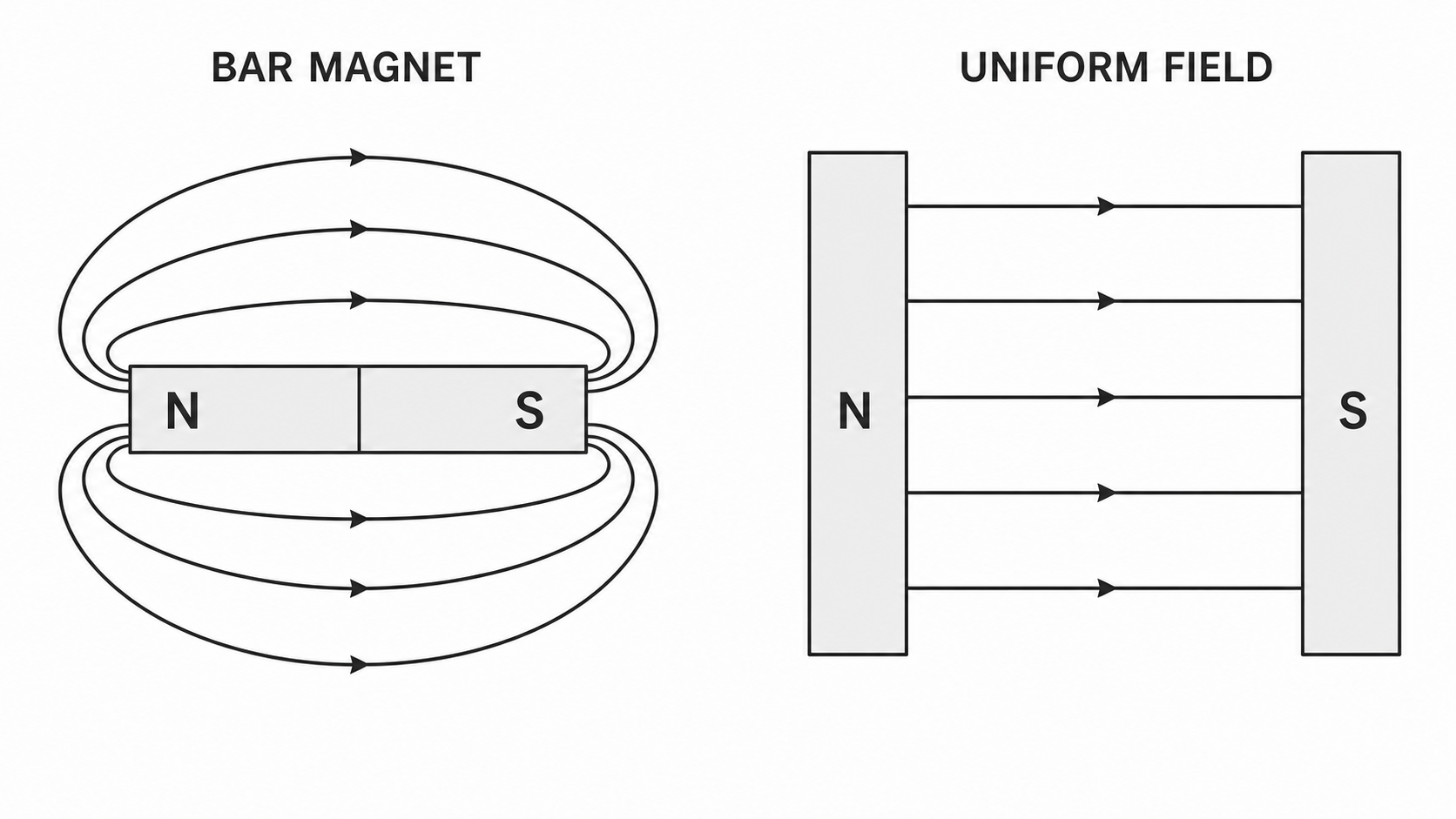
Magnetic field lines are a model used to represent an invisible field. They are not wires, streams or paths along which something must travel. At any point, the arrow on a field line shows the direction in which the north pole of a very small compass would point.
Around a bar magnet:
- outside the magnet, arrows point from the north pole to the south pole;
- lines curve from one pole around to the other and never cross;
- lines are drawn closest together near the poles, representing a stronger field there;
- wider line spacing represents a weaker field, but the exact number of drawn lines is a choice made by the diagram author.
A uniform magnetic field has the same strength and direction throughout the region being considered. It is represented by straight, parallel, equally spaced lines whose arrows all point the same way. The central region between two broad, close, unlike pole faces can approximate a uniform field; near the edges, the field curves and is no longer uniform.
[DIAGRAM: asset_name: 48_1PH0-P2-12A_12.1-12.6 - Magnets and magnetic fields - diagram 01; asset_slug: 48_1ph0-p2-12a_12-1-12-6-magnets-and-magnetic-fields_diagram_01; recommended_method: image_gen; description: Two-panel monochrome scientific diagram comparing curved external field lines around a labelled bar magnet with straight parallel equally spaced lines in a uniform field.]
Continue this lesson.
You’re previewing NovaLearn without an account. Create a free account to read the rest.
Create free account