6.36P-6.42P - Nuclear fission and power stations
Follow a neutron-triggered fission through a controlled chain reaction to electrical generation. Use that mechanism to weigh nuclear power’s benefits, radioactive waste and safety requirements.
Locating the nuclear energy source
A turbine in a large power station needs a steady supply of thermal energy. In a gas-fired station, combustion supplies this energy. In a nuclear power station, the reactor supplies it through changes inside atomic nuclei, so no fuel is burned in the reactor.
Three kinds of nuclear change can release energy:
- nuclear fission, in which a large nucleus splits;
- nuclear fusion, in which small nuclei join;
- radioactive decay, in which an unstable nucleus changes spontaneously and emits radiation.
This lesson focuses on fission because present nuclear power stations use a controlled fission chain reaction as their heat source. Fusion is also a possible nuclear energy source, but its mechanism belongs to the next lesson. Radioactive decay can release energy without an incoming particle, whereas the reactor fission model begins when a neutron is absorbed by a suitable fuel nucleus.
The useful energy is not released by electrons changing shells or by atoms burning. It comes from a change in the nucleus. In the reactor, the energy of moving fission products and neutrons is transferred by collisions, increasing the thermal energy of the fuel and coolant.
Following one U-235 fission
Uranium-235, written U-235, is a fissile isotope: under the right conditions, its nucleus can split after absorbing a neutron. The diagram is a simplified model of the event and its continuation, not a scale picture of nuclei or neutron paths.
[DIAGRAM: asset_name: 29_1PH0-P1-06F_6.36P-6.42P - Nuclear fission and power stations - diagram 01; asset_slug: 29_1ph0-p1-06f_6-36p-6-42p-nuclear-fission-power-stations_diagram_01; recommended_method: image_gen; description: two-panel monochrome teaching diagram showing one neutron-induced U-235 fission into two radioactive daughter nuclei, at least three emitted neutrons, released energy, and the first linked generation of a chain reaction]
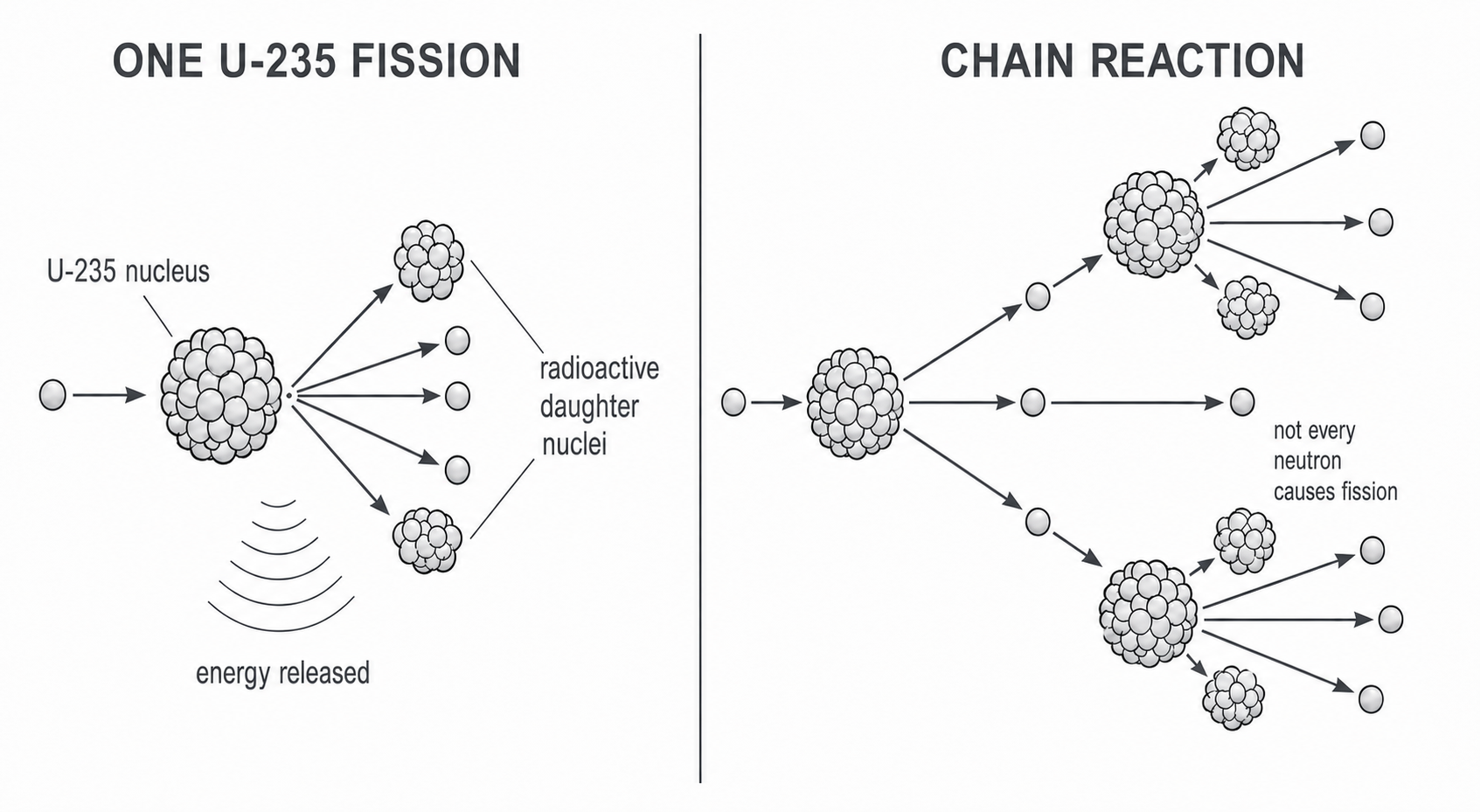
The sequence is:
- A neutron is absorbed by a U-235 nucleus.
- The resulting nucleus is unstable and splits into two smaller daughter nuclei.
- Two or more neutrons are emitted. A diagram may show three, but the required general statement is two or more.
- Energy is released. Collisions transfer this energy to the surrounding fuel and coolant as thermal energy.
The daughter nuclei produced by fission are unstable and therefore radioactive. They decay and emit ionising radiation. This matters twice: it is part of the outcome of every fission, and it explains why used reactor fuel remains radioactive and must be handled remotely, shielded and securely contained.
Do not confuse emitted neutrons with the daughter nuclei. The daughter nuclei are the two smaller nuclei formed when U-235 splits; the extra neutrons can travel on and cause further fissions.
Controlling a chain reaction
If an emitted neutron is absorbed by another U-235 nucleus, it can cause another fission. That fission releases more neutrons, which may cause still more fissions. This repeating process is a nuclear chain reaction.
Not every emitted neutron causes another fission. Some escape from the fuel and some are absorbed without causing U-235 to split. In a steady controlled chain reaction, the reactor is managed so that, on average, one neutron from each fission goes on to cause one further fission. The number of fissions each second and the rate of energy release then remain approximately steady.
Two reactor components have different jobs:
| Component | Action on neutrons | Effect on the chain reaction |
|---|---|---|
| moderator | slows fast neutrons released by fission | makes the slowed neutrons more likely to cause fission in U-235, helping the chain continue |
| control rods | absorb neutrons | reduce the number available to cause further fission, controlling the rate or stopping the chain reaction |
The moderator is not the component used to soak up extra neutrons. In many reactors, water acts as both moderator and coolant, but these are different functions: as moderator it slows neutrons; as coolant it carries thermal energy away from the fuel.
Moving the control rods changes the rate through a causal chain:
- insert the rods further → more neutrons absorbed → fewer further fissions each second → lower rate of thermal energy release;
- withdraw the rods partly → fewer neutrons absorbed → more available to cause fission → higher rate of thermal energy release.
The rods are adjusted to keep the reaction controlled as the required output changes. Fully inserting suitable control rods can stop the self-sustaining chain reaction; withdrawing them does not mean allowing an uncontrolled explosion. After shutdown, radioactive products still release decay heat, so cooling is still needed even after the self-sustaining fission chain stops.
Continue this lesson.
You’re previewing NovaLearn without an account. Create a free account to read the rest.
Create free account