10.4-10.6 - Potential difference and energy per charge
Connect a voltmeter across a component, explain its reading as energy per coulomb and use charge and voltage to calculate energy transfer.
A voltmeter compares two points
Potential difference, also called voltage or p.d., is measured with a voltmeter. Its unit is the volt, symbol V. The symbol V therefore has two jobs in this topic: italic or equation-style V names the quantity potential difference, while V written after a number is the unit volt; context makes the meaning clear.
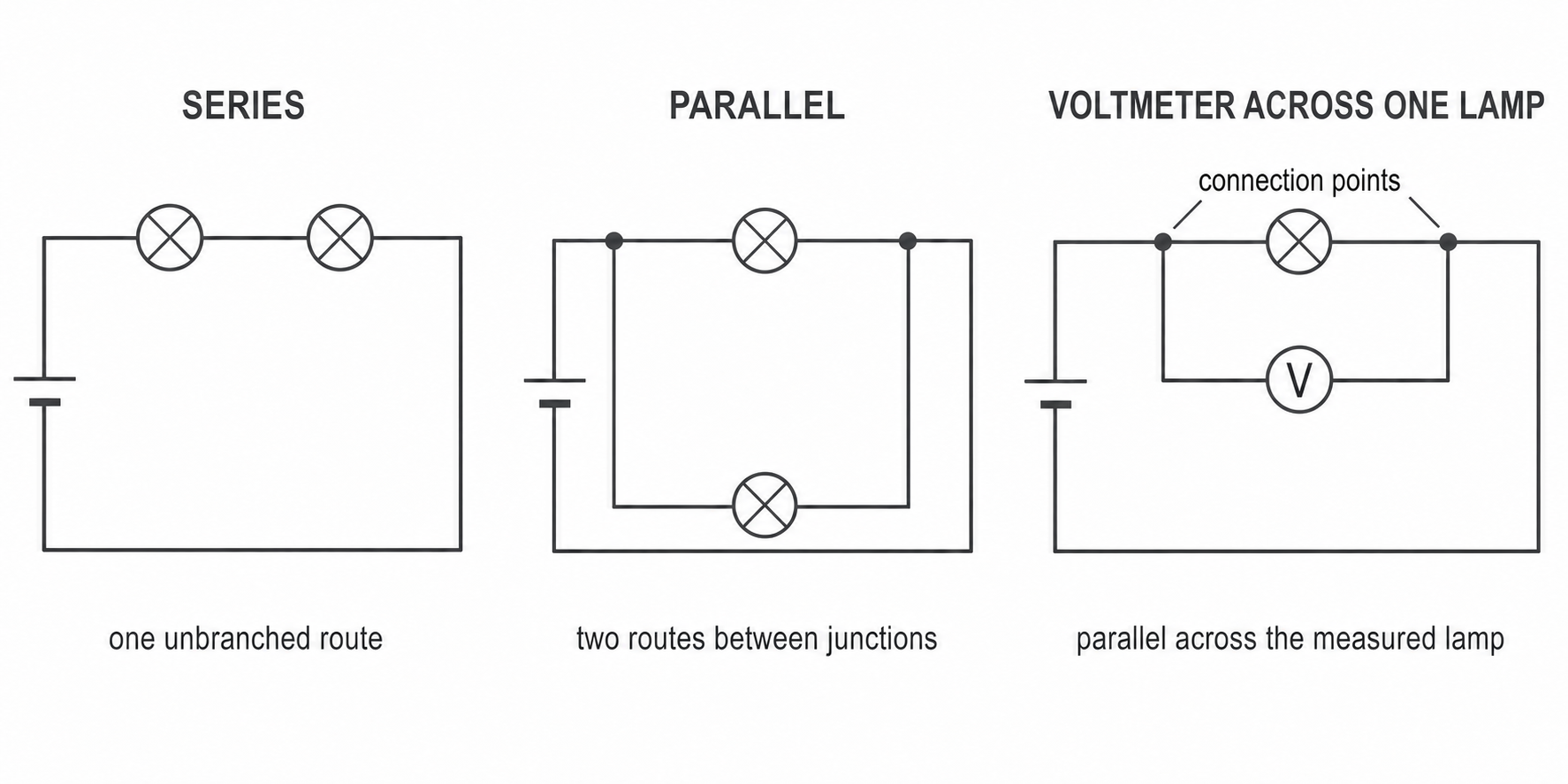
A voltmeter must be connected in parallel across the component being measured. Its two leads connect to the two points on opposite sides of that component, as in the third panel of the circuit comparison below. It then compares those two points and measures the potential difference across that component.
Use this placement check:
- Name the component whose potential difference is required.
- Locate the wire immediately before and immediately after that component.
- Connect one voltmeter terminal to each of those two points, forming a separate parallel branch.
- Check that the main route through the component has not been cut and that the voltmeter is not merely across a different component or the whole source.
Putting the voltmeter into the single main route is a series connection and is incorrect for this measurement. Placing it across the wrong pair of points may produce a reading, but it answers a different question because it measures the potential difference between those other points.
A voltmeter measures between two points: connect it in parallel across the exact component named in the question, and record the reading in volts.
[DIAGRAM: asset_name: 39_1PH0-P2-10A_10.1-10.6 - Charge, voltage and circuit symbols - diagram 02; asset_slug: 39_1ph0-p2-10a_10-1-10-6-charge-voltage-circuit-symbols_diagram_02; recommended_method: image_gen; description: three-panel monochrome circuit comparison showing one unbranched series route, two parallel lamp branches between junctions and a voltmeter connected across one named lamp]
Voltage is energy transferred per unit charge
The charge passing through a component can be measured in coulombs (C). Potential difference tells us how much energy is transferred for each coulomb of charge that passes:
Potential difference is the energy transferred per unit charge passed. One volt is one joule per coulomb: .
For a component, a potential difference of 6 V means that 6 J of energy is transferred by the component for every 1 C of charge that passes through it. For a cell, 6 V means the source transfers 6 J of energy to the circuit for every 1 C of charge moved through the source.
The phrase per coulomb matters. A 6 V reading does not mean that exactly 6 C has passed, and it does not mean that only 6 J is transferred in total. If more charge passes through the same potential difference, more energy is transferred in total.
Continue this lesson.
You’re previewing NovaLearn without an account. Create a free account to read the rest.
Create free account