14.3 - Density core practical
A solid that fits in your hand can hide its volume in an irregular shape, and a balance weighing a liquid also weighs its container. Core Practical 14.3 solves both problems by finding mass and volume separately, then combining them to determine density. You will follow the mandatory water-displacement route for a solid and the balance-and-measuring-cylinder route for a liquid.
Planning the density investigation
The aim is to investigate the densities of solid and liquid samples. Density is not read directly from one instrument. A balance measures mass, another measurement gives volume, and the two values are processed using the relationship from the previous lesson.
density = mass / volume
- is density
mis the mass of the sampleVis the volume of the sample
The units must form a consistent set. Laboratory balances commonly read in grams and measuring cylinders in cubic centimetres, so is convenient. If mass is in kilograms and volume is in cubic metres, density is in . A measuring cylinder may be marked in millilitres; for water and other liquids, as units of volume.
Use an electronic balance, a measuring cylinder, water, thin thread, several insoluble solid samples, several low-risk liquids and paper towels. Record each instrument's resolution before starting. For example, a balance that changes in steps of 0.1 g has a resolution of 0.1 g.
This investigation changes the material or substance tested, a categoric independent variable. The dependent result is the calculated density. Keep the temperature reasonably constant, use the same measuring instruments where possible, and follow the same reading procedure for every sample. The samples do not need equal masses or volumes: dividing mass by volume makes a fair density comparison possible.
Finding the density of a solid
An irregular solid does not have a simple length-width-height calculation. The Pearson core practical therefore uses water displacement: a completely immersed object pushes aside a volume of water equal to the object's own volume.
[DIAGRAM: asset_name: 55_1PH0-P2-14B_14.3 - Density core practical - diagram 01; asset_slug: 55_1ph0-p2-14b-density-core-practical_diagram_01; recommended_method: image_gen; description: a monochrome three-stage apparatus sequence showing solid mass measurement, initial cylinder volume and complete immersion with final volume for displacement subtraction]
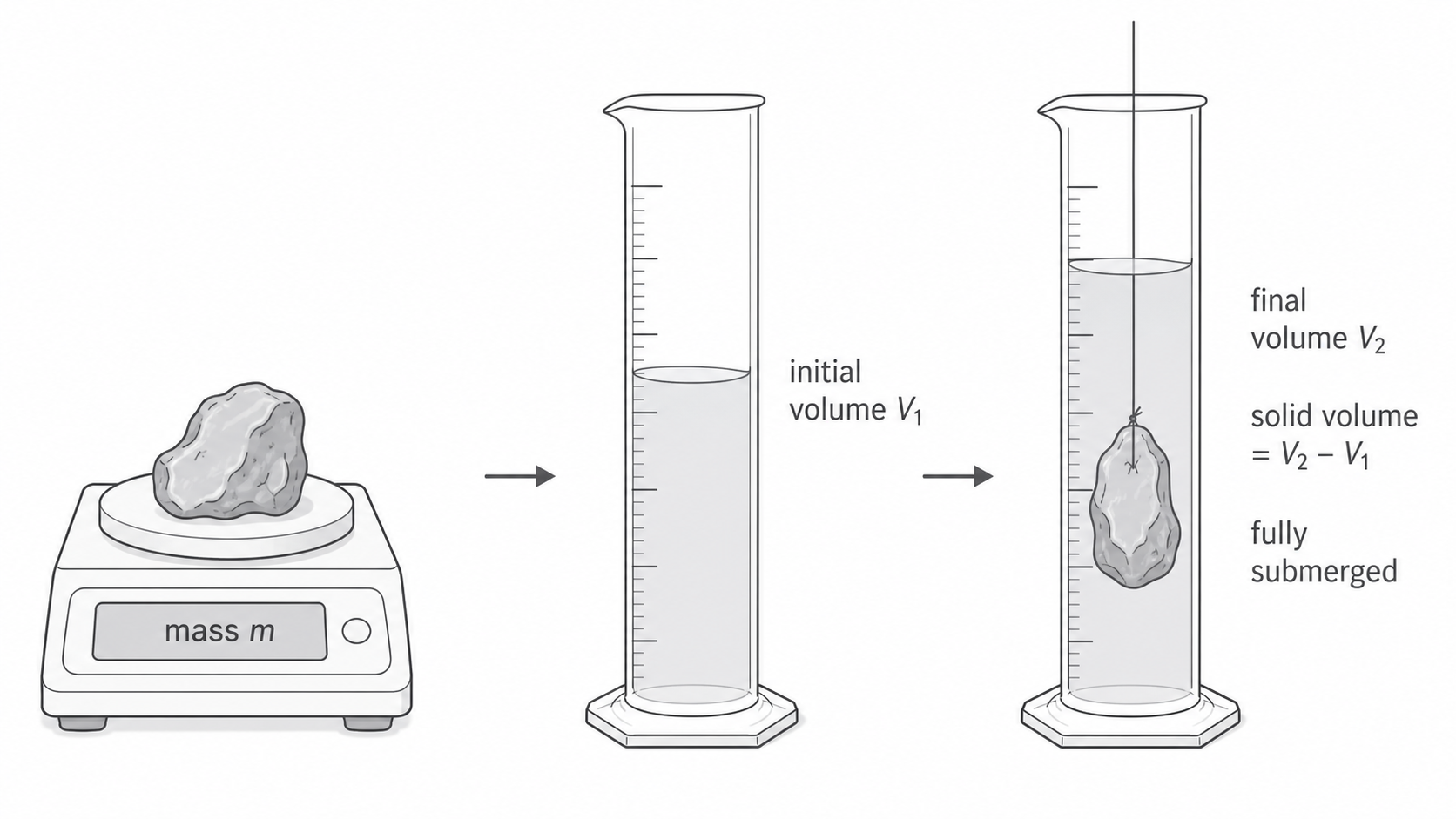
This apparatus sketch is not a numerical scale. Read the actual graduated cylinder before and after immersion; the volume difference is the displaced volume.
Method
- Check that the solid is dry, insoluble in water and small enough to be completely immersed in the measuring cylinder.
- Zero the balance, place the dry solid on it and record its mass
min grams. - Add enough water to the measuring cylinder to cover the solid later. Place the cylinder on a level surface and read the bottom of the water's concave meniscus at eye level. Record the initial volume in .
- Tie the solid to a thin thread and lower it gently into the water. Make sure the whole solid is below the surface, with no trapped air bubbles. Do not let water splash out.
- Read the new water level in the same way and record the final volume .
- Calculate the solid's volume using , then calculate .
The final cylinder reading is not the volume of the solid. Only the increase in water reading is the displaced volume.
Worked example
An irregular metal sample has mass 64.8 g. The water level rises from to .
- Find the displaced volume: .
- Select the relationship: .
- Substitute: .
- Calculate: to two significant figures.
- Sense-check: the final reading is higher than the initial reading, the volume and density are positive, and a value of several is plausible for a metal.
Finding the density of a liquid
For a liquid, the measuring cylinder supplies the volume but the container must be removed from the mass result. This can be done by subtracting two balance readings or by taring the balance with the empty cylinder on it.
[DIAGRAM: asset_name: 55_1PH0-P2-14B_14.3 - Density core practical - diagram 02; asset_slug: 55_1ph0-p2-14b-density-core-practical_diagram_02; recommended_method: image_gen; description: a monochrome two-panel apparatus comparison showing empty and liquid-filled measuring cylinders on balances, with measured volume and liquid-mass subtraction clearly identified]
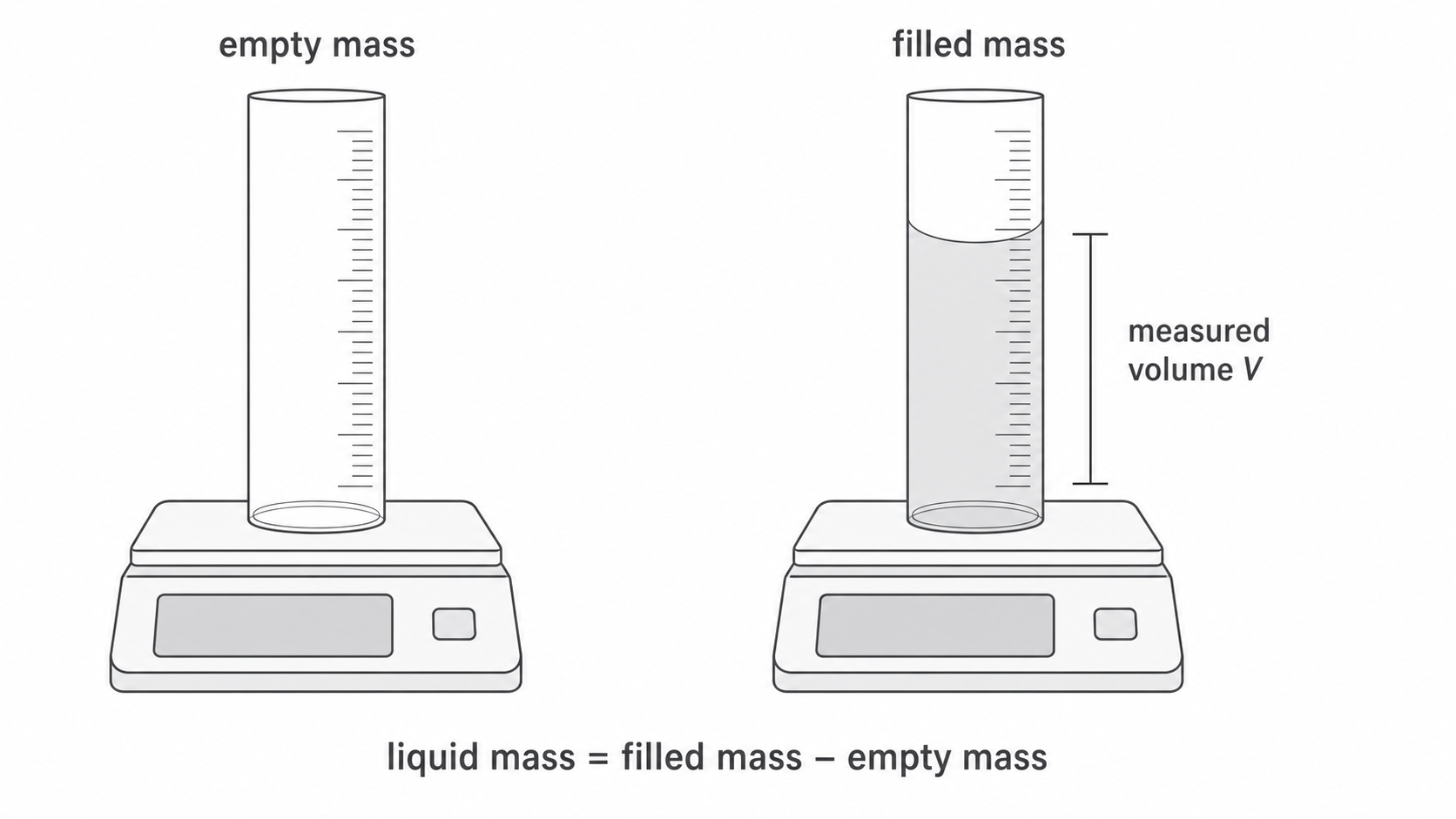
The volume label refers to the reading on the graduated scale, not the physical height of the liquid. The illustration supplies no numerical volume.
Method
- Make sure the measuring cylinder is clean and dry. Place it on the balance and record the empty-cylinder mass
m0. - Remove the cylinder from the balance and add a suitable volume of the liquid. Read the bottom of a concave meniscus at eye level and record the volume
Vin . - Wipe any liquid from the outside of the cylinder. Return it to the balance and record the filled-cylinder mass
m1. - Find the liquid's mass using .
- Calculate the density using .
Continue this lesson.
You’re previewing NovaLearn without an account. Create a free account to read the rest.
Create free account