7.19P - Observing the Universe
Observing tools changed what astronomers could detect, record and compare. Use the atmosphere’s different effects on radiation to decide which instruments benefit from going into space.
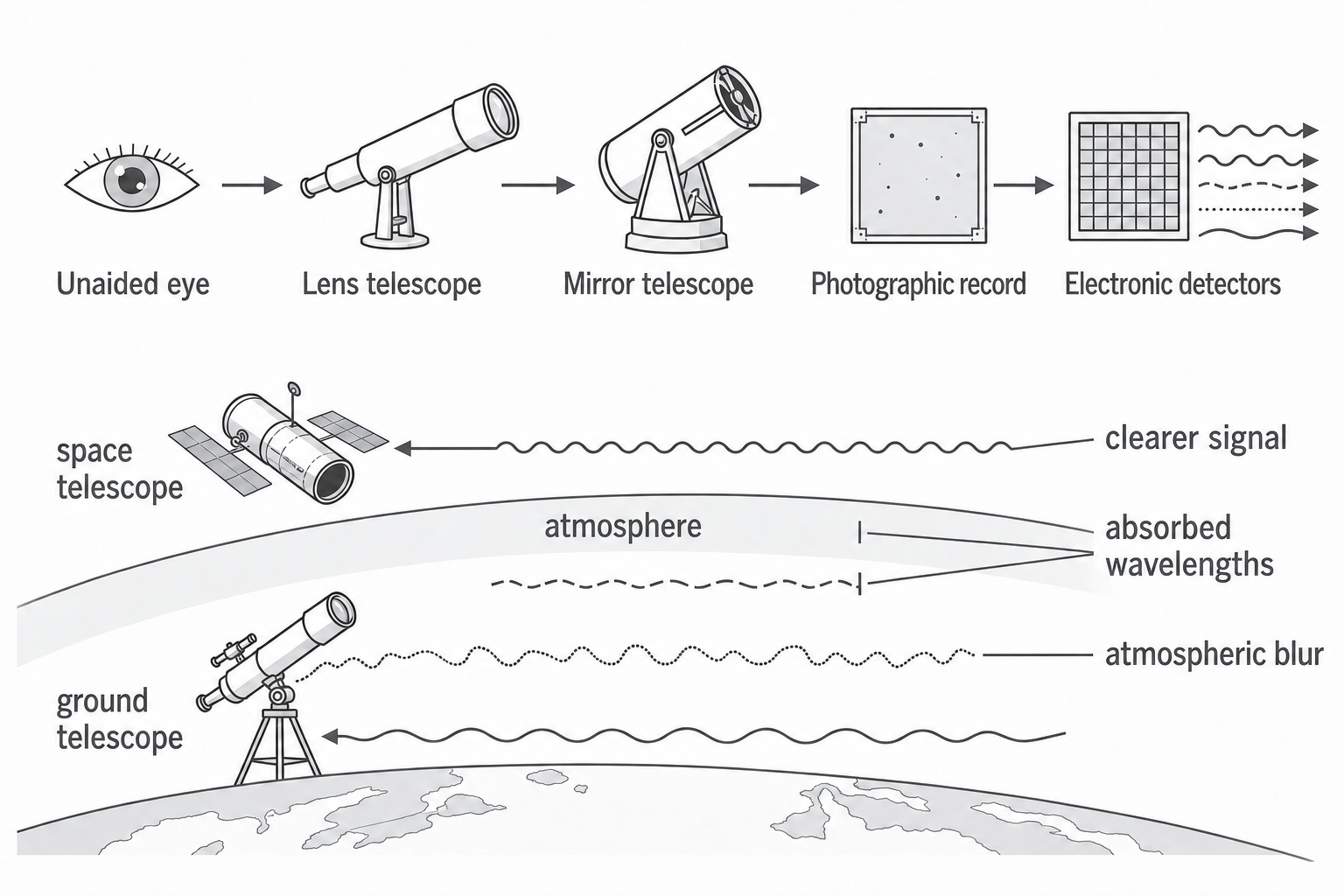
From eyes to recorded light
For most of history, people observed the night sky with unaided eyes. They could record the positions and motions of bright objects, but faint detail was unavailable and observations were limited to visible light.
Optical telescopes changed this by collecting more light and resolving finer detail. Early refracting telescopes used lenses. Later reflecting telescopes used mirrors, which could be made with much larger light-collecting areas. Photographic plates then allowed a lasting record to be studied instead of relying only on what an observer could see at the eyepiece.
Modern telescopes use sensitive electronic detectors and computers to record, combine and analyse data. Astronomy has also expanded beyond visible light: different instruments detect radio waves, infrared, ultraviolet, X-rays and gamma rays. These signals can reveal features that are faint or invisible in visible-light observations.
What the atmosphere changes
Some modern telescopes remain on the ground. Large ground-based telescopes can be built, maintained and upgraded more easily, and the atmosphere transmits useful windows of visible light and radio waves. Other telescopes are placed outside Earth's atmosphere because the atmosphere changes the radiation before it reaches the ground:
- gases in the atmosphere absorb many wavelengths, including most infrared and X-rays, so those signals may not reach a ground telescope;
- atmospheric particles scatter some light, and light pollution adds unwanted background light, making faint objects harder to observe;
- moving layers of air refract light by changing amounts, causing twinkling and blurring fine detail.
A space telescope can receive wavelengths that the atmosphere blocks and can obtain sharper images without atmospheric disturbance. It is not useful because it is significantly closer to a star: a few hundred or even a million kilometres is negligible compared with the enormous distances between stars.
Choosing a ground or space observatory
[DIAGRAM: asset_name: 33_1PH0-P1-07C_7.16P-7.19P - Star life cycles and telescopes - diagram 02; asset_slug: edexcel-gcse-physics-7-16p-7-19p-star-life-cycles-telescopes_diagram_02; recommended_method: image_gen; description: two-band monochrome educational diagram tracing unaided-eye, lens, mirror, photographic and digital multi-wavelength observing, then comparing blurred or absorbed ground-based signals with clearer space-telescope reception above Earth's atmosphere]
Continue this lesson.
You’re previewing NovaLearn without an account. Create a free account to read the rest.
Create free account