14.4-14.6 - Changes of state and internal energy
Follow the same particles through changes of state. Explain density, conserved mass and why heating can change state without raising temperature.
Density and changes of state
Imagine 0.20 kg of one substance as a solid, a liquid and a gas. Its mass is the same in each state because the number and type of particles have not changed. Its volume can change, however, so its density can change because density = mass / volume.
- In a solid, particles are close together in a fixed arrangement. In a liquid, they are also close together but have an irregular arrangement and can move past one another. Their densities are often similar, and which state is denser depends on the substance; ice, for example, is less dense than liquid water.
- In a gas, particles are much farther apart. The same mass occupies a much larger volume, so the gas is usually much less dense than the solid or liquid.
The comparison must use the same substance and mass. Saying “a gas particle is less dense” misses the model: it is the large average spacing between particles, and therefore the larger volume of the sample, that lowers the gas's density.
Heating or cooling can rearrange the same particles into a different state:
| Change | Direction | What distinguishes it |
|---|---|---|
| melting | solid to liquid | the solid becomes liquid |
| freezing | liquid to solid | the liquid becomes solid |
| evaporation | liquid to gas | occurs at the liquid surface and can happen below the boiling point |
| boiling | liquid to gas | occurs throughout the liquid at its boiling point |
| condensation | gas to liquid | gas particles form a liquid |
| sublimation | solid directly to gas | the liquid state is skipped |
[DIAGRAM: asset_name: 56_1PH0-P2-14C_14.4-14.10 - Changes of state and thermal energy - diagram 01; asset_slug: phy-g-state-changes-repaired; recommended_method: matplotlib; description: a precise particle-model map linking solid, liquid and gas with correctly directed labelled arrows for all six required changes of state]
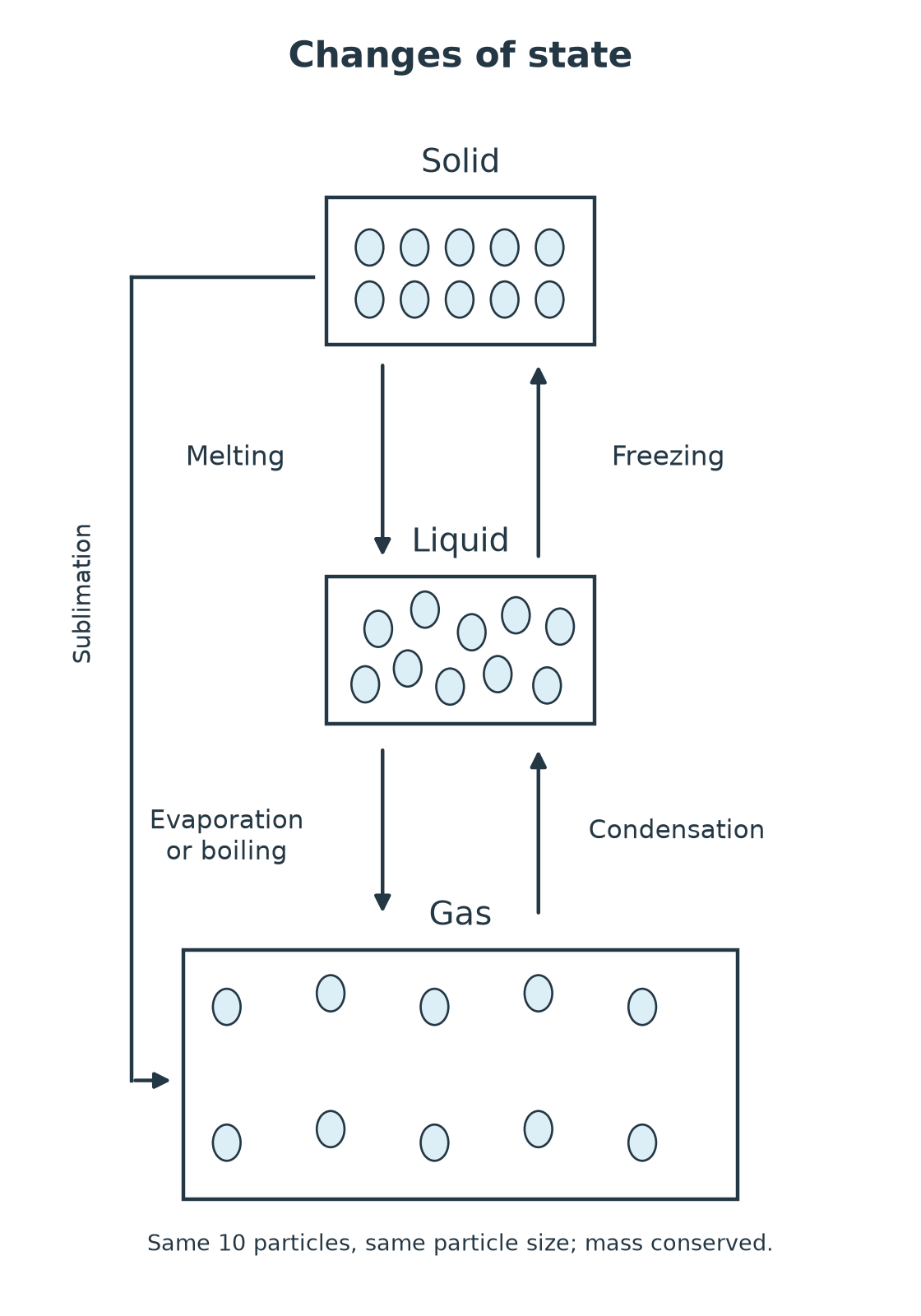
These are physical changes. The particles themselves do not melt, expand, split or turn into a new substance; only their arrangement, movement and energy change. If the change is reversed, the material recovers its original properties. This differs from some chemical changes, in which new substances form and simply reversing the conditions does not recover the starting material.
Mass is conserved during every state change. In a sealed system, the measured total mass before and after is the same. An open dish can lose measured mass during evaporation only because gas particles leave the chosen system, not because matter has been destroyed.
Continue this lesson.
You’re previewing NovaLearn without an account. Create a free account to read the rest.
Create free account