14.1-14.2 - Particle model and density
Use particle arrangement and movement to explain solids, liquids and gases, then compare materials using mass per unit volume.
From visible matter to a particle model
A metal key keeps its shape, water flows to fit its bottle, and air spreads through all the available space in a sealed container. These are large-scale observations. To explain them, physicists use a simple kinetic theory model of matter.
In the particle model, matter is represented as tiny particles with spaces between them. Kinetic refers to movement: the particles move, although the type of movement and their arrangement depend on the state of matter.
The circles in a particle diagram could represent atoms, molecules or ions, depending on the substance. They are not tiny pieces with all the visible properties of the whole material. The circles and the gaps are also not drawn to scale, and any arrows represent movement rather than permanent tracks.
[DIAGRAM: asset_name: 54_1PH0-P2-14A_14.1-14.2 - Particle model and density - diagram 01; asset_slug: phy-g-particle-states-repaired; recommended_method: matplotlib; description: Three schematic regions with equal-size particles: ordered solid, close irregular liquid and widely spaced gas; arrows show motion, not force.]
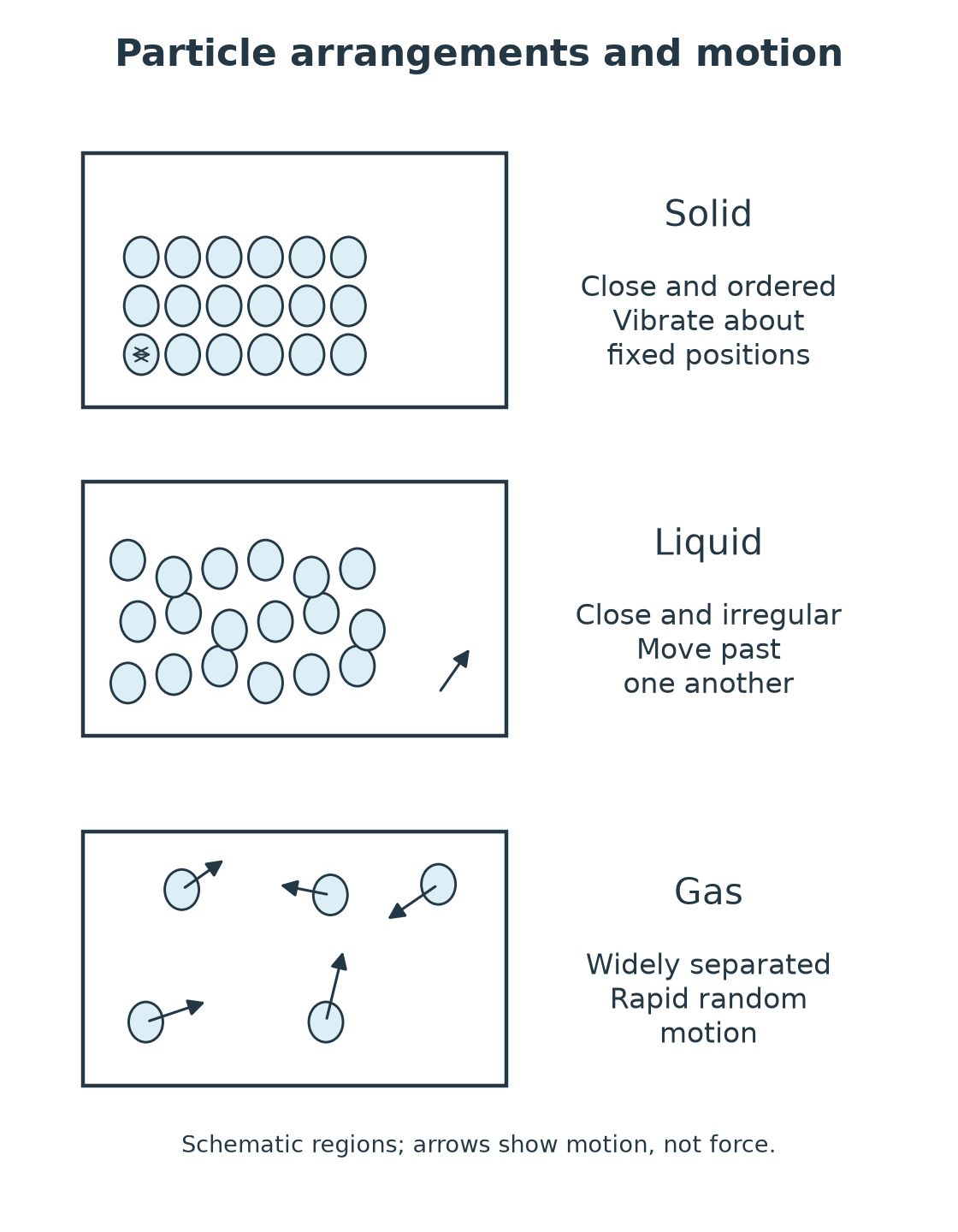
The diagram is a model of one small region of each material. It helps connect an invisible particle arrangement and movement to properties that can be observed.
Explaining solids, liquids and gases
The two questions to ask about every state are: How are the particles arranged? and How do they move?
| State | Arrangement of particles | Movement of particles | What the model explains |
|---|---|---|---|
| solid | very close together, usually in a regular arrangement; each particle has a fixed position | vibrate about fixed positions but do not move past one another | the solid keeps a fixed shape and volume because the particle arrangement is maintained |
| liquid | close together, mostly touching and arranged irregularly | move randomly and slide past one another | the liquid flows and changes shape because particles can change neighbors, but it keeps nearly the same volume because there is little empty space between them |
| gas | much farther apart, with large gaps and no regular arrangement | move rapidly and randomly in all directions | the gas has no fixed shape or volume because particles travel throughout the available space; the large gaps also allow a gas to be compressed |
All three states contain moving particles. “Solid particles do not move” is therefore incorrect: they vibrate around fixed positions. A liquid is not a halfway arrangement in which particles stop moving; its close particles continually move past one another. A gas is mostly empty space on the particle scale, but that space is not filled with air or another substance.
Continue this lesson.
You’re previewing NovaLearn without an account. Create a free account to read the rest.
Create free account