4.12P-4.14P - Hearing and sound frequencies
Follow sound through vibrating solids and the human ear, explain the limits of hearing, and distinguish ultrasound from infrasound. This lesson is Higher-tier separate Physics.
Converting sound and solid vibrations
Place a fingertip lightly on a loudspeaker cone while it plays a low note. The cone moves backwards and forwards, but it does not travel across the room with the sound. Its vibration creates a travelling sound wave in the surrounding air.
In air, sound is a longitudinal mechanical wave. Air particles oscillate backwards and forwards around their equilibrium positions, producing moving regions of higher pressure called compressions and lower pressure called rarefactions. Energy and information travel with the wave, but matter is not transferred overall.
The conversion between a sound disturbance and a solid vibration works in both directions:
- Sound wave to solid vibration: alternating pressure at a solid surface produces an alternating force. If the solid can respond, it is driven backwards and forwards at the frequency of the incoming sound.
- Solid vibration to sound wave: a vibrating surface pushes and pulls the particles next to it. This produces a sequence of compressions and rarefactions that travels away as a sound wave.
A microphone diaphragm uses the first process before its motion is converted into an electrical signal. A loudspeaker cone uses the second process after an electrical signal has driven the cone. In each case the solid is a transducer, part of a system that converts a disturbance or signal from one form to another.
Real solids do not respond equally at every frequency. Their mass, stiffness, dimensions, damping and contact with the surrounding medium determine the range over which they vibrate strongly enough to detect or produce a useful sound. Far outside that response range, the motion may be too small or too heavily damped; at very high frequencies, inertia can also prevent the solid from following each rapid pressure change effectively.
A limited frequency range does not mean that frequencies outside it stop being sound. It means that the particular solid, transducer or detector does not convert those disturbances efficiently enough to give a useful response.
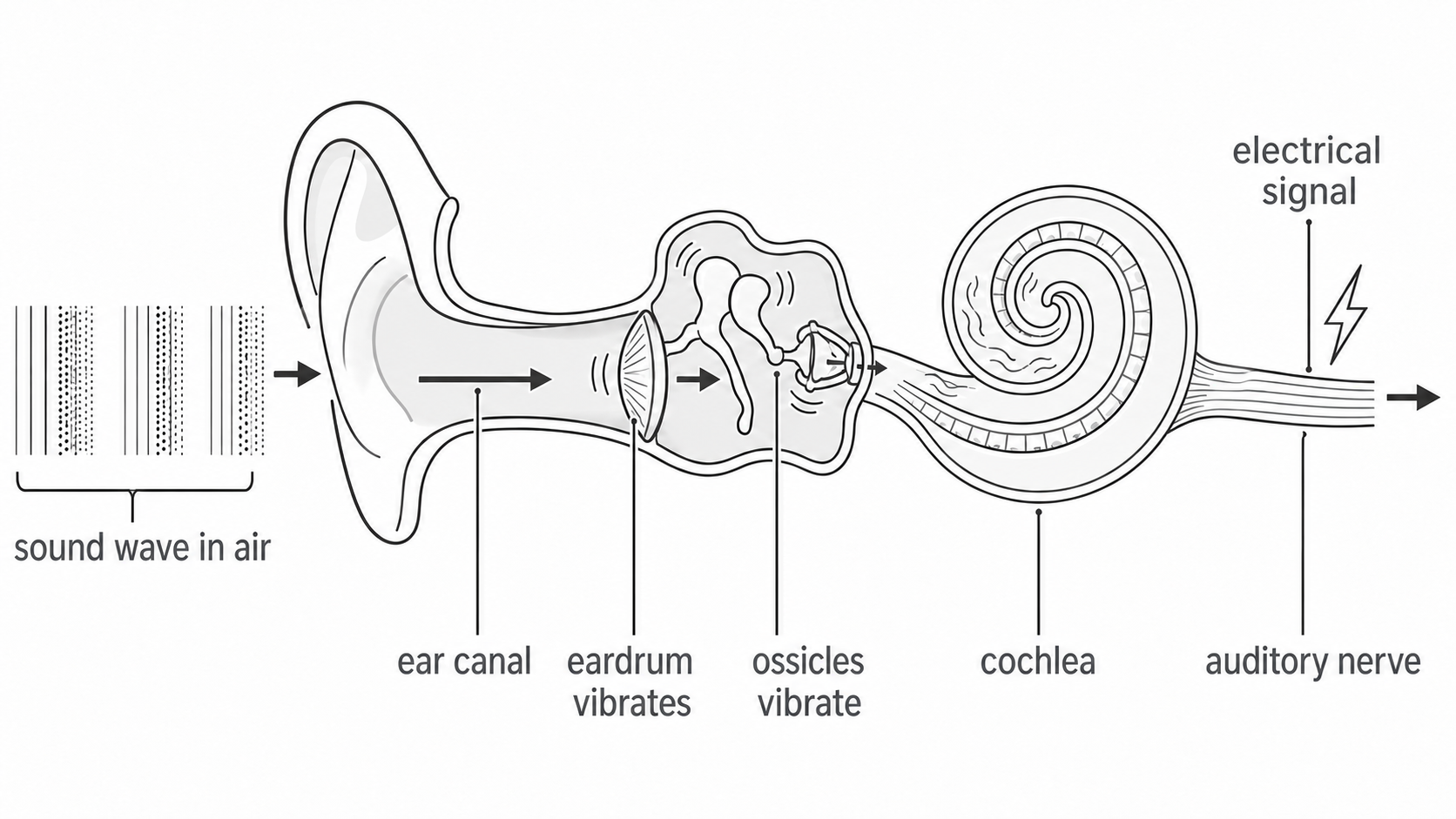
Following sound through the human ear
The ear applies the same sound-to-vibration process in several linked stages. The diagram is a simplified representation rather than a scale drawing.
[DIAGRAM: asset_name: 16_1PH0-P1-04D_4.12P-4.16P - Sound, ultrasound and infrasound - diagram 01; asset_slug: 16_1ph0-p1-04d_4-12p-4-16p-sound-ultrasound-infrasound_diagram_01; recommended_method: image_gen; description: simplified cross-sectional human ear diagram tracing incoming sound pressure waves through eardrum and ossicle vibrations to cochlear motion and an electrical signal in the auditory nerve]
Continue this lesson.
You’re previewing NovaLearn without an account. Create a free account to read the rest.
Create free account