10.1-10.3 - Charges, circuit symbols and connections
Understand atomic charge, recognise circuit symbols and trace the connections that make a circuit series or parallel.
Charge starts with particles in atoms
Metal wires, cells and circuit components are made of atoms. An atom has a tiny central nucleus containing protons and neutrons, with electrons in the region outside the nucleus. The familiar picture of electrons on neat circular tracks is only a simple representation; it is not a scale drawing of fixed electron paths.
| Particle | Position in the atom | Relative charge | Relative mass |
|---|---|---|---|
| proton | nucleus | +1 | 1 |
| neutron | nucleus | 0 | 1 |
| electron | outside the nucleus | -1 | about 1/1800 |
Protons and electrons carry equal-sized but opposite charges. Neutrons have no charge. A proton and a neutron have almost the same mass, whereas an electron has much less mass, so nearly all of an atom's mass is concentrated in its nucleus even though electrons occupy the surrounding region.
In an uncharged atom, the number of protons equals the number of electrons, so the positive and negative charges balance. Do not confuse charge with mass: a neutron has no charge but has about the same mass as a proton, while an electron has negative charge but very little mass.
Circuit symbols are a shared language
A circuit diagram is a representation of electrical connections. It shows which terminals are joined and in what order; it does not try to look like the physical apparatus on a bench. Straight lines represent connecting wires, while standard symbols identify components.
[DIAGRAM: asset_name: 39_1PH0-P2-10A_10.1-10.6 - Charge, voltage and circuit symbols - diagram 01; asset_slug: 39_1ph0-p2-10a_10-1-10-6-charge-voltage-circuit-symbols_diagram_01; recommended_method: vector; description: Complete exact symbol reference: cell and battery polarity, open and closed switch, A/V meters, fixed and variable resistors, lamp, motor, diode, thermistor, LED outward light arrows, LDR inward light arrows.]
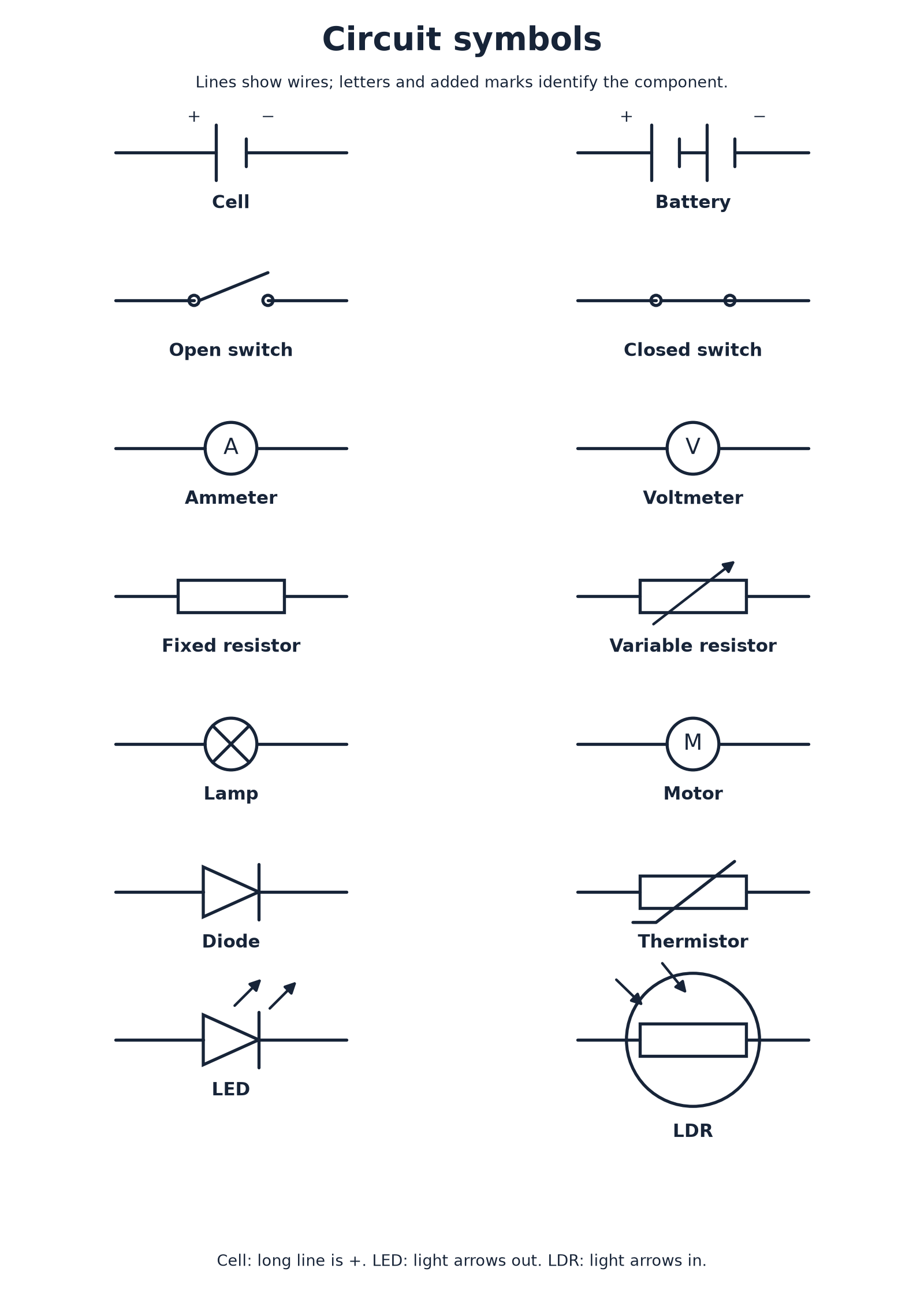
Learn the visual differences as small families rather than as unrelated marks:
| Family | What to notice |
|---|---|
| cell and battery | one cell has one long line and one short line; a battery has two or more cell pairs |
| positive and negative terminals | the long line of a cell is the positive terminal; the short line is the negative terminal |
| switch | an open switch has a visible gap; a closed switch has a continuous conducting route |
| meters | a voltmeter is a circle containing V; an ammeter is a circle containing A |
| resistors | a fixed resistor is a rectangle; a variable resistor adds a diagonal arrow; a thermistor adds a diagonal line with a short bar; an LDR is a resistor in a circle with arrows pointing towards it |
| output components | a lamp is a circle with a cross; a motor is a circle containing M |
| diodes | a diode has a triangle pointing towards a short perpendicular bar (the cathode); an LED adds two outward light arrows. Do not confuse these with the inward arrows of an LDR |
Continue this lesson.
You’re previewing NovaLearn without an account. Create a free account to read the rest.
Create free account