4.8P, 4.15P-4.16P - Ultrasound, infrasound and sound transmission
Use echoes to measure distance and form images, and use seismic waves as evidence about the Earth. Echo calculations and applications are Higher-tier; the final part on sound crossing media (4.16P) applies to both tiers.
Calculating distance and depth from an echo
Higher tier and separate Physics: code 4.8P uses a pulse's travel time and wave speed to calculate a distance or depth. In these depth examples, neglect the small depth of the boat's transducer below the water surface. Sonar is a clear example: a transducer sends a sound pulse, the pulse reflects from the seabed, and the returning echo is detected.
[DIAGRAM: asset_name: 15_1PH0-P1-04C_4.8P-4.11 - Wave interactions and refraction - diagram 03; asset_slug: edexcel-gcse-physics-4-8p-4-11-wave-interactions-refraction_diagram_03; recommended_method: image_gen; description: monochrome sonar depth model showing a transducer, separate downward pulse and upward echo arrows, one-way depth bracket and measured round-trip time]
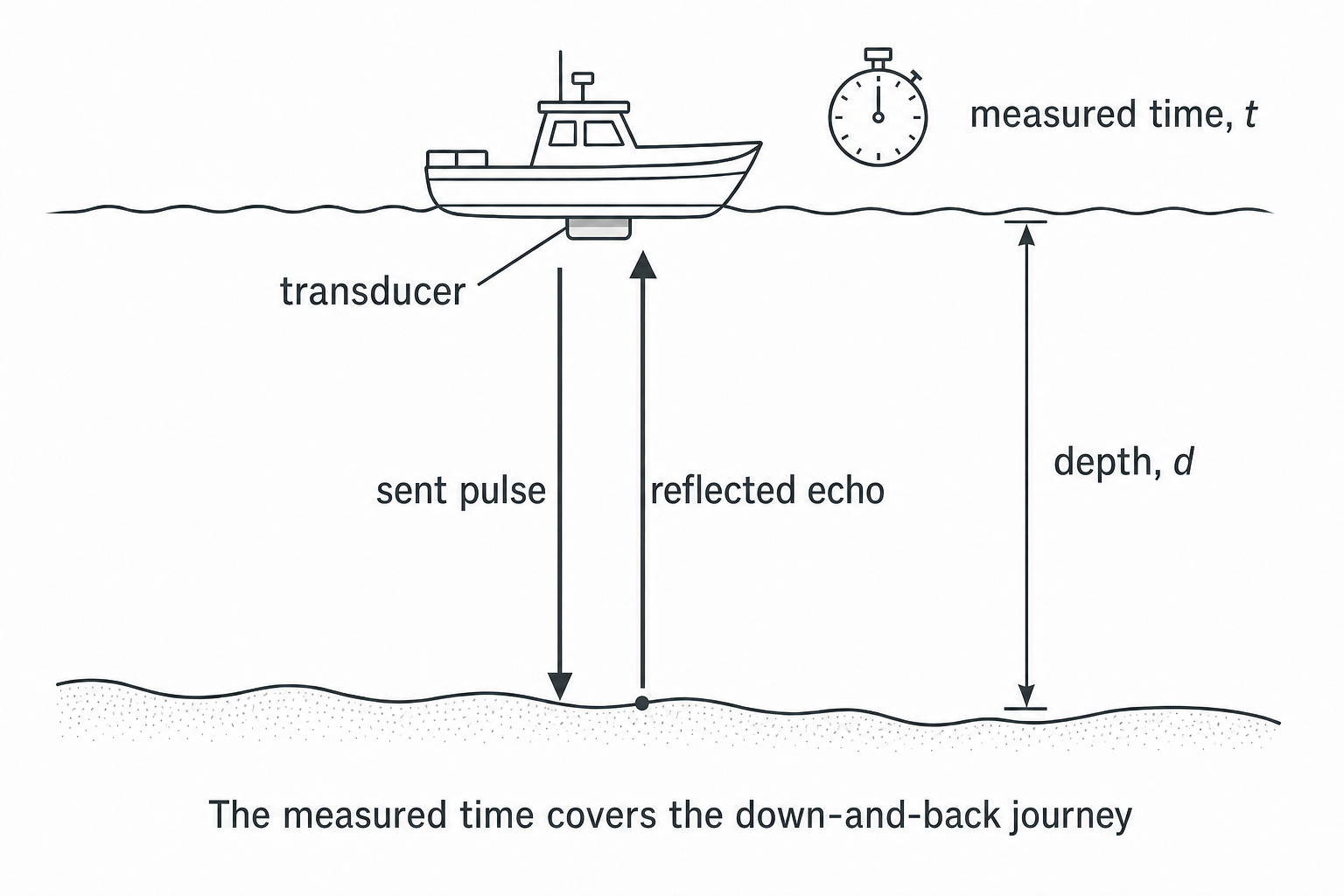
Let v be wave speed in metres per second, t be time in seconds and s be the total distance travelled in metres. The supplied wave-speed relationship is:
wave speed = distance travelled / time taken
Rearranged: distance travelled = wave speed × time taken
For a receiver at the far end of a one-way journey, the required distance is simply s. For an echo that returns to the source, the measured time covers two equal legs: down and back. The distance from source to reflector is therefore half the total:
depth, d = v t / 2
The equation is on the aid, but the factor of two is not a separate formula to memorise. It comes from tracing what distance the measured time actually covers.
Worked example
A vertical sonar pulse travels through seawater at . Its echo returns after emission. Calculate the water depth.
First convert milliseconds to seconds:
Calculate the total down-and-back distance:
The depth is one half of that journey:
So the water depth is 630 m to three significant figures. This is physically sensible because the one-way depth must be less than the 1260 m total path. The value is a reasonable value for this calculation, but real sound speed in seawater varies with conditions.
Using ultrasound for echoes and imaging
Higher tier: 4.15P.
Active sonar
In this example, active sonar uses an ultrasound pulse to locate an underwater object or measure water depth. A transducer under a boat converts an electrical pulse into a solid vibration, launching ultrasound into the water. The pulse reflects from the seabed or another boundary, and the returning echo makes the transducer vibrate. The system converts this vibration back into an electrical signal and measures the time between emission and reception.
The round-trip calculation in the previous part turns the measured echo delay into a distance. In practice the instrument must distinguish the returning pulse from other echoes and use the appropriate sound speed for the water.
Continue this lesson.
You’re previewing NovaLearn without an account. Create a free account to read the rest.
Create free account