11.6P-11.7P - Electrostatic uses and spark prevention
Use repulsion, attraction and earthing to explain electrostatic spraying and how dangerous sparks can be prevented during fuelling.
Directing charged droplets
Imagine spraying a plant with an ordinary mist. Some droplets hit the same small area, while others drift past the leaves or fall to the ground. Electrostatic spraying adds a controllable electric force to guide the droplets.
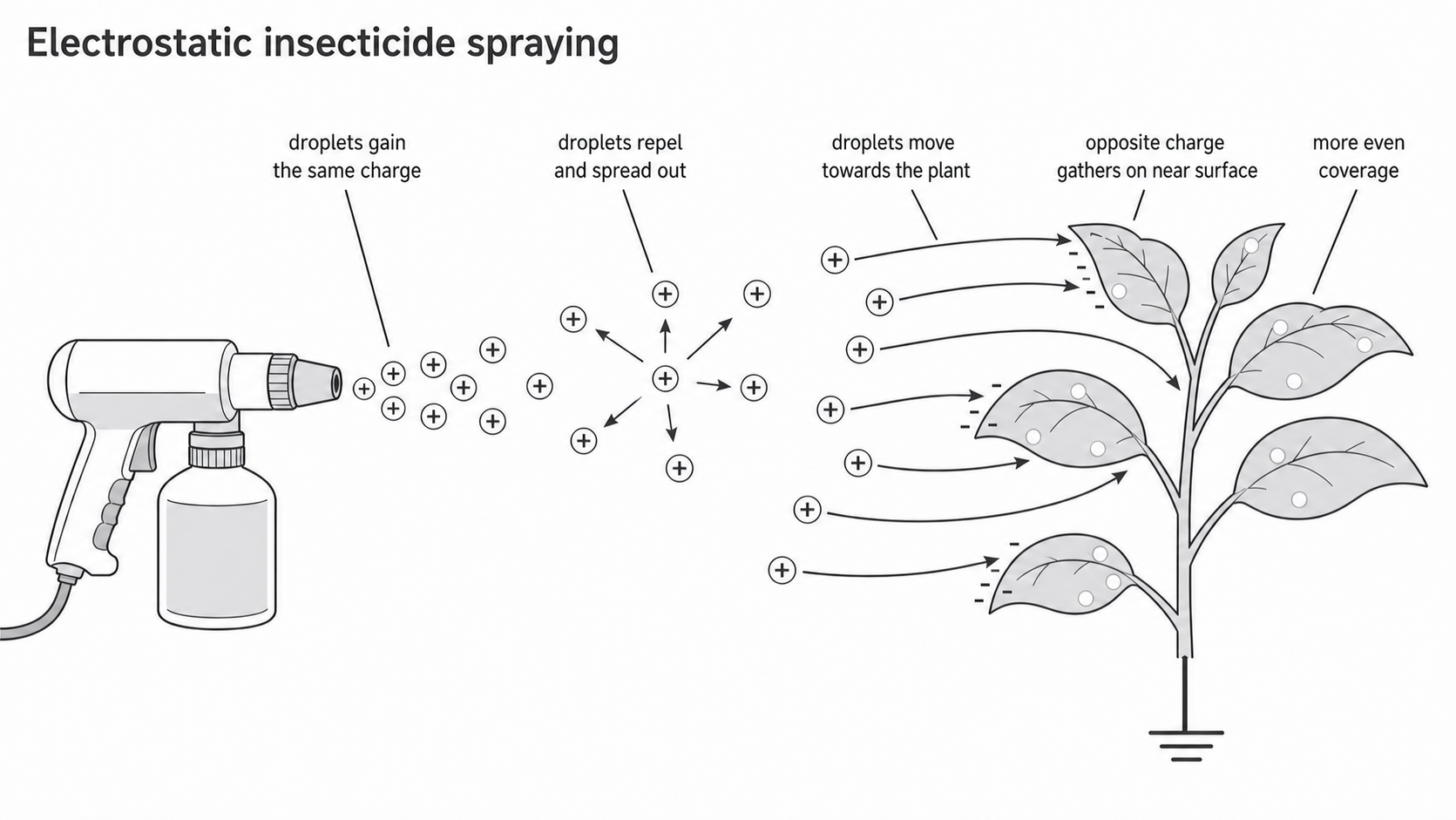
In an electrostatic insecticide sprayer, the nozzle gives the small liquid droplets the same type of charge as they leave:
- Like charges repel, so neighbouring droplets push apart and the spray spreads out instead of clumping.
- The target can be given the opposite charge. If the plant is an earthed conductor and the droplets are positive, electrons are attracted from Earth towards the near leaf surfaces. This produces an induced negative region close to the droplets, so they are attracted towards the plant. For negative droplets, electrons move away to Earth and the induced near region is positive.
- Droplets can be drawn towards several parts of the leaves, giving more even coverage and reducing the amount that misses the target.
[DIAGRAM: asset_name: 47_1PH0-P2-11B_11.6P-11.10P - Electrostatic uses, dangers and fields - diagram 01; asset_slug: 47_1ph0-p2-11b_11-6p-11-10p-electrostatic-uses-dangers-fields_diagram_01; recommended_method: image_gen; description: Monochrome process diagram showing equally charged insecticide droplets repelling, induced opposite charge on an earthed plant, motion towards leaves and more even coverage.]
Electrostatic paint spraying uses the same two effects: equally charged paint droplets spread out, while attraction to an oppositely charged or earthed object helps the paint coat it. In a laser printer or photocopier, a pattern of charge attracts toner particles to selected places before the toner is transferred and fixed to the paper. In each application, electrostatic forces control where small particles or droplets go.
Continue this lesson.
You’re previewing NovaLearn without an account. Create a free account to read the rest.
Create free account