15.6 - Spring extension and work core practical
Measure unloaded and loaded spring lengths, process a force-extension graph and determine work done. Use repeat and unloading measurements to judge the evidence.
Design the spring practical
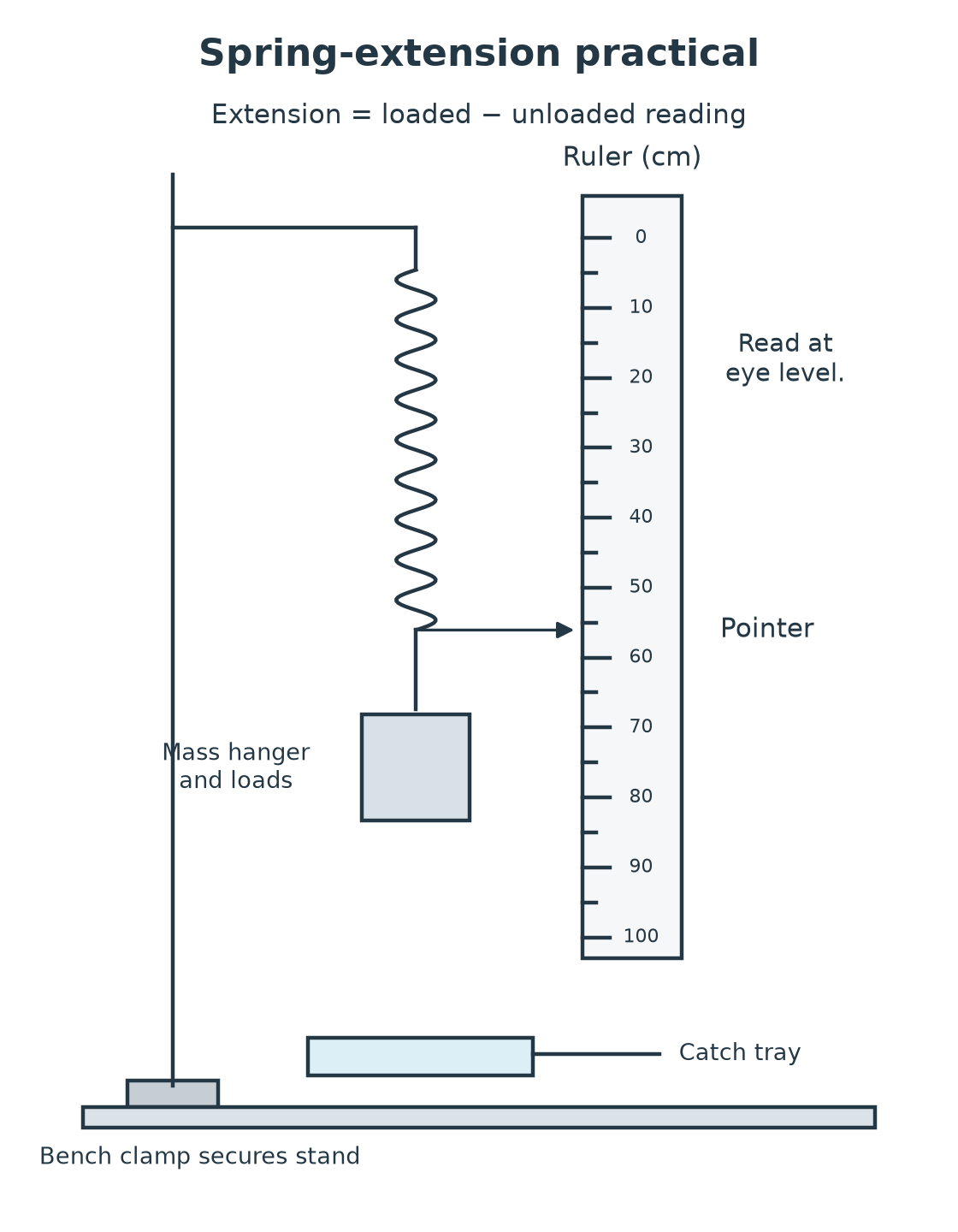
[DIAGRAM: asset_name: 60_1PH0-P2-15A_15.1-15.6 - Springs and elasticity core practical - diagram 01; asset_slug: phy-g-spring-apparatus-repaired; recommended_method: matplotlib; description: A precise side-view apparatus diagram showing a secured stand, hanging steel spring, nearby fixed metre rule, horizontal pointer, mass hanger and padded catch tray.]
For a linear spring, F = kx and work done from zero extension is E = ½kx² = ½Fx. Force is in N, extension in m and work in J.
The aim of core practical 15.6 is to investigate the extension and work done when different forces are applied to a spring. Use a laboratory spring, stand, bosses and clamps, bench clamp, metre rule, small pointer, mass hanger, slotted masses, balance if masses are not labelled, eye protection and a padded catch tray.
The pointer is attached to the moving lower end of the spring and ends immediately beside the fixed ruler. Its position is easier to judge than the curved bottom of a coil. The ruler does not need to read zero initially because extension is found from the difference between loaded and unloaded readings.
| Variable role | Quantity | How it is handled |
|---|---|---|
| Independent | Force applied to the spring, , in N | Change the total suspended mass in measured steps. Include the mass hanger and calculate its weight using when required. |
| Dependent | Extension, , in m | Subtract the unloaded pointer reading from each loaded pointer reading. |
| Controlled | Spring and support geometry | Use the same spring, support point, ruler, pointer and vertical alignment throughout. |
| Controlled | Reading condition | Add masses gently and use the same rule for waiting until oscillations have stopped before every reading. |
The genuine risks are a toppling stand, falling masses and a spring or load detaching while elastic energy is stored. Clamp the stand to the bench, keep the catch tray below the hanger, wear eye protection, keep faces, hands and feet out of the line of the spring and load, and add masses gently. Use only the teacher-approved force range; do not deliberately overload an ordinary spring to make it permanently deformed.
Measure and process the results
- Clamp the stand securely to the bench. Suspend the spring vertically, fix the metre rule parallel and close to it, attach the pointer, and place the padded tray below the hanger.
- With no suspended load, record the pointer position . Check the pointer at eye level so the line of sight is perpendicular to the ruler.
- Attach the mass hanger gently. Record the total suspended mass, calculate or read its force in newtons, wait until the spring is stationary, and record the loaded pointer position .
- Calculate extension using , then convert it to metres. The mass hanger is part of the applied load and must not be omitted.
- Add masses in equal, teacher-approved steps and obtain at least six well-spaced force values. Never add a mass while the hanger is swinging.
- Remove the masses in reverse order. Check whether the pointer returns to ; return to the zero-load condition before beginning another sequence.
- Repeat the complete loading sequence twice more. Calculate the mean extension for each force and compare the range of repeats rather than repeating only one convenient reading.
The following illustrative data show three complete loading runs for a spring that remained in its linear region and returned to its unloaded length.
| Force, (N) | Run 1 extension (m) | Run 2 extension (m) | Run 3 extension (m) | Mean extension, (m) | Work done, (J) |
|---|---|---|---|---|---|
| 0.0 | 0.000 | 0.000 | 0.000 | 0.000 | 0.00 |
| 1.0 | 0.024 | 0.025 | 0.026 | 0.025 | 0.013 |
| 2.0 | 0.049 | 0.050 | 0.051 | 0.050 | 0.050 |
| 3.0 | 0.074 | 0.075 | 0.076 | 0.075 | 0.11 |
| 4.0 | 0.099 | 0.100 | 0.101 | 0.100 | 0.20 |
| 5.0 | 0.124 | 0.125 | 0.126 | 0.125 | 0.31 |
| 6.0 | 0.149 | 0.150 | 0.151 | 0.150 | 0.45 |
Continue this lesson.
You’re previewing NovaLearn without an account. Create a free account to read the rest.
Create free account