10.28-10.32 - Electrical power and domestic devices
Distinguish energy from power, choose a power equation from the available measurements and follow energy through battery-powered and mains-powered devices.
Power is a rate of energy transfer
Imagine that two devices each transfer 6000 J of energy. Device A takes 20 s, while device B takes 60 s. They transfer the same amount of energy, but device A transfers it more quickly, so device A is more powerful.
Power is the energy transferred per second. Power is measured in watts, symbol W.
One watt means one joule of energy transferred each second:
Energy and power are different quantities. Energy transferred is an amount, measured in joules (J). Power is a rate, measured in watts (W). A low-power device can transfer more energy overall than a high-power device if it operates for long enough.
For an energy transfer over a measured time:
power = energy transferred / time taken
P is power in watts (W), E is energy transferred in joules (J), and t is time in seconds (s).
The supplied equation support includes . You must still select the correct values, convert energy to joules and time to seconds, and give the answer in watts.
Worked example
A portable heater transfers 18.0 kJ of energy in 45.0 s. Calculate its average power.
First convert kilojoules to joules:
Select the equation and substitute:
The average power is , to three significant figures. This means the heater transfers an average of 400 J each second. The result is sensible because , which recovers the stated energy transfer.
Current and potential difference set power
For a circuit device, power depends on two quantities measured for that same device:
- the current through the device, measured in amperes (
A); - the potential difference across the device, measured in volts (
V).
These phrases matter. Current is not "across" a device, and potential difference is not "through" it. Current tells us the rate of charge flow: . Potential difference tells us the energy transferred per unit charge: .
Multiplying them shows why both determine the rate of energy transfer:
current × potential difference = (C/s) × (J/C) = J/s = W
electrical power = current × potential difference
P is power in watts (W), I is current in amperes (A), and V is potential difference in volts (V).
If the potential difference stays the same, a larger current gives a larger power. If the current stays the same, a larger potential difference gives a larger power. A current value on its own is not enough because a different potential difference can change the power.
Worked example
The motor in a cordless cleaner has a potential difference of 18 V across it and a current of 2.4 A through it. Calculate its electrical power.
To two significant figures, the electrical power is 43 W. This is an energy-transfer rate of about 43 J/s. The unit check agrees: gives J/s.
The same power can come from different pairs of current and potential difference. A device operating at 12 V and 3.0 A has power 36 W; a device operating at 24 V and 1.5 A also has power 36 W. Neither current nor potential difference alone decides the power.
Power from current and resistance
For a resistive component, when its current and operating resistance are known, combine two relationships already used for circuits:
Substitute for V in the power equation:
electrical power = current squared × resistance
P is power in watts (W), I is current in amperes (A), and R is resistance in ohms (ohm).
The square applies to the current only: means . If resistance remains fixed and current doubles, the power becomes four times as large because .
[DIAGRAM: asset_name: 44_1PH0-P2-10F_10.28-10.32 - Electrical power and domestic devices - diagram 02; asset_slug: edexcel-gcse-physics-10-28-10-32-electrical-power-domestic-devices_diagram_02; recommended_method: matplotlib; description: exact fixed-resistance graph of electrical power against current for a 10 ohm device, with labelled axes, scale, curve and points at one, two and three amperes]
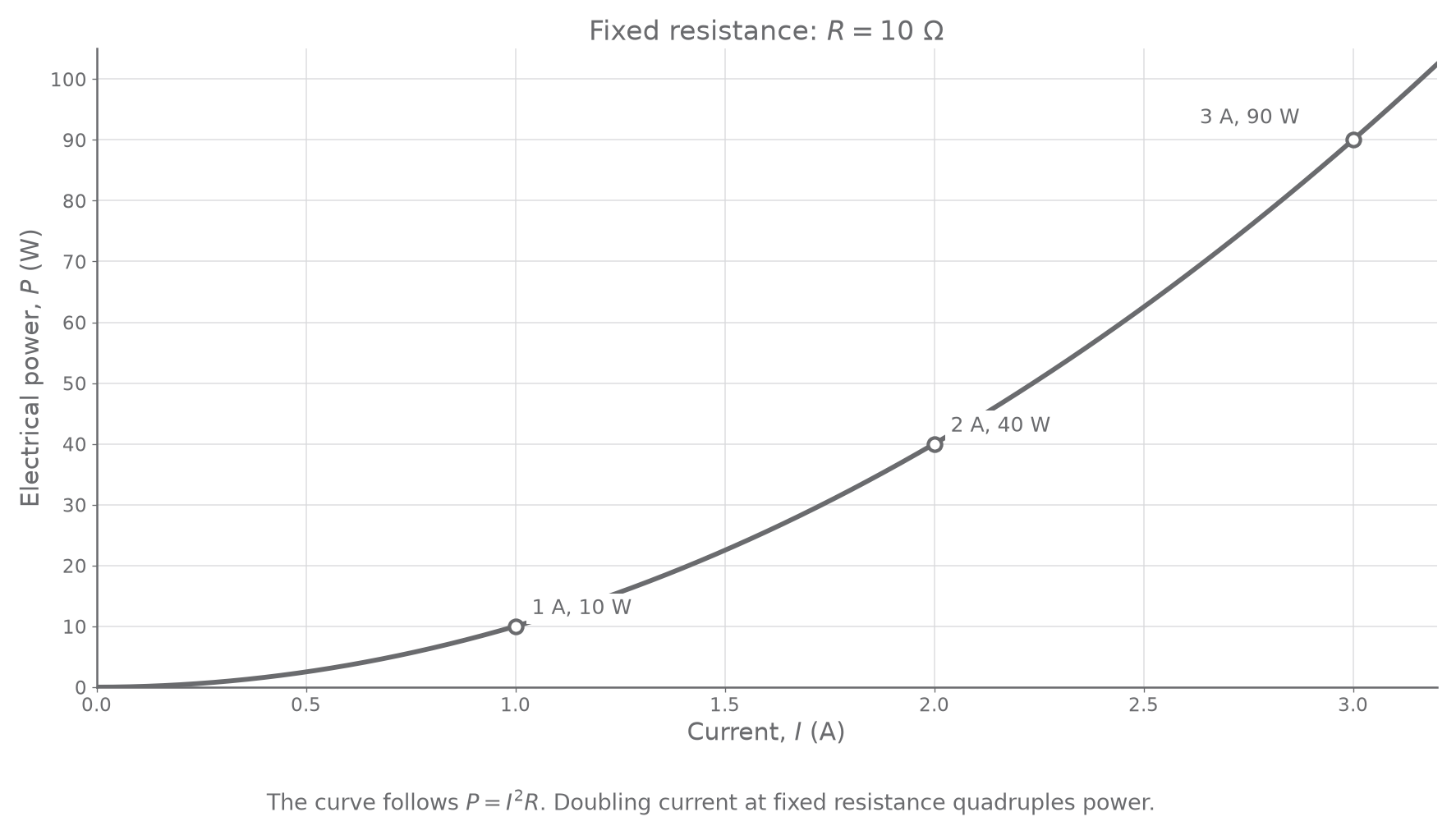
The graph uses with a fixed resistance of 10 ohm. It passes through (1 A, 10 W), (2 A, 40 W) and (3 A, 90 W), so doubling current from 1 A to 2 A quadruples power. The curve applies only while resistance is fixed; a real heating element may become hotter and change resistance.
Worked example
A heating element has resistance 8.0 ohm and carries a current of 3.0 A. Calculate the power transferred to the element.
The power is 72 W, to two significant figures. The result is plausible because the squared current is , not 6.0 A.
Continue this lesson.
You’re previewing NovaLearn without an account. Create a free account to read the rest.
Create free account