12.7-12.9 - Current, electromagnets and solenoids
A current creates a magnetic field. Use compass observations and the right-hand grip rule to find its shape and direction, then explain why winding the wire into a solenoid produces a strong central field.
A current makes a magnetic field
Place a horizontal straight section of copper wire just above a plotting compass, parallel to the needle's initial north–south direction. Use a current-limited low-voltage supply and a switch. First observe the compass while no current is flowing. The compass points along Earth's magnetic field. Connect the wire to a low-voltage d.c. supply and switch on briefly: the compass needle turns. Switch off and it returns; reverse the current and the needle deflects in the opposite direction.
The changing compass direction is evidence of a magnetic effect around the conductor when current flows. Copper on its own has not become a permanent magnet: the effect appears with the current and reverses when the current reverses.
A magnetic field is a region in which a magnet or magnetic material experiences a force. A small plotting compass shows the field direction at its position: the north-seeking end of its needle points along the field.
To explore the field around the wire rather than at just one position, the straight conductor can pass through a horizontal card. Plotting compasses placed at several positions around the conductor show the local direction. A compass follows the combined field of the wire and its surroundings, so the wire's field should be large enough to dominate Earth's field when mapping the circular pattern. Iron filings can reveal the rough pattern, but a compass is needed to determine direction. Switch a high-current demonstration on only briefly because the wire may heat; handle iron filings so they cannot enter the eyes.
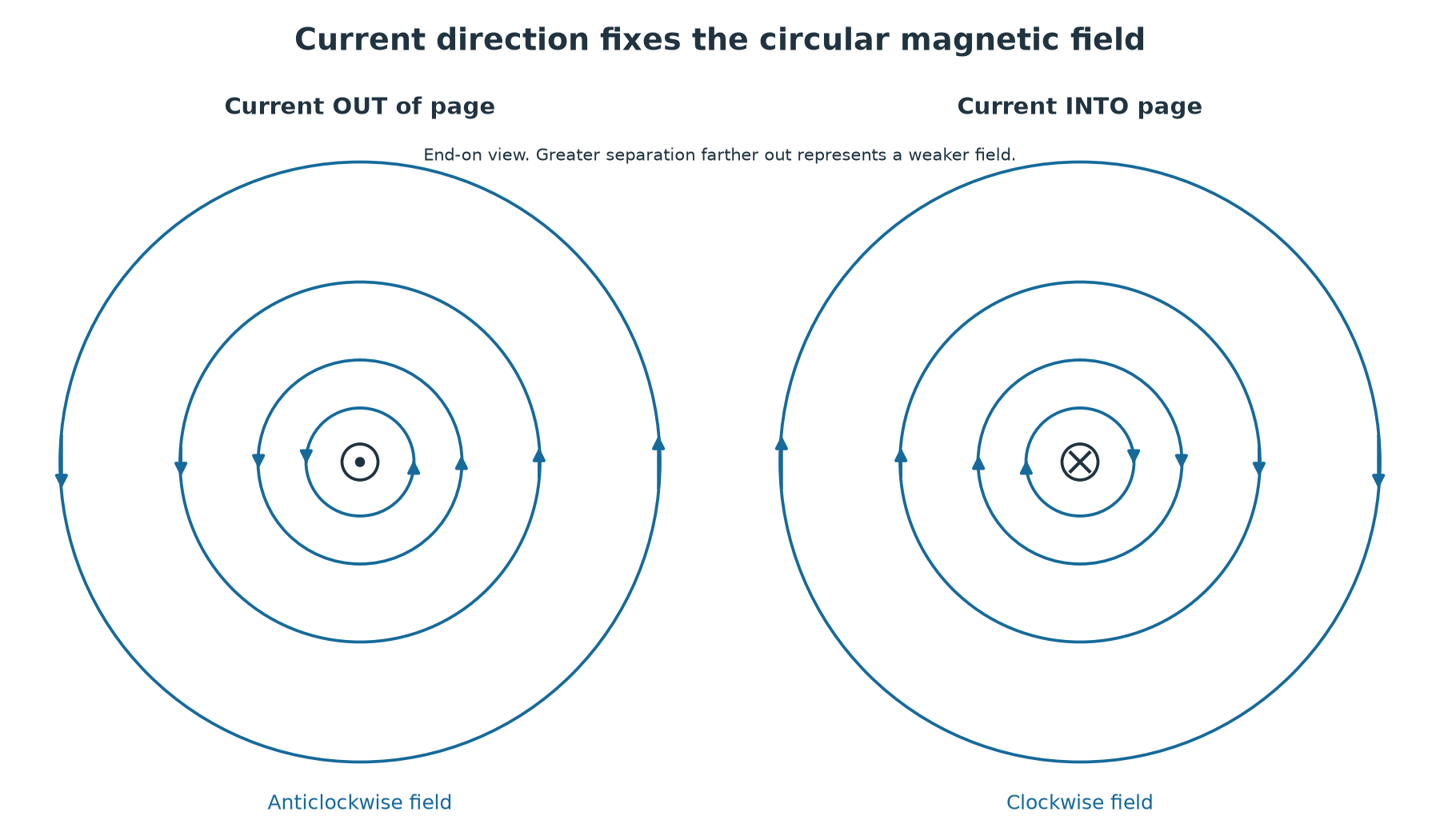
A field-line drawing summarises these observations. The lines are a representation of the field, not material rings or paths that exist around the wire.
Shape and direction around a straight conductor
Viewed end-on, the magnetic field around a long straight current-carrying conductor consists of concentric circles centred on the conductor. At every point, the field direction is tangent to one of those circles, matching the direction in which the north-seeking end of a plotting compass points.
Use the right-hand grip rule to connect field direction to conventional current:
- Point your right thumb in the direction of the conventional current.
- Curl your fingers around the conductor.
- Your curled fingers show the direction of the circular magnetic field.
In an end-on diagram, a dot represents current coming out of the page, like the tip of an arrow approaching you. The field is then anticlockwise. A cross represents current going into the page, like the tail feathers of an arrow moving away. The field is then clockwise. Reversing the current reverses every field arrow.
[DIAGRAM: asset_slug: phy-f-wire-field-v2; description: wire field;]
What changes field strength
The magnetic field has both direction and strength. For a long straight conductor, compare one factor at a time:
| Change | Quantity kept the same | Effect on magnetic field strength |
|---|---|---|
| Increase the size of the current | Distance from the conductor | The field becomes stronger |
| Decrease the size of the current | Distance from the conductor | The field becomes weaker |
| Move closer to the conductor | Current | The field becomes stronger |
| Move farther from the conductor | Current | The field becomes weaker |
At a fixed distance in the same surroundings, field strength is directly proportional to the size of the current. For example, doubling the current doubles the field strength at that point. This is more precise than only saying that both quantities increase.
Continue this lesson.
You’re previewing NovaLearn without an account. Create a free account to read the rest.
Create free account