10.22-10.27 - Heating effects and electrical energy
Explain how electron–ion collisions heat a resistor, distinguish useful heating from unwanted dissipation and calculate electrical energy transferred over time. The wire-design section, 10.25, is Higher Tier only.
Why resistors heat
Switch on a circuit containing a resistor and the resistor may become warmer than its surroundings. The source transfers energy electrically to the resistor while a current flows: charge does work against the electrical resistance. Starting at room temperature, the resistor warms and then transfers energy to the cooler surroundings. At a steady operating temperature, energy can still enter and leave at equal rates even though its temperature no longer rises.
When energy spreads into the surroundings, it is dissipated. The energy has not disappeared and charge has not been used up. Energy is conserved, but energy in the thermal stores of the resistor and its surroundings is often less useful for the circuit's intended job.
The particle model explains how the transfer happens inside a metal resistor:
- A metal contains positive ions arranged in a lattice and conduction electrons that can move through it.
- When the circuit is complete, the electrons have an overall drift through the lattice. Their microscopic motion is not a smooth, empty path.
- The electrons collide with ions in the lattice. During collisions, energy is transferred from the electrons to the ions.
- The ions vibrate more about their fixed positions. This increases the thermal energy of the lattice and raises the resistor's temperature.
[DIAGRAM: asset_name: 43_1PH0-P2-10E_10.22-10.27 - Heating effects and electrical energy - diagram 01; asset_slug: 43_1ph0-p2-10e_10-22-10-27-heating-effects-electrical-energy_diagram_01; recommended_method: image_gen; description: Two-panel monochrome particle model showing conduction electrons drifting through a metal lattice, collisions transferring energy, and ions vibrating more as the resistor heats.]
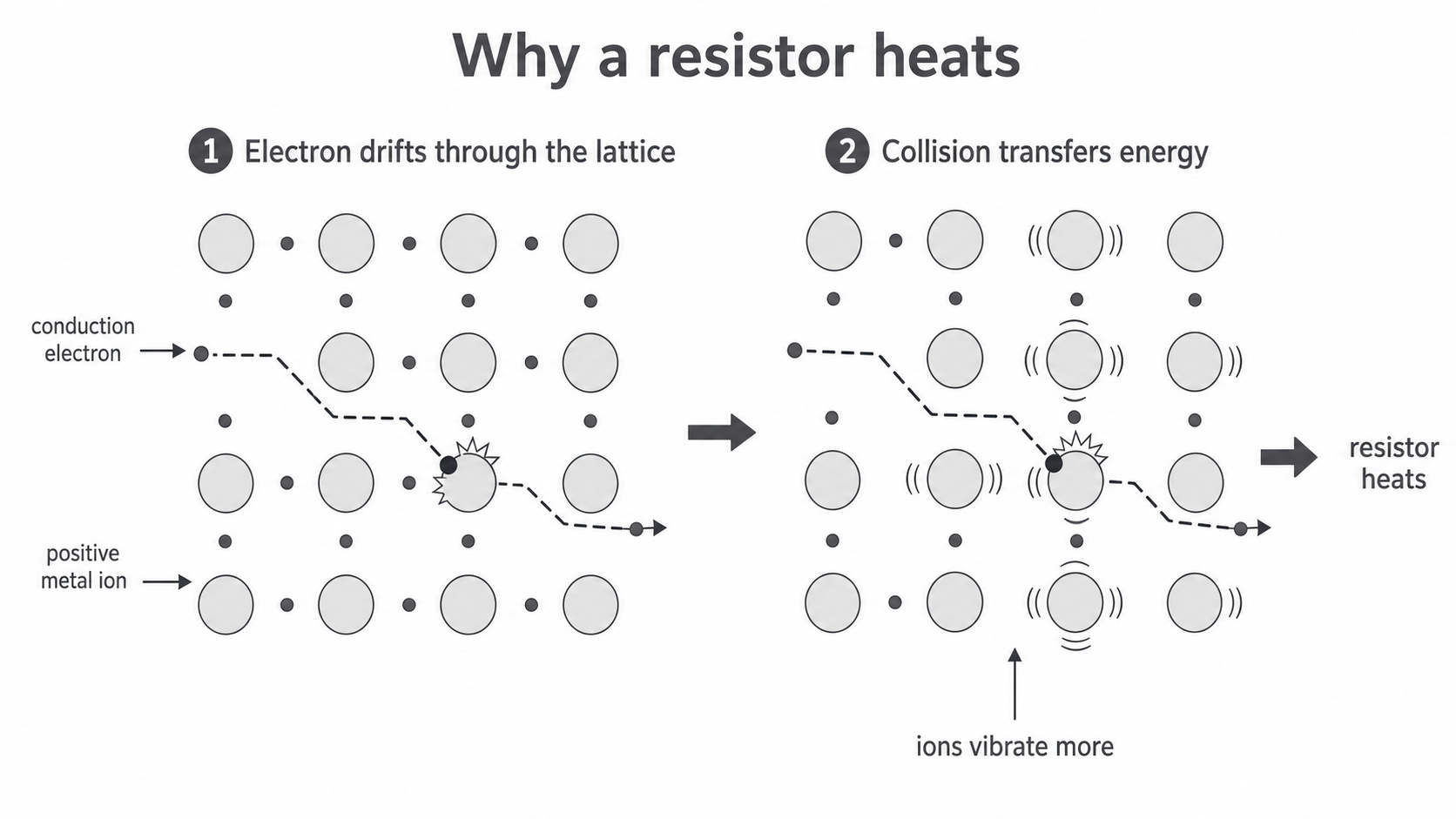
Current is the rate of flow of charge. It is not the speed of one electron, so saying that resistance "slows down the current" mixes up two different ideas. A smaller current means less charge passes a point each second.
Useful and unwanted heating
The heating effect is not automatically useful or wasteful. The judgement depends on the intended energy transfer.
| Situation | Advantage or disadvantage | Energy account |
|---|---|---|
| A resistance heating element warms water or air | Advantage: heating is the intended effect | Electrical energy is transferred to the thermal store of the element and then to the material being heated |
| A toaster element becomes hot enough to heat bread | Advantage: the hot element provides the required heating | Energy is transferred thermally from the element to the bread and surroundings |
| Connecting wires warm while supplying another component | Disadvantage: the heating is not the intended effect | Some electrical energy is dissipated to the wires and surroundings, so less reaches the intended component |
| A wire or component overheats | Disadvantage: excessive temperature can damage components or insulation and cause burns or fire | Thermal energy accumulates faster than it can spread safely to the surroundings |
The same device can involve both. Heating an element may be useful, while heating its connecting wires is unwanted. Good design places the intended energy transfer in the heating element and limits heating elsewhere.
Continue this lesson.
You’re previewing NovaLearn without an account. Create a free account to read the rest.
Create free account