R12, G19 - Similarity ratios for lengths, areas and volumes
Use corresponding lengths to scale areas and volumes of similar figures, then work backwards from area or volume information. Link these ratios to capacity, mass and coating, and explain why equal areas alone do not guarantee the same shape.
Length, area and volume scale factors (Higher)
If a model's lengths are all doubled, will its paint and its capacity both double? A rectangle and a cube show why different measurements change by different factors.
You already know
Similar figures have equal corresponding angles and one common positive factor for all corresponding lengths. Match corresponding sides and keep the direction of the ratio consistent. A rectangle's area is base times height; a cuboid's volume is length times width times height.
Doubling a rectangle's base and height multiplies its area by . Doubling a cuboid's three dimensions multiplies its volume by .
[DIAGRAM: asset_name: Length, area and volume scaling; asset_slug: 1ma1_m44_scale_powers; caption: Doubling every length multiplies area by four and volume by eight.; description: Similar rectangles of dimensions 2 by 1 and 4 by 2 have areas 2 and 8 square units. Similar cubes with edges 1 and 2 have volumes 1 and 8 cubic units, illustrating factors 2, 4 and 8.]
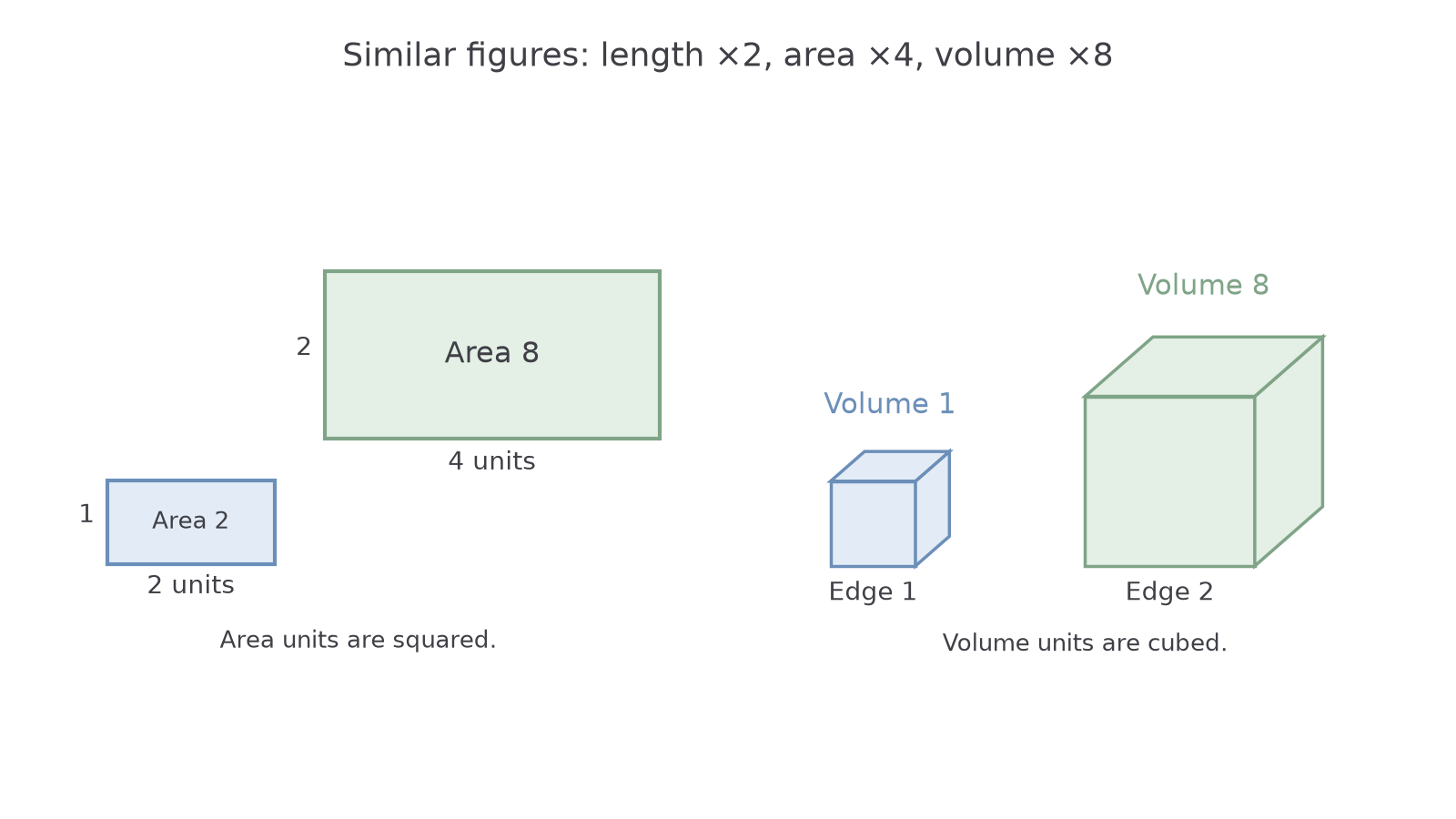
The same reasoning works with a general factor . A rectangle's new area is . A triangle's area gains the same factor because . Uniform enlargement scales both dimensions of each small piece of a shape, so the square relationship extends to other similar plane shapes. Each face of a solid also scales in two dimensions.
For a cuboid, . A uniform enlargement scales three dimensions of every small volume element, so the cube relationship extends to other similar solids.
Scaling similar figures
All corresponding lengths must have the same positive factor . A length ratio gives area ratio and volume ratio , in the same order.
Not on the formula sheet: learn it.
For example, length ratio A:B gives area ratio and volume ratio . From A to B, use factors , and respectively.
Worked example 1: an enlargement
Question. A solid has surface area and volume . A similar solid has every length doubled. Find its surface area and volume.
Plan. Square the length factor for surface area and cube it for volume.
Why use different powers? Surface area measures two dimensions; volume measures three.
Answer. and .
Check. The surface area quadruples and the volume increases eightfold, matching the diagram's factors.
Change only the length factor from to ; keep the starting measurements.
Worked example 2: a reduction
Question. A similar solid has every length half that of the solid with surface area and volume . Find its surface area and volume.
Plan. Apply the same powers to the reducing factor.
Why can the answers have the same number? They measure different quantities in different units and came from different starting values.
Answer. and .
Check. Reversing the reduction doubles lengths: and .
Similarity is essential. Doubling only a cuboid's height doubles its volume, but leaves the other two length factors at . There is no common factor , so the cubed similarity rule cannot be used.
Watch out
Wrong: a length ratio means the area ratio is . That applies a one-dimensional ratio to a two-dimensional measurement. Correct: square both ratio terms to get , keeping their order.
Change only the length factor from Worked example 2.
Recovering length scales from area and volume (Higher)
Work backwards through the power: take a positive square root for a length factor from areas, or a positive cube root from volumes.
A length factor makes an area factor and a volume factor . Reversing those steps requires roots, not division by or . This root method is not on the formula sheet: derive it by reversing the similarity scale-factor rules.
Worked example 3: an area ratio gives a length
Question. Two similar triangles have areas and . A side of the smaller triangle is . Find the corresponding larger side.
Plan. Find the area factor, take its square root, then scale the side.
Why a square root? Area gained two copies of the length factor; the root recovers one copy.
Answer. .
Check. .
Change only the larger area from to .
Worked example 4: a different area factor
Question. Similar triangles have areas and . The corresponding smaller side is . Find the larger side.
Plan. Recover the length factor before applying it to the side.
Why not multiply the side by ? That is the area factor, rather than the length factor.
Answer. .
Check. Doubling lengths quadruples area: .
Not every root is a whole number. Areas and give length factor . Keep the root exact until a final approximation is requested.
Worked example 5: a volume ratio gives a surface-area ratio
Question. Similar solids A and B have volumes and . Find their length ratio and surface-area ratio A:B.
Plan. Take cube roots to recover lengths, then square the length-ratio terms.
Why pass through lengths? Volume and area use different powers of the common length factor.
Answer. Length ratio ; surface-area ratio .
Check. Cubing returns , the simplified volume ratio.
Change only B's volume from to .
Worked example 6: a different volume ratio
Question. Similar solids A and B have volumes and . Find their length ratio and surface-area ratio A:B.
Plan. Simplify the volume ratio, recover lengths by cube roots, then square.
Why are the ratios different? One compares three-dimensional volumes and the other compares two-dimensional surfaces.
Answer. Length ratio ; surface-area ratio .
Check. A factor in length gives factors in surface area and in volume.
Root-taking uses known similarity; it cannot establish similarity from areas or volumes alone.
Continue this lesson.
You’re previewing NovaLearn without an account. Create a free account to read the rest.
Create free account