G12, G13 - Three-dimensional shapes, plans and elevations
A solid has width, depth and height, while each flat view records only two of them. You will identify solid properties, draw plans and elevations, and decide what these views can reveal or hide.
Faces, surfaces, edges and vertices
Could two stacks containing 6 and 8 cubes look identical from above, the front and the side? Before tackling their views, distinguish the features of the solids themselves.
A cube has six square faces. Even its unseen faces and edges count: a dotted line in a drawing represents an edge hidden by the solid, rather than an edge that does not exist.
Parts of a solid
A flat face is a planar part of a solid's boundary. A curved surface is not flat. An edge is where surfaces meet; it may be straight or curved. A vertex is a corner where edges meet, or a pointed apex such as the tip of a cone.
A cube is a special cuboid: squares are rectangles, so its six square faces also satisfy the cuboid definition. A prism has the same cross-section all along its length. A polygonal right prism has two matching parallel polygonal ends and rectangular side faces; “right” means the length direction is perpendicular to the ends.
A pyramid has one polygonal base and triangular side faces meeting at one common apex. Its cross-sections get smaller towards the apex, unlike a prism's constant cross-section.
[DIAGRAM: asset_name: Flat and curved solids; asset_slug: 1ma1_m54_solids; caption: Flat faces and curved surfaces give different kinds of boundaries.; description: Seven labelled line drawings show a cube, cuboid, triangular right prism, cylinder, square-based pyramid, cone and sphere. Dashed edges identify hidden polygon edges. The cylinder and cone have circular rims; the sphere has a smooth outline and no edge.]
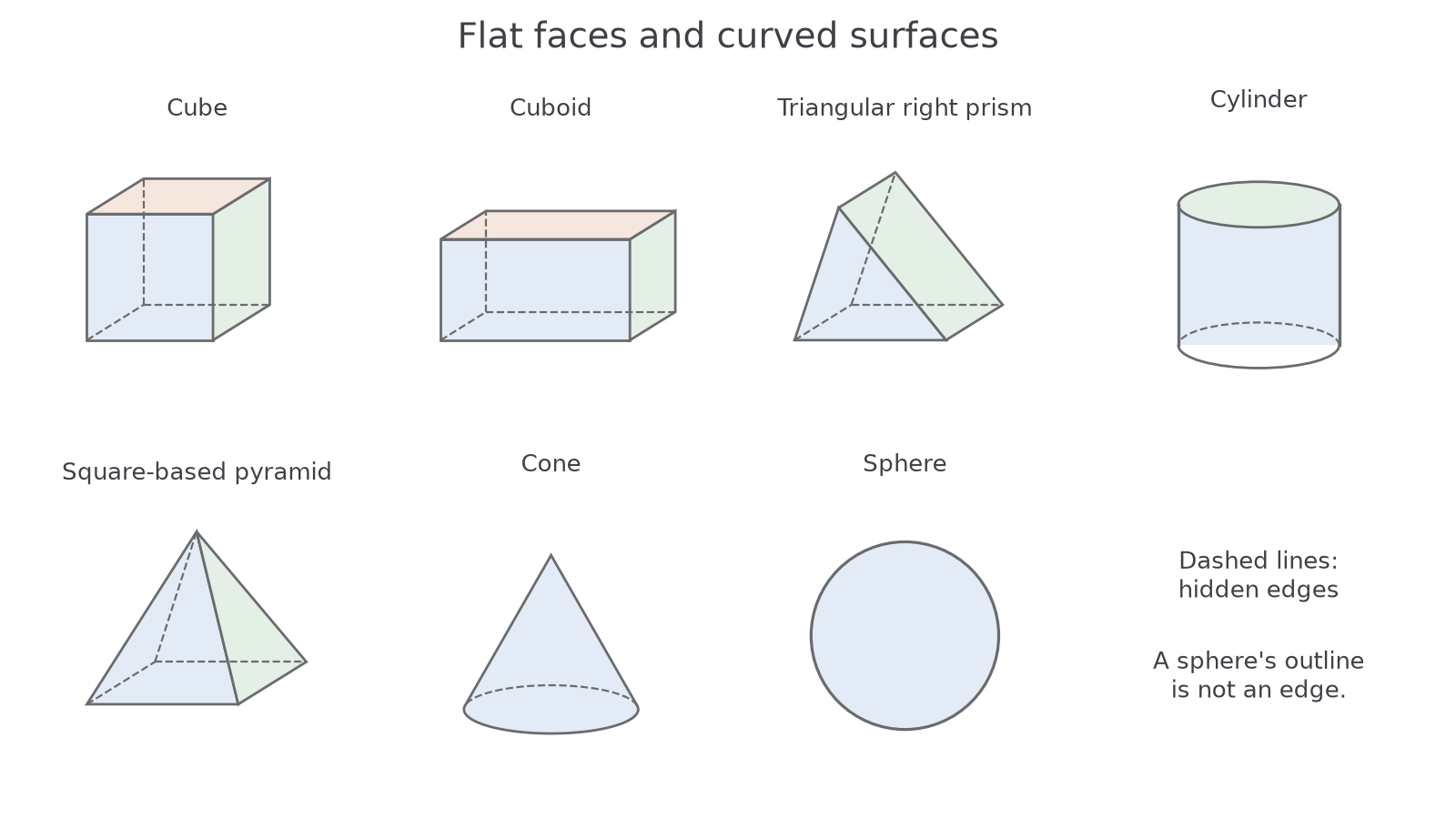
Keep flat faces separate from curved surfaces when counting.
| Solid | Flat faces | Curved surfaces | Edges | Vertices |
|---|---|---|---|---|
| Cube or cuboid | 6 | 0 | 12 straight | 8 |
| Triangular right prism | 5 | 0 | 9 straight | 6 |
| Square-based pyramid | 5 | 0 | 8 straight | 5 |
| Cylinder | 2 | 1 | 2 circular | 0 |
| Cone | 1 | 1 | 1 circular | 1 apex |
| Sphere | 0 | 1 | 0 | 0 |
A cylinder's curved surface can be unrolled into a rectangle, but it is not a flat rectangular face while wrapped around the cylinder. Some books use “face” for every surface; the table explicitly counts flat faces to avoid that ambiguity.
For a prism with an -sided polygonal cross-section, the two ends supply vertices and edges. Another edges join matching end vertices. There are rectangular side faces and two end faces. Hence the counts are faces, edges and vertices. These counting relationships are not on the formula sheet: derive them by counting the ends and joining sides.
Worked example 1: counting a pentagonal prism
Question. Find the numbers of faces, edges and vertices of a right prism with pentagonal ends.
Plan. Count both end polygons, then the features joining them.
Why this step? Each joining edge connects existing end vertices; it does not create another vertex.
Answer. 7 faces, 15 edges and 10 vertices.
Check. .
The next example changes only the end polygon, from a pentagon to a hexagon.
Worked example 2: counting a hexagonal prism
Question. Find the numbers of faces, edges and vertices of a right prism with hexagonal ends.
Plan. Replace each count of five end features with six.
Why this step? Adding one side to each end adds one side face, three edges and two vertices overall.
Answer. 8 faces, 18 edges and 12 vertices.
Check. , again.
A square-based pyramid instead has faces, edges and vertices. Count its shared apex once. The cube, these prisms and this pyramid all have vertices minus edges plus faces equal to 2, despite looking different. For the prism counts, shows why the value stays the same.
Watch out
Wrong: “Four triangular side faces mean four pyramid apexes.” They share the same point. Right: count each distinct vertex once; a square-based pyramid has its four base corners and one apex, giving 5.
Your turn changes only the prism's end polygon again.
Views and viewing directions
A plan or elevation looks straight towards a solid and records the two dimensions perpendicular to the viewing direction.
Plan and elevations
A plan is the view vertically from above, showing width and depth. A front elevation shows width and height. A side elevation shows depth and height. The question must identify which direction is front and which side is viewed.
These are orthographic views: parallel lines of sight do not make distant edges smaller. A photograph taken at an angle shows perspective and is not normally a plan or elevation.
Imagine a cuboid 6 cm wide, 4 cm deep and 3 cm high. From above, height disappears. From the front, depth disappears. From the right, width disappears.
Worked example 3: three views of a cuboid
Question. A cuboid is wide, deep and high. The front faces its width. State the dimensions of its plan, front elevation and right-side elevation.
Plan. Remove the dimension along each line of sight.
Why this step? Each view loses the direction you are looking along, rather than losing the smallest dimension.
Answer. Rectangles measuring 6 by 4, 6 by 3 and 4 by 3 cm respectively.
Check. Width agrees in plan and front; height agrees in both elevations.
The next example changes only the cuboid's height, from 3 to .
Worked example 4: changing the height
Question. The cuboid is now wide, deep and high. State the same three views.
Plan. Keep the ground dimensions and update both elevations.
Why this step? A height change is invisible from directly above but changes both side-on views.
Answer. Rectangles measuring 6 by 4, 6 by 5 and 4 by 5 cm respectively.
Check. Both elevations use the same height, 5 cm.
For an upright cylinder of radius 5 cm and height 9 cm, the plan is a circle of diameter 10 cm. Its front and side elevations are rectangles 10 cm wide and 9 cm high. An upright right cone also has a circular plan, but its elevation is a triangle. That triangular outline is not a flat triangular face. A sphere gives a circular outline from every direction.
A plain plan shows occupied ground positions rather than stack heights. In an elevation, a short stack in front may hide the bottom of a taller rear stack, but the taller stack can still determine the top outline.
An elevation uses vertical height, not the length of a sloping roof edge. Identify the perpendicular height above the base before drawing the elevation.
Watch out
Wrong: a radius-5 cylinder has an elevation only 5 cm wide. That shows half its width. Right: the view spans its diameter, .
Changing the named front can interchange width and depth, so follow the question's arrow. For your turn, only the cuboid's height changes again.
Constructing aligned views
For no-gap stacks of cubes on level ground, the plan uses occupied positions and each elevation uses the greatest height along a line of sight.
Continue this lesson.
You’re previewing NovaLearn without an account. Create a free account to read the rest.
Create free account