N13, R1, R11, G14 - Standard units and compound measures
A numerical answer gains meaning from its unit: a distance, an area and a speed need different conversions. You will convert standard and compound units, read times and timetables, and calculate speed, pay, unit prices, density and pressure using consistent units.
Choosing and converting standard units
Does mean the same speed as ? The numbers look very different, but units decide the comparison. Start by changing one unit at a time.
You already know
Multiplication and division undo each other. A smaller unit needs a larger count for the same quantity: one metre contains 100 centimetres.
A measurement gives a number and a unit. Changing the unit changes the number, while the measured quantity stays the same. Use a practical unit: centimetres for a pen, kilometres for a road.
| Quantity | Unit equalities to know |
|---|---|
| Length | ; ; |
| Mass | ; 1 tonne |
| Capacity | |
| Time | 1 minute = 60 seconds; 1 hour = 60 minutes; 1 day = 24 hours |
| Money | £1 = 100 pence |
These unit equalities are not on the formula sheet: learn them. Currencies are different units too: you need a stated exchange rate to convert between them.
Worked example 1: smaller units
Question. Convert to grams.
Plan. Count 1000 grams for each kilogram.
Why this step? Grams are smaller, so more of them fit the same mass.
Answer. .
Check. .
Change only the direction of the conversion: start with the gram measurement and recover kilograms.
Worked example 2: larger units
Question. Convert to kilograms.
Plan. Group the grams into groups of 1000.
Why this step? The larger unit needs a smaller numerical count.
Answer. .
Check. It lies between 2 kg and 3 kg, as 2350 g lies between 2000 g and 3000 g.
Decimals need care in money too: £3.08 is 308 pence, since the pounds is 8 pence. Similarly, .
Watch out
Wrong: . Multiplying gives a much larger mass. Correct: , since a kilogram contains 1000 grams.
Use the same larger-unit conversion for a different mass.
Clock times, elapsed time and timetables
A clock time tells you when something happens; a duration tells you how long it lasts. Keep them distinct when a journey crosses midnight.
In 12-hour notation, a.m. is before noon and p.m. is after noon: 7:25 p.m. is 19:25. Midnight is 00:00 in 24-hour notation and noon is 12:00. For afternoon and evening times after 12:59 p.m., add 12 to the hour; 12:25 p.m. stays 12:25, while 12:25 a.m. is 00:25. Include the day when it matters.
A decimal duration is a fraction of an hour. hours is 1 hour plus minutes, not 1 hour 40 minutes. Conversely, 1 hour 45 minutes is hours. Sixty minutes make an hour, so counting forward through convenient clock times is often safer than subtracting four-digit times.
Worked example 3: a journey across midnight
Question. A train leaves at 23:40 on Monday and arrives at 00:25 on Tuesday. Find the journey time.
Plan. Count to midnight, then from midnight to arrival.
Why this step? The arrival is on the next day, so its smaller clock number does not mean a negative duration.
Answer. 45 minutes, or hours.
Check. Adding 45 minutes to 23:40 gives 00:25 the next day.
Now add an onward connection to this same train journey. Read each service's column down the station rows; read across a row to compare services at that station. A dash means that service does not call there.
Worked example 4: choosing a connection
Question. After that train arrives at Central at 00:25 on Tuesday, a passenger needs at least 10 minutes to change. Which onward service can they catch first, and how long do they wait?
| Station | Service A | Service B | Service C |
|---|---|---|---|
| Central, departs Tuesday | 00:30 | 00:42 | 01:05 |
| Harbour, arrives Tuesday | 01:00 | 01:15 | 01:40 |
Plan. Add the minimum change time to arrival, then choose the first departure at or after that time.
Why this step? The next listed departure is unusable if the connection is too short.
Answer. Service B, leaving at 00:42 and arriving at 01:15; the wait is 17 minutes.
Check. , whereas A allows only 5 minutes.
An earlier arrival is not necessarily a shorter journey. When comparing journey durations, use each service's own departure and arrival in the correct station rows.
Watch out
Wrong: 09:10 minus 08:45 is 65 minutes, from . Clock hours contain 60 minutes. Correct: 08:45 to 09:00 is 15 minutes, then 10 more gives 25 minutes. Likewise, hours means 1 hour 15 minutes, rather than 1 hour 25 minutes.
Change only the required connection time and reconsider the departures.
Square units, cubic units and capacity
Area changes in two dimensions and volume in three, so the length conversion factor must be used twice or three times.
A square of side has side , hence area . A cubic metre contains cubic centimetres. Surprisingly, a cube only one metre wide holds a thousand litres: .
[DIAGRAM: asset_name: Length and area conversion factors; asset_slug: 1ma1_m37_square_conversion; caption: A one-metre side is 100 centimetres, so a one-square-metre area is 10,000 square centimetres.; description: A square has both side dimensions labelled 1 m equals 100 cm, with an area statement 1 square metre equals 100 times 100 square centimetres.]
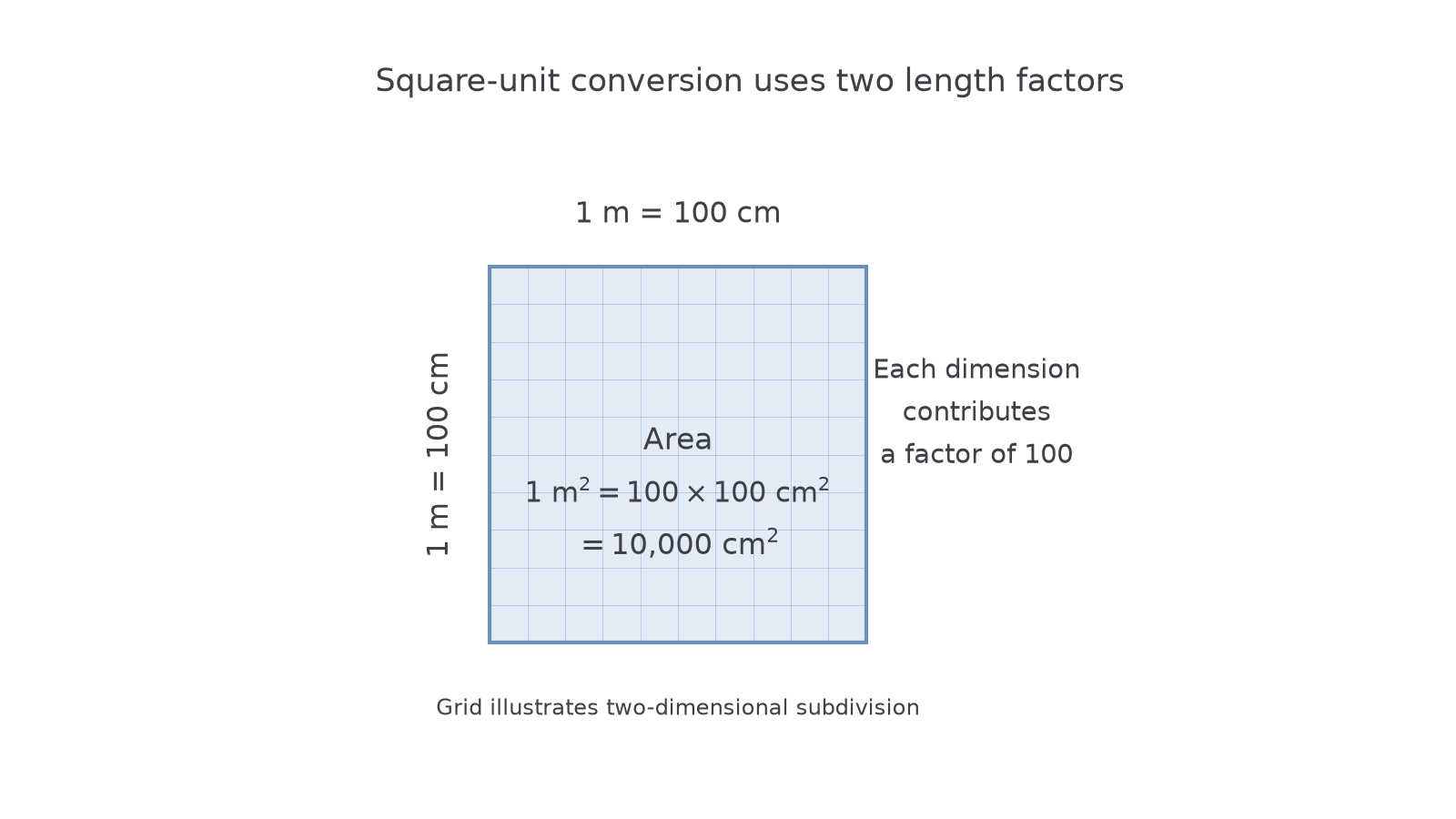
Capacity is how much a container can hold. Know and . These conversion relationships are not on the formula sheet: derive square and cubic factors from the length units, and learn the capacity equalities.
Worked example 5: square units
Question. Convert to square centimetres.
Plan. Square the metre-to-centimetre factor, then apply it to the area.
Why this step? Both length and width contain the factor 100.
Answer. .
Check. Three quarters of is .
Change only the dimension from area to volume; the factor 100 now appears three times.
Worked example 6: cubic units and litres
Question. Convert to cubic centimetres and litres.
Plan. Cube the length factor, then use 1000 cubic centimetres per litre.
Why this step? A cubic centimetre is much smaller than a cubic metre, so very many fit inside.
Answer. , or .
Check. litres using the cubic-metre equality.
Variables obey the same unit factor: and . If is a side length in metres, its square's area is . Do not square a variable that already represents an area. Other useful checks are , , and .
Watch out
Wrong: . This changes only one dimension. Correct: . Use three factors for volume.
Change the volume while keeping the same destination units.
Continue this lesson.
You’re previewing NovaLearn without an account. Create a free account to read the rest.
Create free account