A11, A18 - Completing the square and the quadratic formula
A11 links a quadratic's algebra to its turning point. A18 gives you ways to solve it even when its factors are awkward. You will complete the square, use the quadratic formula, choose a method, and handle parameters and algebraic fractions.
Completing the square and finding a turning point (Higher)
How can you find the lowest point of without plotting a table of values? At , the output is 2. At , it is . Completing the square will show why no input gives a lower output.
You already know
Expanding gives . A real number squared is never negative.
To produce the middle term , use . The square then includes 9, so subtract 9 to keep the expression unchanged. This is an identity: it holds for every input.
Worked example 1: reveal the minimum
Question. Complete the square for and find the turning point.
Plan. Halve the middle coefficient, correct the constant, then make the square zero.
Why this step? Writing one square exposes a lower bound: adding a non-negative square cannot make smaller.
Answer. The minimum is , with symmetry line .
Check. Expanding gives .
The graph makes the same point visually. Inputs equally far from have equal squares, so equal heights.
[DIAGRAM: asset_name: Turning point from completed square form; asset_slug: 1ma1_m24_square; caption: The square is smallest at x equals minus 3, giving the minimum (-3,-7).; description: A graph of y equals (x plus 3) squared minus 7 shows its minimum (-3,-7), symmetry line x equals minus 3 and symmetric points (-5,-3) and (-1,-3).]
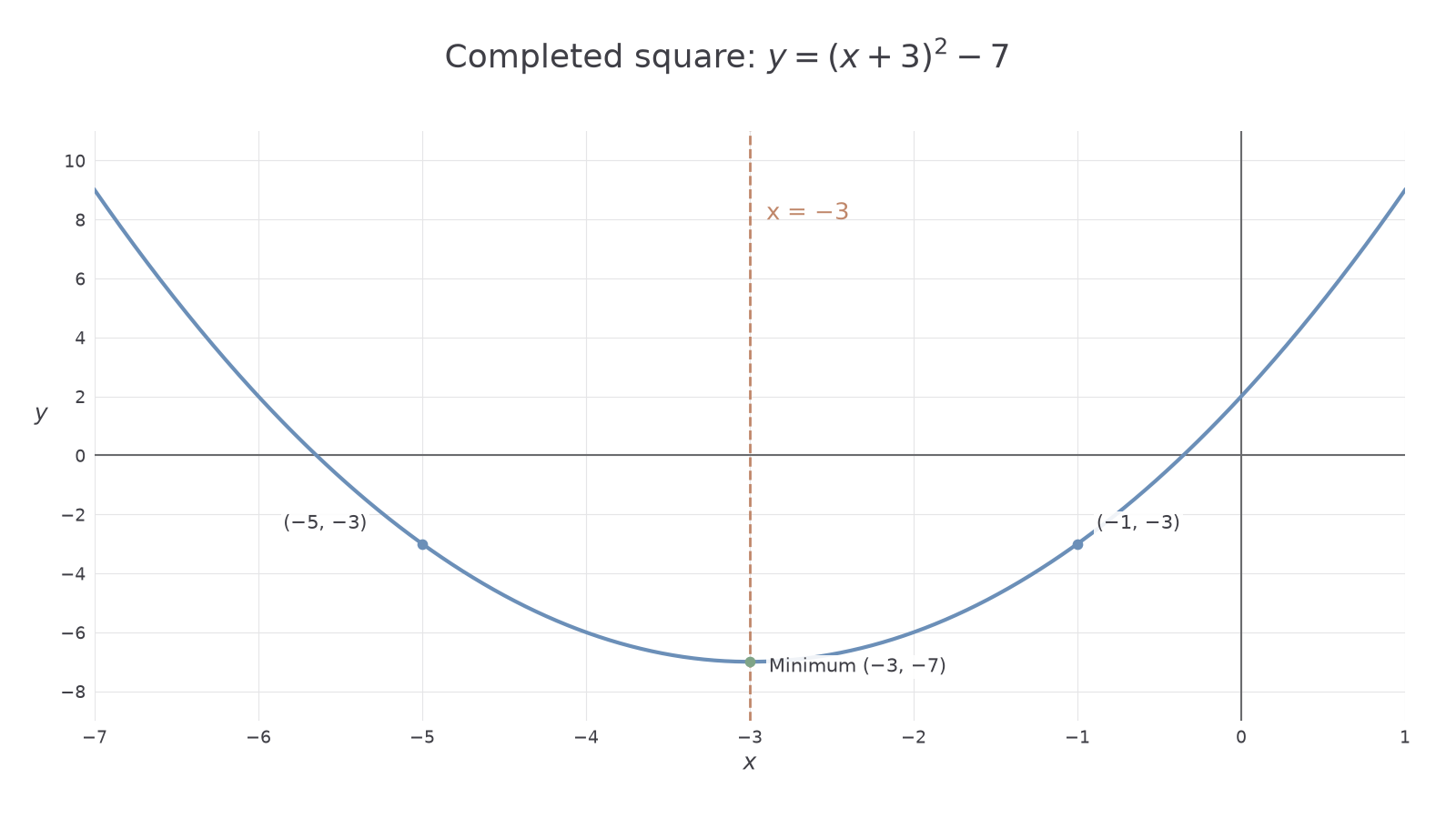
In the next example, only the sign of the middle term changes. Watch how the horizontal coordinate changes while the minimum height stays the same.
Worked example 2: a negative middle coefficient
Question. Complete the square for and find its turning point.
Plan. Keep the sign when halving the middle coefficient.
Why this step? The turning-point input makes the bracket zero; it is not simply the signed number written inside it.
Answer. The minimum is .
Check. At , the original output is .
An odd middle coefficient works too: . With a leading coefficient, factor it from the first two terms first:
The correction inside the bracket is multiplied by 2 as well. The minimum is . A negative squared coefficient reverses this: has maximum .
Completed-square form
For , where , the turning point is . It is a minimum if and a maximum if .
Not on the formula sheet: derive it from the non-negativity of a real square.
Use expansion to catch a missing correction before you read a turning point.
Watch out
The line is wrong: the right side has constant 11. Subtract the extra 9 to get .
Try the same constant correction with a different middle coefficient.
Solving by completing the square (Higher)
Once a square is isolated, square roots undo it. There are usually two possibilities because opposite numbers have the same square.
Worked example 3: two exact roots
Question. Solve by completing the square.
Plan. Rewrite the left side as a square, isolate it and take both signs.
Why this step? Taking only the positive square root loses one solution.
Answer. or .
Check. Each root has , so the original expression is zero. To three significant figures they are 5.83 and 0.172.
Only the constant changes next, from 1 to . The bracket remains , but the roots move further from the symmetry line.
Worked example 4: change the constant
Question. Solve , giving exact answers.
Plan. Use the same square and adjust its constant.
Why this step? Keeping the surd preserves an exact answer; rounding before the final step loses accuracy.
Answer. .
Check. Substituting into the completed-square expression gives .
Rearrange first when needed. For , division by 2 gives . Adding 4 to both sides gives , so or . Both make the original left side 10.
A zero square gives one repeated root: gives . A negative right side, such as , gives no real solution. This is why a quadratic need not have two distinct real roots.
Watch out
The line is incomplete. Include too, then apply any contextual restrictions.
For example, a rectangle with width , length and area gives . The roots are 3 and , but only the positive width 3 metres fits. The length is 7 metres.
The two real roots of a quadratic are equally far from its symmetry line. In , they are and , so their average is . That stays true even when the roots are awkward surds.
The quadratic formula and real roots (Higher)
The quadratic formula works even when convenient factors are hard to find. First put the equation in the form with zero on one side.
Quadratic formula
For , with ,
On the formula sheet (2026 version; the 2027 sheet will have the same content).
The coefficients include their signs. In , , so . Write brackets around negative substitutions.
Worked example 5: signed substitution
Question. Use the quadratic formula to solve .
Plan. Identify , , , then evaluate both signs.
Why this step? The whole numerator is divided by , not just the square-root term.
Answer. , approximately 1.78 and to three significant figures.
Check. For either root, , so
Dividing by 8 confirms that the original expression is zero for both roots.
Now change only , from to 1. This changes the number under the square root.
Worked example 6: a square discriminant
Question. Use the formula to solve .
Plan. Keep , , and use .
Why this step? A square discriminant makes the square root rational, so these roots simplify to fractions.
Answer. or .
Check. gives the same pair.
The discriminant is . Positive gives two distinct real roots; zero gives one repeated real root; negative gives no real roots. For it is zero and the graph touches the axis at . For it is and the graph misses the axis.
Rearrangement matters. becomes , with . The formula gives , hence 2 and . Enter the complete numerator in brackets on a calculator and round only the final roots.
Watch out
For , writing loses its sign. Use , giving and .
Practise the signed substitution with another constant.
Continue this lesson.
You’re previewing NovaLearn without an account. Create a free account to read the rest.
Create free account