G6, G20 - Pythagoras theorem in two dimensions
Pythagoras' theorem links the three side lengths of a right-angled triangle. You will understand its area relationship, find missing lengths, test whether an angle is right, and choose the useful right triangles inside larger two-dimensional problems.
The hypotenuse and the square relationship
A ladder stands with its foot from a vertical wall. How high does it reach? Subtracting from will not work: these lengths run in different directions.
You already know
A right angle is . Squaring multiplies a number by itself; taking a positive square root recovers a positive length. A triangle's area is .
The two sides meeting at the right angle are perpendicular. The remaining side crosses opposite the right angle, even when the triangle is tilted on the page.
Hypotenuse
The hypotenuse is the side opposite the right angle in a right-angled triangle. It is always that triangle's longest side. A non-right-angled triangle has no hypotenuse.
For perpendicular lengths and , a hypotenuse of gives . Squares built on the two perpendicular sides together have the same area as the square built on the hypotenuse.
A loop marked into equal sections can therefore set out a right angle: stretch it into sides of , and sections. The angle between the - and -section sides is exactly right.
Pythagoras' theorem
The triangle must be right-angled; meet at the right angle and is the hypotenuse.
On the formula sheet (2026 version; the 2027 sheet will have the same content).
Here is why it works for every right triangle, rather than just the example. Arrange four congruent right triangles inside a square of side . Their hypotenuses enclose a central square of side . Its angles are right because the two acute triangle angles together make , leaving at each meeting point.
[DIAGRAM: asset_name: Four-triangle area derivation of Pythagoras theorem; asset_slug: 1ma1_m58_area_derivation; caption: The large square contains four equal right triangles and a central hypotenuse square; description: A square of side a plus b contains four congruent blue right triangles with legs a and b. Their hypotenuses, all labelled c, enclose a sage central square. The chosen plotted leg lengths are 3 and 4, but the labels and area equation show the general argument.]
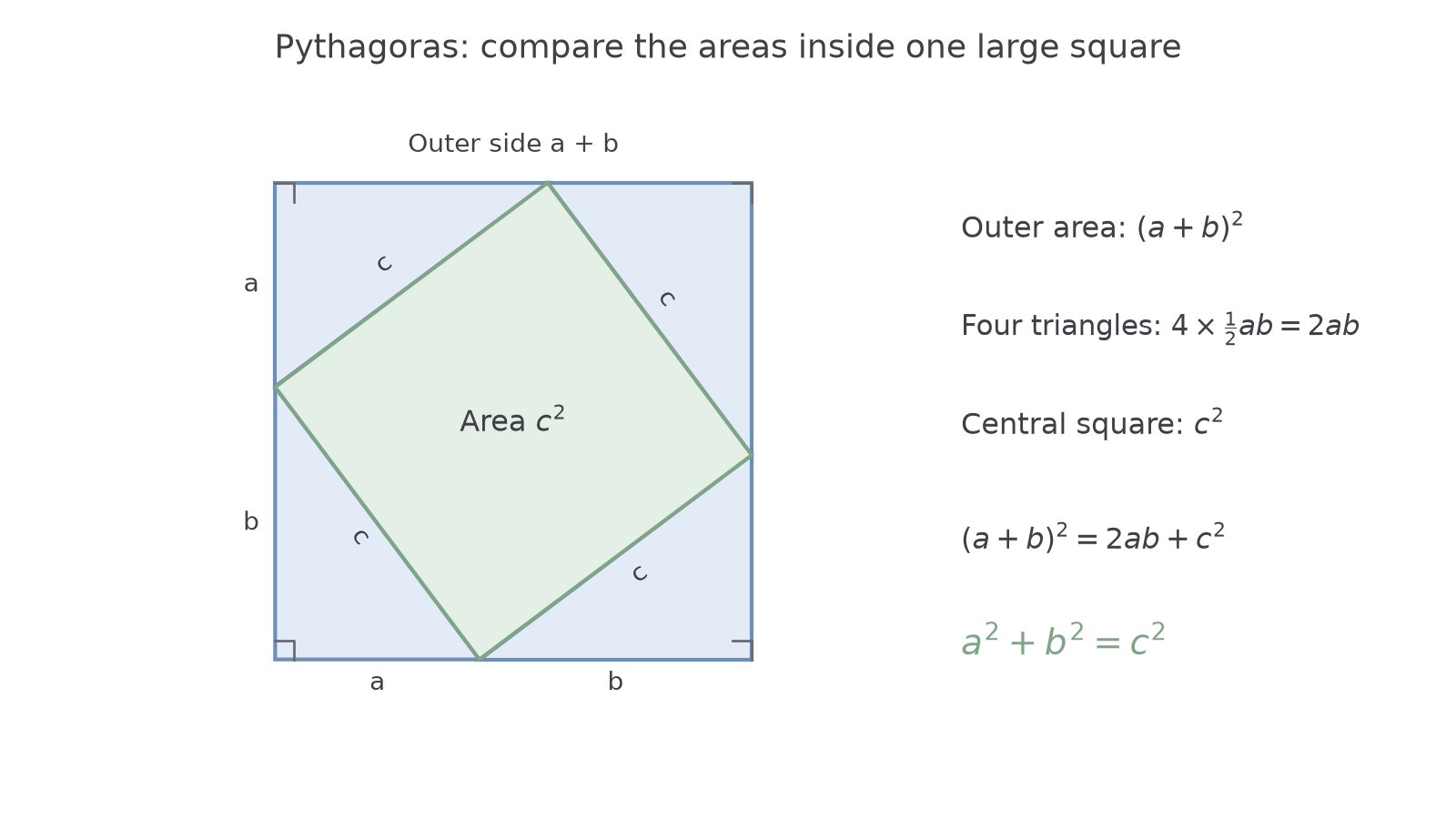
Calculate the same outer area in two ways:
The picture therefore explains a relationship between areas, although its final use is often to find a length.
Worked example 1: identifying the square relationship
Question. Triangle is right-angled at , with , , units. Identify the hypotenuse and check Pythagoras' relationship.
Plan. Locate the side opposite , then compare squares.
Why this step? Side roles come from the right angle, not from which side looks horizontal.
Answer. is the hypotenuse, and .
Check. is longer than both and .
Change the two perpendicular lengths to and units. The area construction still works, including when the lengths are unequal.
Worked example 2: checking the area construction numerically
Question. Four right triangles with perpendicular sides , units form the construction above. Find the central square's area and side.
Plan. Subtract the four triangle areas from the outer square area.
Why this step? Subtracting the triangle regions leaves exactly the central square, without gaps or overlap.
Answer. Its area is square units and its side is units.
Check. .
An accurate relationship must square all three lengths.
Watch out
Wrong: . That adds lengths, whereas Pythagoras adds square areas. The correct line is , or .
The next check uses the same side roles with letters.
Finding a hypotenuse or shorter side
Identify the unknown side before deciding whether to add or subtract squares.
If the hypotenuse is missing, add the two perpendicular-side squares. If a perpendicular side is missing, subtract the known perpendicular-side square from the hypotenuse square. Both come from rearranging the same printed formula.
Worked example 3: finding the hypotenuse
Question. A right triangle has perpendicular sides and . Find its hypotenuse .
Plan. Add the squares, then take the positive square root.
Why this step? Pythagoras gives , so the last square root is essential.
Answer. .
Check. The hypotenuse is longer than both given sides.
Keep the same triangle but hide the perpendicular side instead. Changing the unknown changes the rearrangement.
Worked example 4: finding a shorter side
Question. A right triangle has hypotenuse , one perpendicular side and other side . Find .
Plan. Subtract the known leg square, then take a positive root.
Why this step? Adding here would calculate a side longer than the already-known hypotenuse.
Answer. .
Check. .
The same subtraction gives for a hypotenuse of and leg of . Results need not be integers: legs , give , about to three significant figures. Keep the root or full calculator value until final rounding.
Watch out
Wrong: . The subtraction gives , not . Take to get . Square units become length units after the root.
A negative value under the square root is a signal to check the side roles or the data: the hypotenuse must be longest.
Continue this lesson.
You’re previewing NovaLearn without an account. Create a free account to read the rest.
Create free account