N4, N5 - Primes, factors, multiples and systematic lists
Build whole numbers from prime factors, find shared factors and multiples, and choose the right method for grouping or repeating cycles. Organised lists will help you justify that you have found every possibility exactly once.
Prime factors and unique factorisation
A club has blue counters and green counters. What is the greatest number of identical packs it can make, using every counter? Prime factors will help us decide which pack counts are possible.
You already know
A power such as records three equal factors. To check a factorisation, multiply the factors to reconstruct the original number.
A factor, or divisor, divides a number exactly. The positive factor pairs of are , , and , giving factors . A multiple is made by multiplying by an integer; the positive multiples of begin .
Prime number
A prime number is an integer greater than one with exactly two positive factors: one and itself. An integer greater than one with more than two positive factors is composite.
The primes begin . One is not prime: it has only one positive factor. Two is the only even prime; every larger even number also has two as a factor.
A prime factorisation writes a whole number as a product of primes. Split composite factors until only primes remain. The unique factorisation theorem says that every integer greater than one has exactly one prime factorisation, apart from the order of its factors.
Worked example 1: splitting into primes
Question. Express as a product of powers of prime factors.
Plan. Split composite factors, then collect repeated primes as powers.
Why continue past ? Every final factor must be prime; is composite.
Answer. .
Check. . Starting instead with produces the same primes.
Change only the input by doubling it. That adds one more factor of two.
Worked example 2: one extra prime factor
Question. Express as a product of powers of prime factors.
Plan. Separate a factor of two, then factorise .
Why increase the index from two to three? Multiplying by two adds one occurrence of the prime; it does not double every prime in the product.
Answer. .
Check. , and all three bases are prime.
Repeated division is another route. For , divide successively by , giving quotients . Hence . Stop only when the quotient is one.
Watch out
Wrong: calling a prime factorisation. Its value is , but is composite. Right: .
Double the second example's input once more.
Highest common factors and lowest common multiples
Shared factors divide both numbers, while shared multiples can be made from whole copies of either number.
HCF and LCM
The highest common factor (HCF) is the greatest positive integer that divides every given number. The lowest common multiple (LCM) is the smallest positive integer that is a multiple of every given number.
For and , the common factors are , so the HCF is . Their positive multiple lists begin and ; the first shared value is , so that is the LCM. Prime factorisation makes larger cases easier.
Worked example 3: shared and additional primes
Question. Find the HCF and LCM of and .
Plan. Factorise both numbers. For the HCF take shared primes with their smaller exponents; for the LCM take every prime with its larger exponent.
Why use smaller exponents for the HCF? A factor cannot contain more copies of a prime than either original number contains.
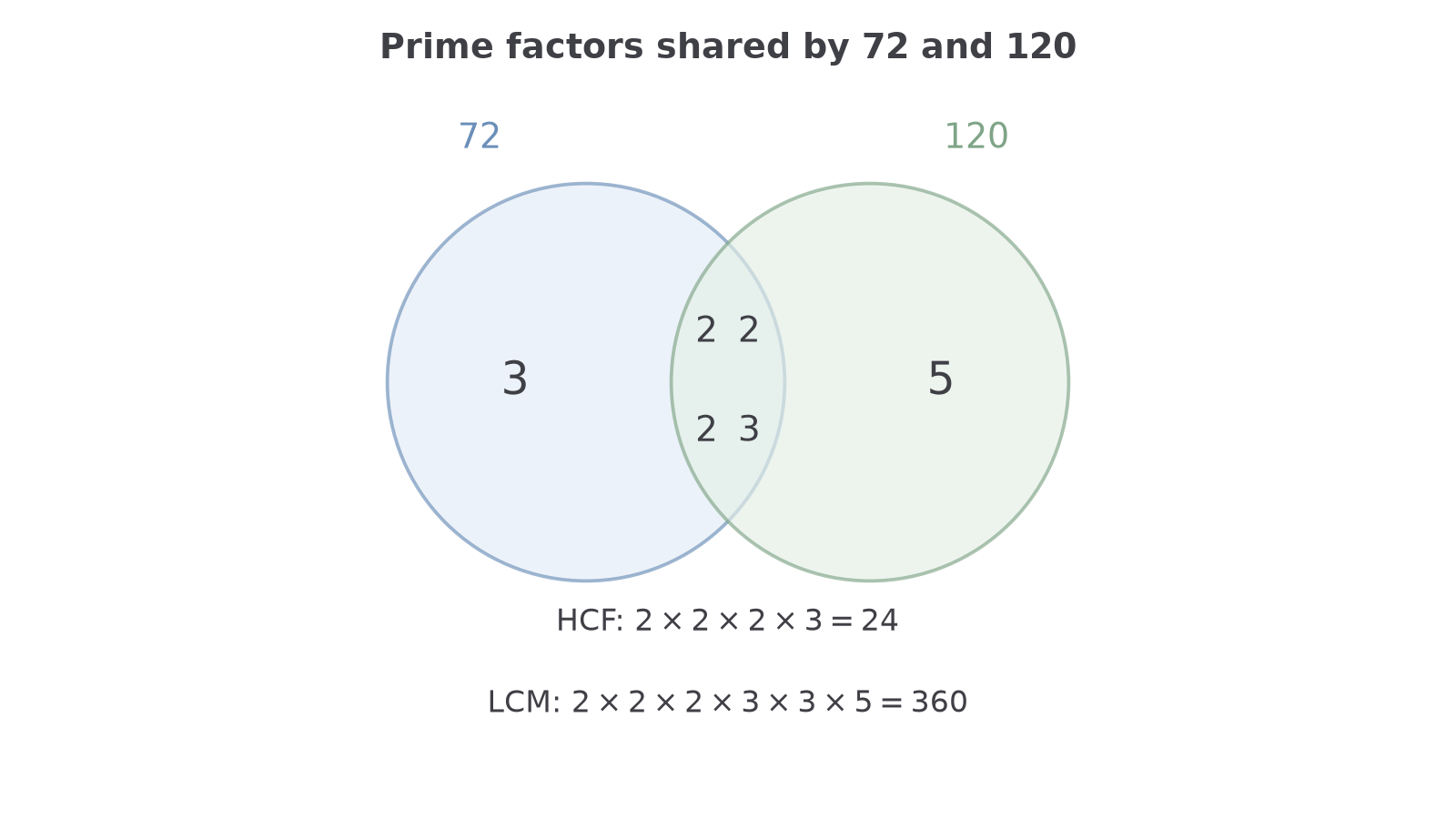
Answer. HCF ; LCM .
Check. , , and .
The overlapping diagram displays occurrences of primes, so its repeated twos matter.
[DIAGRAM: asset_name: Common and additional prime factors; asset_slug: 1ma1_m04_hcf_lcm; caption: The shared primes give the HCF; all the displayed primes give the LCM.; description: Overlapping sets labelled 72 and 120 show shared factors 2, 2, 2 and 3, an extra 3 for 72 and an extra 5 for 120. The shared product is 24 and the product of every displayed prime is 360.]
Change only the second input from to . Recheck which prime occurrences are shared.
Worked example 4: different shared exponents
Question. Find the HCF and LCM of and .
Plan. Compare the prime exponents in the two factorisations.
Why does the LCM stay ? The largest required exponent of every prime is unchanged, although the shared exponents have changed.
Answer. HCF ; LCM .
Check. , , and divides by the two inputs to give and .
If no prime is shared, the HCF is one and the LCM is the product of the inputs. If one positive input divides the other, the HCF is the smaller and the LCM is the larger.
Watch out
An HCF cannot exceed the smaller positive input, and an LCM cannot be below the larger input. If those checks fail, you may have swapped the two methods.
Change only the second input again.
Divisibility, grouping and repeating cycles
Decide whether the problem divides an existing stock into groups or looks for a future shared total.
A pack count must divide each stock, so identical packs use common factors. A shared repeat time must be a multiple of each interval, so repeating cycles use common multiples. “Greatest number of packs” points to HCF; “next together” points to LCM.
Worked example 5: greatest number of identical packs
Question. A club has blue counters and green counters. Find the greatest number of identical packs it can make using every counter, and state the contents of each pack.
Plan. Find the HCF for the pack count, then divide both stocks by it.
Why use HCF? Every pack count must divide both stocks exactly, and the question asks for the largest such count.
Answer. packs, each containing blue and green counters.
Check. and ; no counter is left over.
Change only the blue stock from to . A bigger stock need not give more packs.
Worked example 6: changing one stock
Question. Find the greatest number of identical packs from blue counters and green counters, using every counter. State each pack's contents.
Plan. Recalculate the HCF before dividing the stocks.
Why not assume the HCF increases? Extra factors in one stock help only if the other stock contains them too.
Answer. packs, each with blue and green counters.
Check. and .
For cycles, suppose two lights flash together, then flash every and seconds. The first positive common multiple is , so they next coincide after . This assumes constant intervals and a shared start. The initial coincidence at zero is not the next one.
Prime powers also test divisibility without calculating the entire number. A number is divisible by , leaving . It is not divisible by , since it has only two factors of three. Divisibility by ten requires factors of both two and five; decimal multiples of ten end in zero.
A square number has even exponents in its prime factorisation, because every factor is paired with its copy. Thus is square, but is not. This is why you can recognise a huge square from its prime exponents without finding its value.
Watch out
The LCM cannot be the number of non-empty packs from stocks of and . It exceeds both stocks. Decide what the required number must divide, or be divisible by, before calculating.
Change only the green stock in the second pack example.
Complete lists without duplication
A systematic list uses a fixed order so you can explain why nothing is missing or counted twice.
Fix one choice, list every allowed continuation, then move to the next first choice. For two-digit numbers, each tens digit gives one row. The rows cannot overlap because their tens digits differ.
Worked example 7: listing without repeated digits
Question. List all two-digit numbers made from , using each digit at most once in a number.
Plan. Fix the tens digit and list the possible units digits in increasing order.
Why are and both included? Changing digit order changes the number.
Answer. .
Check. Every allowed tens digit has a row, and each row uses both other digits exactly once.
Change only the repetition rule: digits may now repeat. Each row gains the number with two matching digits.
Worked example 8: allowing repeated digits
Question. List all two-digit numbers made from , allowing repeated digits.
Plan. Use the same row order and include every available units digit.
Why do the rows now have three entries? Choosing the tens digit no longer forbids that digit in the units column.
Answer. .
Check. The old six numbers remain, and exactly have been added.
Unordered selections need a different rule. For pairs from A, B and C, list only letters later in the alphabet after the first: AB, AC, then BC. BA is the same pair as AB. There are unordered pairs.
For factor pairs of , try divisors in increasing order: , , , , . Stop when the next pairs would reverse earlier ones. The factor appears once in the final factor list, even though it occurs twice in its pair.
Watch out
A plausible-looking list is not enough to establish completeness. Use a rule that covers every allowed first choice and every continuation. Check whether order and repetition matter before listing.
Keep repetition allowed and change just one available digit, from to .
Quick Recap
- Prime factorisation ends with prime bases and is unique apart from order.
- HCF uses shared prime occurrences; LCM uses enough of every prime for both inputs.
- Grouping stock uses factors; shared repeat times use multiples.
- A fixed listing order shows completeness and prevents duplication.
The opening club can make identical packs, each with blue and green counters.