G22, G23 - Sine rule, cosine rule and triangle area
A triangle need not contain a right angle for you to calculate its missing measurements. G22 gives you the sine and cosine rules for lengths and angles; G23 connects two sides and their included angle to the area. You will learn which information each rule needs and how to combine the rules without losing accuracy.
Opposite pairs and the sine rule (Higher)
Can two different triangles have an angle of , an opposite side of , and another side of ? Surprisingly, yes: the second side can swing into two positions. We will calculate both rather than trust a sketch.
You already know
Triangle angles add to . This angle sum and the exact trigonometric values are not on the formula sheet: learn them. In a right triangle, is opposite divided by hypotenuse. Use degree mode for these calculations.
First make the labels do some work. In triangle , side is opposite angle , and similarly for and . Opposite means the side does not form an arm of that angle.
[DIAGRAM: asset_name: Opposite side and angle pairs; asset_slug: 1ma1_m60_triangle_pairs; caption: Each lower-case side label is opposite its matching upper-case angle.; description: A non-right triangle ABC with A at the left base, B at the right base and C above; side a is BC, b is AC and c is AB, with labelled angle arcs at A, B and C.]
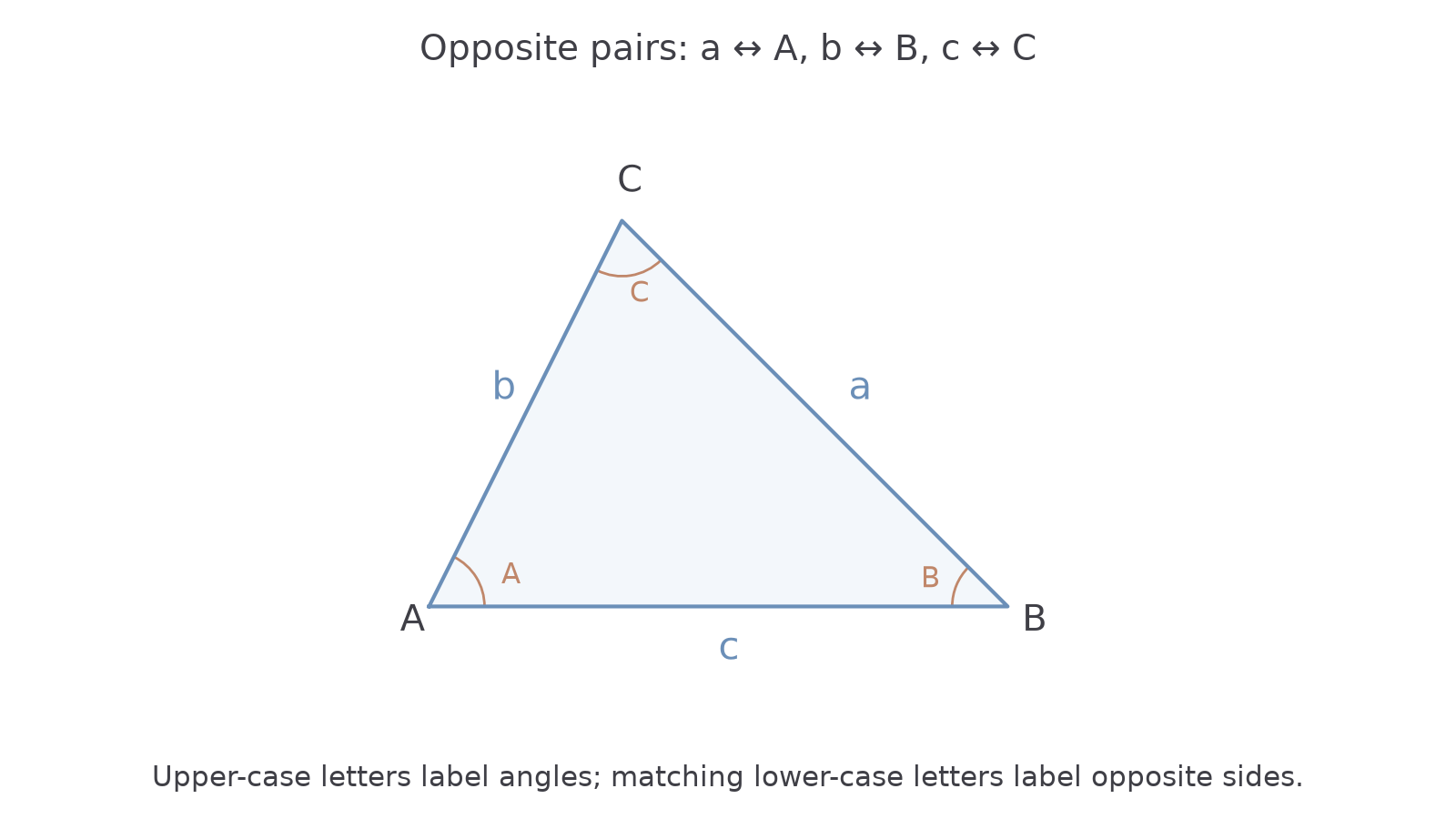
Draw the height from to . It is both and . Equating these and dividing gives . The same argument with another height includes the third pair. A height outside an obtuse triangle gives the same result because supplementary angles have equal sines.
Sine rule
For any triangle, with each side opposite its matching angle,
Use two pairs, including one completely known pair.
On the formula sheet (2026 version; the 2027 sheet will have the same content).
To find a side, keep sides on top. To find an angle, turning both fractions over often makes the rearrangement easier.
Worked example 1: finding a side
Question. , , and . Find to three significant figures.
Plan. Pair with , then isolate .
Why this rule? The complete pair connects directly to the required pair .
Answer. to three significant figures.
Check. , so its opposite side should be longer than . It is.
Change only from to . The opposite side should grow, while the known pair stays fixed.
Worked example 2: changing the opposite angle
Question. , , and . Find to three significant figures.
Plan. Use the same paired equation with the new angle.
Why keep the denominator? The known side is still opposite .
Answer. to three significant figures.
Check. It is longer than the side in example 1, as expected.
Now let the unknown be an angle. Inverse sine returns an acute angle for a positive sine below one. Its supplement has the same sine, so test both against the angle sum and any given acute or obtuse condition.
Worked example 3: two possible angles
Question. , , and . Find both possible values of to one decimal place.
Plan. Find , then check both angles.
Why consider the supplement? A sine value does not distinguish an acute angle from its obtuse supplement.
Answer. or .
Check. The third angles are and , both positive. Both triangles are possible.
Change only to . This changes the sine value, but the two-angle check is still needed.
Worked example 4: checking a changed known side
Question. , , and . Find both possible values of to one decimal place.
Plan. Repeat the paired sine calculation and angle-sum checks.
Why are both allowed? Adding to either still leaves room for a positive third angle.
Answer. or .
Check. The third angles are and . Neither is zero or negative.
There may be two triangles, one triangle, or none. For instance, permits none because a sine cannot exceed one.
Watch out
Wrong: , so this is the only possible . Inverse sine gives only one of two supplementary candidates. Correct: also test , then reject a candidate only if the angle sum or context rules it out. Also keep opposite : adjacent pairs are not interchangeable.
Try the angle method again, changing just the known opposite side from example 4.
The cosine rule for sides and angles (Higher)
The cosine rule works when you have two sides and their included angle, or all three sides. An included angle lies between the two given sides.
Cosine rule
For any triangle, with opposite ,
On the formula sheet (2026 version; the 2027 sheet will have the same content).
Why does the correction term appear? Place side along a horizontal base. Side has horizontal component and perpendicular component . Pythagoras gives
The bracket is one because the squared horizontal and vertical components make . This also works for an obtuse angle, whose horizontal component is negative. At , the correction is zero: Pythagoras is inside the cosine rule.
Worked example 5: an unknown side
Question. Sides and enclose . Find the opposite side exactly.
Plan. Calculate its square using the included angle, then take the positive root.
Why this rule? There is no complete opposite pair for the sine rule.
Answer. , approximately .
Check. , so the triangle inequality is satisfied.
Change only the included angle to . Its cosine becomes negative, so the opposite side will be longer.
Worked example 6: an obtuse included angle
Question. Sides and enclose . Find the opposite side exactly.
Plan. Use the same rule, taking care with the negative cosine.
Why is the correction added? , so the whole term is positive.
Answer. , approximately .
Check. It is longer than the right-angle comparison , and still less than .
With three sides known, rearrange before entering the calculator. This rearrangement is not printed separately on the formula sheet: derive it from the cosine rule by isolating :
Use inverse cosine at the end. Unlike sine, cosine picks one angle between and .
Worked example 7: an angle from three sides
Question. A triangle has sides , and . Find the angle opposite to one decimal place.
Plan. Put in the opposite-side position, then use inverse cosine.
Why subtract ? This is the side opposite the angle being found.
Answer. .
Check. , so this angle should be acute. It is.
Change only the opposite side from to . The triangle still exists because .
Continue this lesson.
You’re previewing NovaLearn without an account. Create a free account to read the rest.
Create free account