G11 - Geometrical problems on coordinate axes
Coordinates provide evidence about a shape's lengths, directions and midpoints. You will use that evidence to classify shapes, find missing vertices and justify geometrical conclusions, including perpendicular-gradient proofs at Higher tier.
Shapes from coordinates
A sketch of , , , looks like a rectangle. How can coordinates prove that it is a rectangle rather than a square?
You already know
In , the first coordinate gives horizontal position and the second gives vertical position. Horizontal and vertical lines meet at right angles.
The endpoints of have the same -coordinate, so is horizontal. Its length is the difference between the horizontal coordinates:
The endpoints of have the same -coordinate, so is vertical, of length . These lengths are positive distances, even when a coordinate is negative.
Coordinate evidence
Equal -coordinates identify a horizontal segment. Equal -coordinates identify a vertical segment. Subtract the coordinates in the changing direction to find its length, taking the positive difference.
Opposite sides of this shape have the same respective directions and lengths, and the corners are right angles. That establishes a rectangle. A square also needs equal adjacent lengths.
[DIAGRAM: asset_name: Rectangle and diagonal on coordinate axes; asset_slug: 1ma1_m53_coordinate_rectangle; caption: Coordinate differences give width and height.; description: Unit-scaled axes show A(-2,1), B(4,1), C(4,5), D(-2,5). The rectangle is 6 units wide and 4 units high, with dashed diagonal AC and a right-angle marker.]
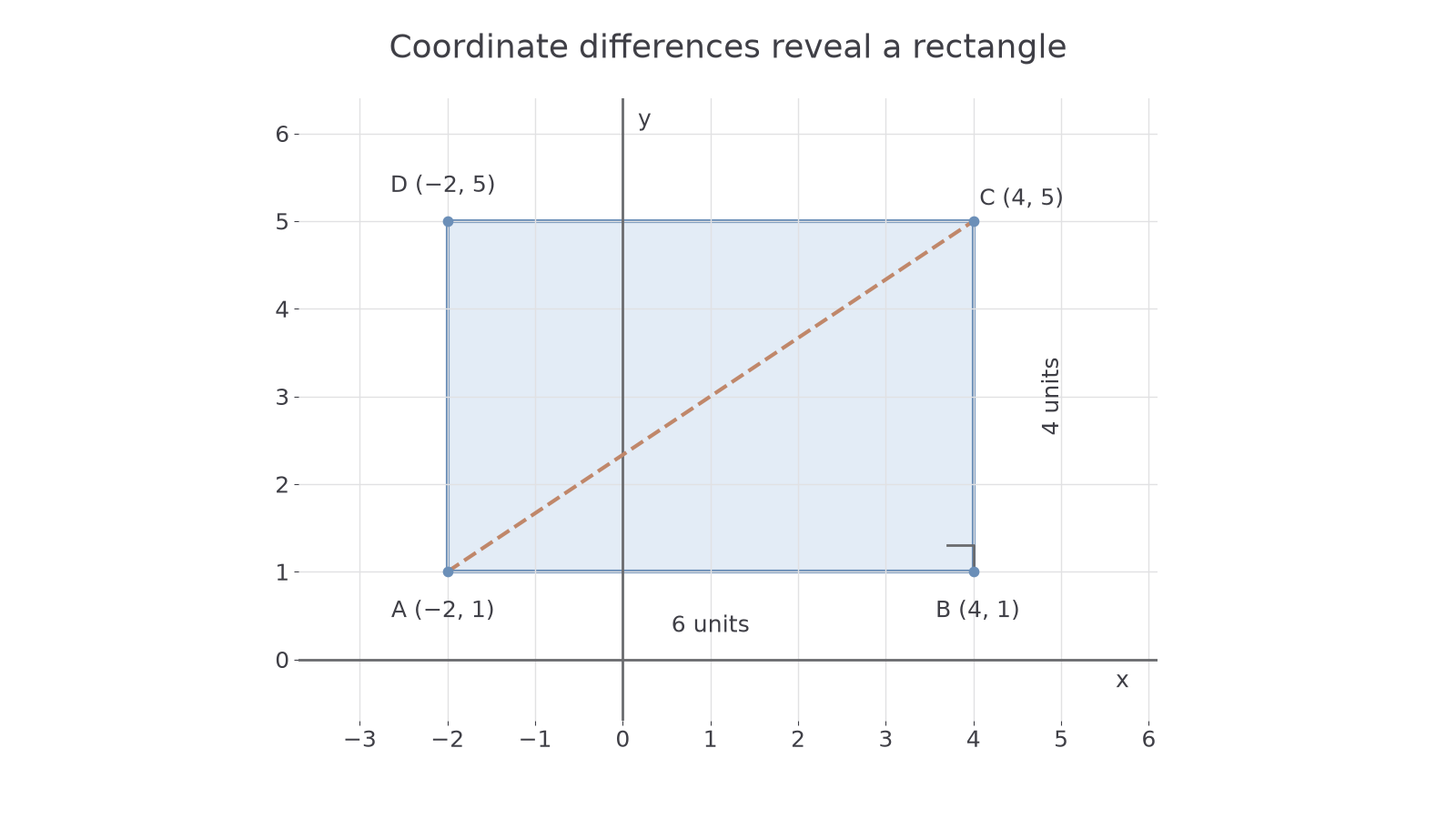
Link the numerical calculation to the shape property in your answer.
Worked example 1: classifying a coordinate rectangle
Question. Identify the most precise quadrilateral with consecutive vertices , , , , and find its area.
Plan. Establish the side directions, calculate adjacent lengths, then classify.
Why this step? Horizontal and vertical sides prove the right angles; the unequal lengths rule out a square.
Answer. A rectangle, not a square; area square units.
Check. Opposite lengths agree, and all four corners join one horizontal to one vertical side.
The next example changes only the top edge's vertical coordinate, from 5 to 8.
Worked example 2: changing the height
Question. The vertices are now , , , . Classify the shape and find its area.
Plan. Keep the horizontal calculation and recalculate the vertical length.
Why this step? Moving both top vertices vertically keeps the right angles but changes the height.
Answer. A rectangle, not a square; area square units.
Check. The area increased by , from 24 to 42.
Triangles use the same direction evidence. For , , , the sides and are perpendicular at , so
square units. Choose a perpendicular base and height, rather than the two sides that look most convenient. Rectangle and triangle area formulae are not on the formula sheet: learn them.
Watch out
Wrong: “Opposite sides are equal, so it must be a rectangle.” A sloping parallelogram also has equal opposite sides. Right: establish the right angles as well, here from horizontal and vertical directions.
The opening shape is a rectangle because of its right angles, and its unequal adjacent lengths 6 and 4 rule out a square. Your turn changes only the right edge's horizontal coordinate from Worked example 2.
Midpoints and distances
A midpoint uses averages of positions, while a distance uses differences between positions.
A midpoint is halfway along a line segment. Travelling halfway changes both horizontal and vertical movements by half, which means averaging corresponding coordinates.
Midpoint
For endpoints and , the midpoint is
Average the two horizontal coordinates and the two vertical coordinates separately.
Not on the formula sheet: learn it.
For a sloping distance, draw a horizontal and vertical route between the endpoints. The two coordinate differences are perpendicular legs of a right triangle. Its hypotenuse is the required straight distance. This uses Pythagoras; the later Pythagoras lesson develops the theorem further.
Distance from perpendicular movements
If the horizontal and vertical movement sizes are and , then
Use the positive root for a length. The right angle is between the coordinate directions.
Pythagoras itself is on the formula sheet (2026 version; the 2027 sheet will have the same content).
Not on the formula sheet: derive it from Pythagoras.
Do the two calculations separately so that averages do not get mixed with differences.
Worked example 3: midpoint and distance
Question. Find the midpoint and distance between and . Give distance to 1 decimal place.
Plan. Average corresponding coordinates for the midpoint; use their perpendicular differences for distance.
Why this step? A diagonal is the hypotenuse, rather than the bent route of length .
Answer. Midpoint ; distance units.
Check. The two half-segment movements are both . The distance is between 10 and 14 units.
The next example changes only 's vertical coordinate, from to .
Worked example 4: changing one coordinate
Question. Find the midpoint and distance between and . Give distance to 1 decimal place.
Plan. Keep the horizontal calculations and update the vertical ones.
Why this step? The horizontal separation stayed 10; only the vertical separation increased.
Answer. Midpoint ; distance units.
Check. Each half moves , and the increased vertical separation makes the total distance larger.
A midpoint can recover a missing endpoint. If and , the movement from to is . Repeat it:
Equivalently, and . These rearrangements are not on the formula sheet: derive them from the midpoint formula.
Watch out
Wrong: midpoint means the missing endpoint is . That doubles its position from the origin. Right: subtract the known endpoint after doubling, giving .
Between horizontal points and , distance is , not . For a sloping length, either subtraction order works when used consistently because the differences are squared. Your turn changes only 's horizontal coordinate from Worked example 4.
Continue this lesson.
You’re previewing NovaLearn without an account. Create a free account to read the rest.
Create free account