A7 - Inverse and composite functions
Function notation lets you name a rule, reverse it and combine it with another rule. You will calculate with numerical and algebraic inputs, find inverse functions with appropriate restrictions, and solve equations involving compositions in either order.
Function notation and permitted inputs (Higher)
Two machines use the rules “double and add one” and “square”. If you feed in , does swapping the machines change the answer? One order gives , the other . Naming the functions will help us explain exactly why.
You already know
A function gives one output for each permitted input. Substitute into the whole rule, and reverse operations in the opposite order when recovering an input.
Write . The letter names the function, while is an input placeholder. The notation means the output at input , not multiplied by five. You replace every input placeholder with the new input.
Domain and range
The domain is the set of permitted inputs. The range is the set of outputs actually obtained from that domain. For with all real inputs, the domain is all real numbers and the range is .
The notation works for a number or a whole algebraic expression.
Worked example 1: a numerical input
Question. Given , find .
Plan. Replace by , then follow the rule.
Why substitute inside the rule? The bracket after the function's name specifies the input; it is not an instruction to multiply the function by that input.
Answer. .
Check. Reversing numerically gives .
Change only the input, from a number to the expression . The rule still acts on the complete input.
Worked example 2: an algebraic input
Question. Given , find .
Plan. Replace with the whole bracket , then expand.
Why keep brackets? Three must multiply both terms of the input. Writing would fail to multiply its added one.
Answer. .
Check. At , the input is , and the result is , agreeing with example 1.
Negative inputs need the same care: . Restrictions still apply before substitution. For , input is forbidden, but . For with real outputs, and , since the square-root symbol selects the non-negative root.
A model can restrict inputs further. If describes a hire charge in pounds for hours, is outside its stated domain even though the expression can be evaluated there.
Watch out
Wrong: for . Right: . The equation has two solutions; the square-root function gives one output.
Change only the algebraic input for your turn.
Reversing a function (Higher)
An inverse function takes an original output and returns the input that produced it.
For , input gives output . The inverse therefore sends back to . Its notation is , read “f inverse”.
Inverse function
An inverse function reverses a function uniquely on the chosen domain. If , then . Its domain is the original function's range, and its range is the original function's domain.
The diagram makes both the reversed operations and their reversed order visible.
[DIAGRAM: asset_name: A function and its inverse; asset_slug: 1ma1_m20_inverse; caption: The inverse reverses the order of the forward operations.; description: The top row sends input 5 through multiply by 3 and subtract 2 to output 13. The lower row sends 13 through add 2 and divide by 3 back to 5.]
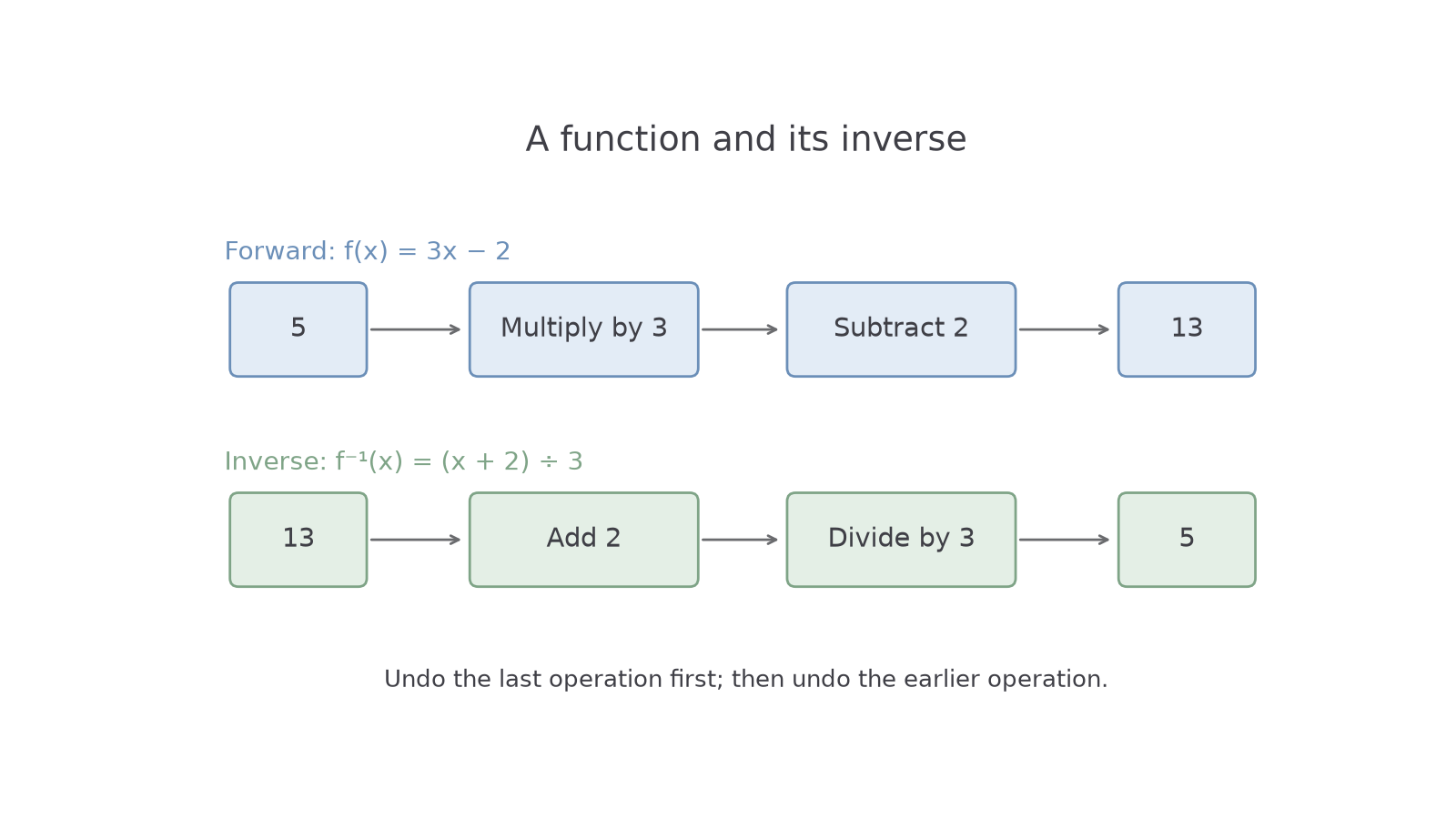
To obtain a formula, write , make the original the subject, then rename the inverse input as .
Worked example 3: an inverse of a linear function
Question. Let , for all real . Find .
Plan. Undo subtracting two, then undo multiplying by three.
Why rename at the end? The inverse input was the original output. The letter in the final answer names that new input.
Answer. , for all real inputs.
Check. , and .
Change only the sign of the constant: the forward function now adds two, so the inverse subtracts it.
Worked example 4: the changed constant
Question. Let , for all real . Find .
Plan. Subtract two before dividing by three.
Why not divide first and then subtract two? That would subtract two from one third of the output rather than undoing the final addition to the tripled input.
Answer. , for all real inputs.
Check. , and .
For a fraction rule, reverse in the same way: gives , then , so its inverse rule is .
Squaring on all real inputs has no inverse function: both and give , so reversing cannot choose one output. Restricting to gives , with inverse domain . Restricting the original to instead gives , again with inverse domain . The original domain decides the branch.
Restrictions also matter for linear functions. If for , its range is . Thus has domain and range .
Watch out
Wrong: . Right: the inverse undoes the function. A reciprocal divides one by its output and usually gives a completely different rule.
Continue this lesson.
You’re previewing NovaLearn without an account. Create a free account to read the rest.
Create free account