G10 - Circle theorems and their proofs
Equal radii, triangle angle facts and congruence explain circle theorems. You will prove the standard results, apply them to angles and lengths, and combine them into complete geometrical arguments.
Angles at the centre and circumference (Higher)
Why does a triangle drawn on a circle's diameter always have a right angle at its third vertex, even when that vertex moves?
Start with a smaller example. If the angle at the centre standing on an arc is , the angle at the circumference standing on that same arc is . The arc, rather than the apparent size of the drawn angles, decides which angles to compare.
You already know
Two equal radii make an isosceles triangle. Its base angles are equal. A triangle's exterior angle equals the sum of its two opposite interior angles.
Let lie on a circle with centre . The angle stands on the arc that does not contain .
Centre and circumference angles
The angle at the centre is twice the angle at the circumference standing on the same arc:
The corresponding centre angle may be reflex.
Not on the formula sheet: learn it.
Why it works
Join , and . Extend to the other end of the diameter, . Write and . Equal radii give and . The exterior angles at are therefore
If and are on opposite sides of diameter , the angle at is . The centre turn through is , twice as large. This turn can be reflex.
If and are on the same side of , subtract the smaller angle instead: the circumference angle is and the corresponding centre angle is . If an endpoint is , just one of the two isosceles-triangle arguments is needed. The same relationship holds in each position.
[DIAGRAM: asset_name: Proving the centre and circumference relationship; asset_slug: 1ma1_m52_centre; caption: Equal radii and exterior angles give twice each part of the circumference angle.; description: An asymmetric circle diagram has centre O, C at the top, D opposite C on the diameter, A on the lower-left circumference and B on the lower-right circumference at unequal positions. Angles ACO and OCB are alpha and beta. Central angles AOD and DOB are twice alpha and twice beta. The two circumference angle parts are unequal, avoiding an isosceles special case for triangle ACB.]
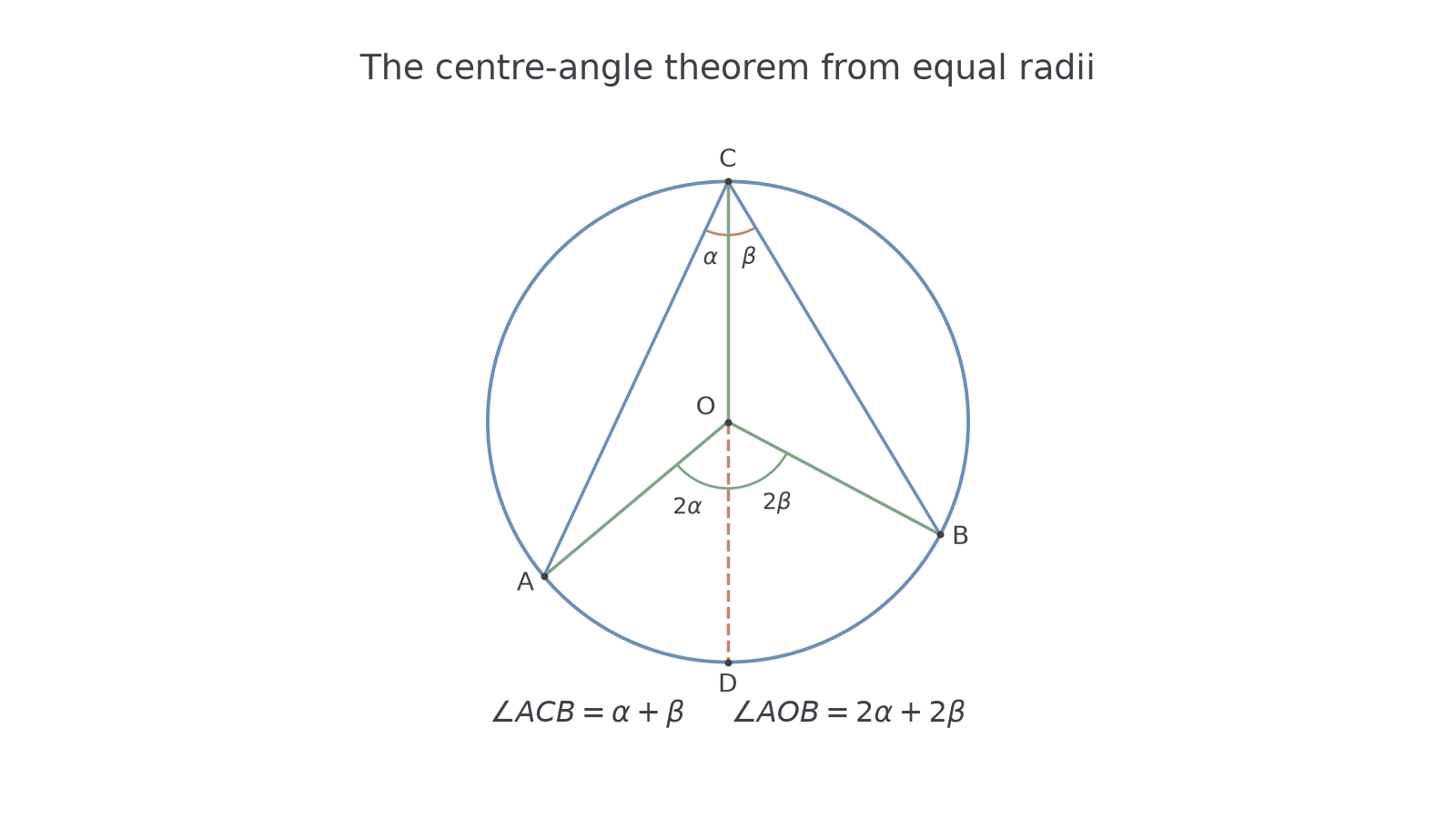
Keep the selected arc in mind throughout the calculation.
Worked example 1: an ordinary centre angle
Question. The centre angle standing on arc away from is . Find .
Plan. Halve the centre angle for that same arc.
Why this step? Both angles stand on the arc not containing .
Answer. .
Check. Doubling gives the supplied .
The next example changes only the centre turn, from to the reflex angle .
Worked example 2: a reflex centre angle
Question. The centre turn standing on arc away from is . Find and the smaller angle between and .
Plan. Halve the specified reflex turn; separately complete the full turn at the centre.
Why this step? The smaller centre angle belongs to the other arc, so halving it would give the wrong circumference angle.
Answer. and .
Check. , and .
If is a diameter, its centre angle is . The angle at any other point on the circle is therefore . This proves the angle in a semicircle theorem and answers the opening question. The semicircle theorem is not on the formula sheet: derive it from the centre theorem.
Watch out
Wrong: for , write “the smaller centre angle is ”. Doubling gives the corresponding reflex turn. Right: the smaller angle is . Name the arc or the reflex angle explicitly.
Only the centre turn changes again in your question.
Same-segment and cyclic-quadrilateral angles (Higher)
Two circumference angles on one chord are equal when their vertices are on the same side of the chord; vertices on opposite sides give a different relationship.
Let and lie on the same side of chord . Both and stand on the same arc on the other side. Each is half the same centre angle, so they are equal. This proves angles in the same segment are equal.
For example, if , then . If also , triangle gives .
Cyclic quadrilateral
A quadrilateral is cyclic when all four vertices lie on one circle. The centre of that circle is not a point on its circumference.
Now place in order around the circle. The angles at and stand on the two different arcs between and . Their corresponding centre turns add to . Halving both gives
This proves that opposite angles of a cyclic quadrilateral sum to . Such angles are called supplementary. The other opposite pair also sums to ; adjacent angles need not.
[DIAGRAM: asset_name: Same segment and cyclic angles; asset_slug: 1ma1_m52_same_segment_cyclic; caption: Same-side angles on a chord are equal; opposite angles of a cyclic quadrilateral are supplementary.; description: Two non-special circle diagrams contrast the results. Left: chord AB and circumference vertices C and D on its same side give equal angles marked x. Right: A, B, C and D occur in order on a circle, with opposite angles at A and C marked alpha and 180 degrees minus alpha.]
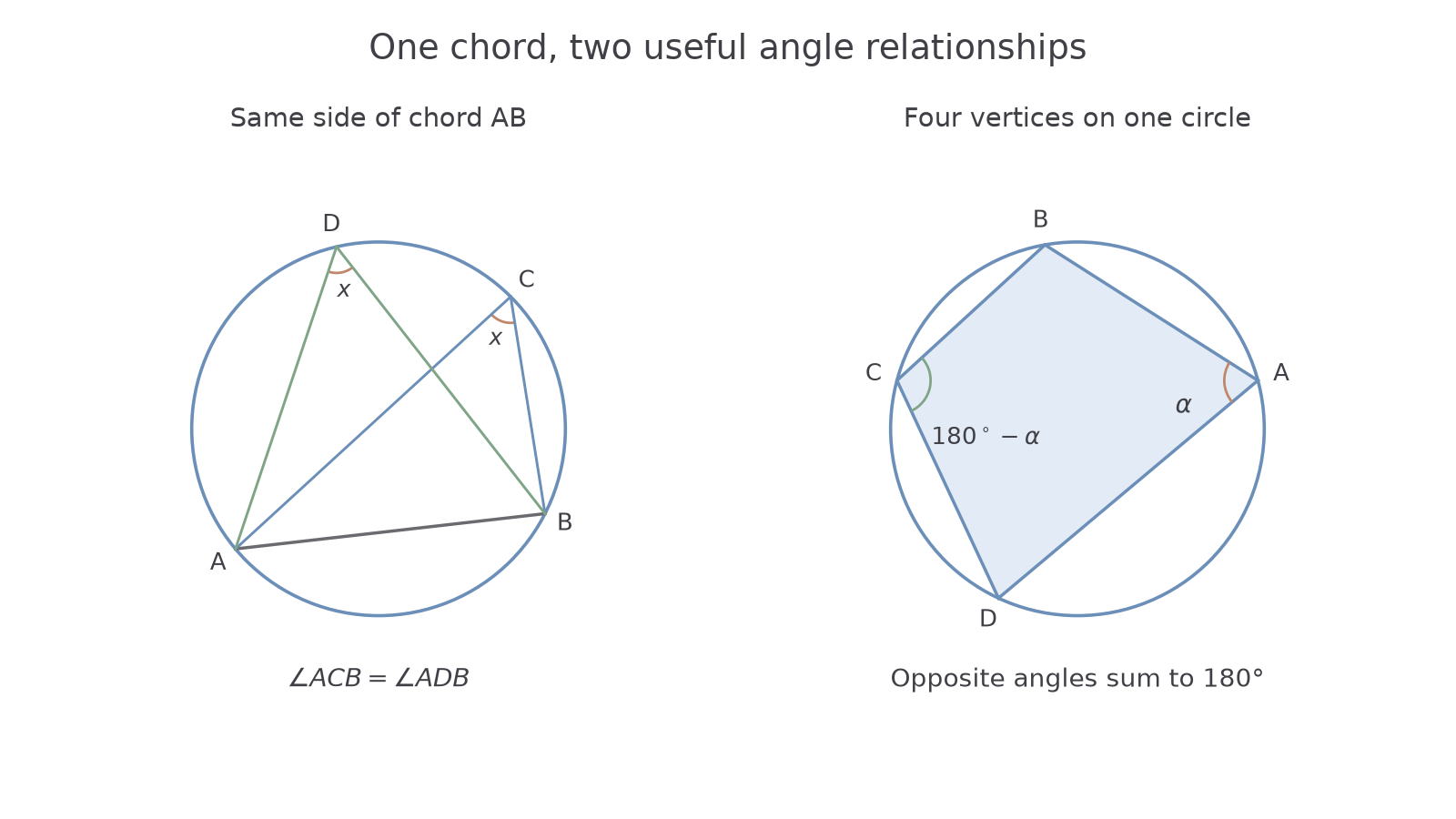
The same-segment and cyclic-quadrilateral theorems are not on the formula sheet: learn them. An exterior angle of a cyclic quadrilateral equals the opposite interior angle: both are supplementary to the same adjacent interior angle. That related result is not on the formula sheet: derive it from the straight-line and cyclic angle sums.
For ordinary numbers, angles at and at give at and at . An exterior angle adjacent to the angle at is . Algebra uses exactly the same opposite-angle sum.
Worked example 3: opposite angles written algebraically
Question. Cyclic quadrilateral has opposite angles degrees at and degrees at . Find and both angles.
Plan. Add the opposite angles to make , then substitute.
Why this step? The angles are opposite, so the cyclic sum applies directly.
Answer. , with angles and .
Check. .
The next example changes only the constant in the angle at , from 22 to 32.
Worked example 4: changing one angle expression
Question. The opposite angles are now degrees and degrees. Find and both angles.
Plan. Use the same opposite-angle equation with the new constant.
Why this step? Changing a given expression changes ; it does not change the theorem.
Answer. , with angles and .
Check. .
Before using a theorem, check exactly which points are on the circle.
Watch out
Wrong: treat quadrilateral , containing the centre , as cyclic just because lie on the circle. The fourth vertex is not on its circumference. Right: identify a quadrilateral with all four vertices on the same circle before using the opposite-angle sum.
For your turn, only the constant in the angle at changes again.
Radii and tangents (Higher)
A tangent is perpendicular to the radius ending at its point of contact, which creates useful right triangles.
Why the angle is a right angle
Let the tangent touch at , and drop the perpendicular from centre to the line at . Suppose . Since the perpendicular is the shortest distance, . Reflect in along the line to a distinct point . The two right triangles have equal legs, so . Then is also on the circle, giving two intersections and contradicting tangency. Hence : the radius meets the tangent at .
Conversely, if a line through is perpendicular to , every other point on that line is farther from than is. It lies outside the circle, so the line is tangent at .
Radius and tangent
At a tangent's contact point ,
The radius must end at the actual contact point.
Not on the formula sheet: learn it.
From an external point , draw tangents touching at and . Triangles and have right angles at , equal radii and common hypotenuse . They are congruent by RHS, so . This proves tangents from the same external point are equal. Corresponding angles also show that bisects the angle between the tangents and the angle between the contact radii. These results are not on the formula sheet: learn the equal-tangent result and derive the angle bisections by congruence.
[DIAGRAM: asset_name: Equal tangents and perpendicular radii; asset_slug: 1ma1_m52_tangents; caption: Equal radii and common hypotenuse give RHS congruence.; description: Tangents from external P meet a circle at A and B. Equal radii OA and OB, common OP, right-angle squares at A and B and matching tangent ticks identify the two congruent right triangles.]
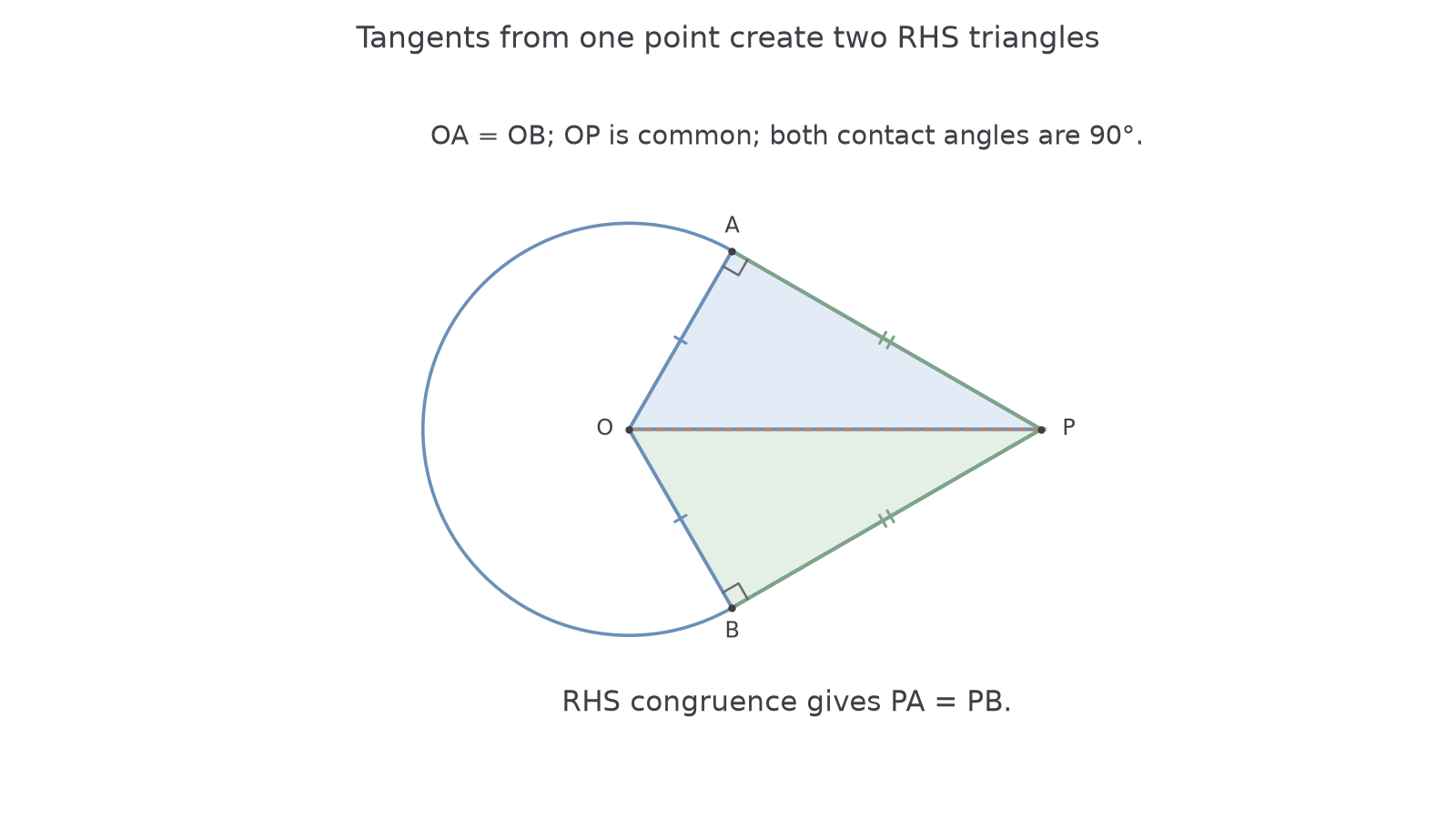
The two right angles also connect the tangent angle to the smaller centre angle.
Worked example 5: the angle between tangents
Question. Tangents touch a circle with centre . The smaller . Find .
Plan. Use the two contact right angles in quadrilateral .
Why this step? The quadrilateral includes both radii and both tangent segments.
Answer. .
Check. The tangent angle and smaller centre angle add to .
The next example changes only the smaller centre angle, from to .
Continue this lesson.
You’re previewing NovaLearn without an account. Create a free account to read the rest.
Create free account