N5, N6 - The product rule and estimates of roots
Count successive choices efficiently, including choices with restrictions. Use familiar powers and carefully chosen trial values to locate unfamiliar roots and justify their rounding.
Counting successive choices (Higher)
A two-letter code uses A, B, C, D or E, followed by a digit from . How many codes disappear if repeated letters are forbidden? A complete list would work, but multiplication is quicker.
You already know
A systematic list fixes one choice, lists every allowed continuation, then moves to the next choice. Decide whether order and repetition matter before counting.
Suppose a café has three sandwiches A, B and C and two drinks X and Y. Its meals are AX, AY; BX, BY; CX, CY. Every sandwich has two continuations, so there are meals. Adding counts menu options rather than complete meals.
The product rule for counting
If there are ways to do one task and, for each, ways to do the next task, there are ways to do both tasks. For more stages, multiply by the number of choices available at each stage.
Each product must count every complete outcome exactly once, and the number of continuations must be constant within the group being counted.
Not on the formula sheet: learn it.
For example, three shirt colours, four trouser styles and two shoe styles give outfits if all combinations are allowed. The actual choices may depend on an earlier choice; a single product still works when the number of continuations remains constant.
Worked example 1: repeated letters allowed
Question. A code has two letters chosen from A, B, C, D and E, followed by one digit chosen from . Letters may repeat. How many codes are possible?
Plan. Count the choices for each position and multiply.
Why multiply? Every letter pair can be followed by each of the three digits, producing a different complete code.
Answer. codes.
Check. For each fixed first letter, there are endings. Five such groups give .
Change only the repetition rule. The first letter is still unrestricted, but the second must now differ from it.
Worked example 2: repeated letters forbidden
Question. Use the same letters and digits, but require the two letters to be different. How many codes are possible?
Plan. Reduce the second letter's choice count, keeping the other counts unchanged.
Why can we still use one product? The available second letters depend on the first, but there are always exactly four of them.
Answer. codes.
Check. There were codes with matching letters. Removing them from gives .
If different first choices give different continuation counts, split into cases and add. If sandwich A permits X and Y, B permits only X, and C permits X, Y and Z, the meal count is . There is no single number of drinks per sandwich to multiply by three.
Watch out
Wrong: using for two different letters. That includes AA, BB, CC, DD and EE. Right: use , before counting any extra positions.
Change only the available letter set from five letters to four.
Order, repetition and excluded cases (Higher)
Restrictions often make one position a better starting point than another. Choose the position that controls the permitted outcomes.
A three-digit number cannot start with zero, although a three-character code can if its rules allow it. Repeated digits are another separate decision. Do not assume a condition that has not been stated.
Worked example 3: excluding a leading zero
Question. How many three-digit numbers can be made from , using no digit more than once?
Plan. Choose the hundreds digit first, then count the remaining digits at each position.
Why is the second count also three? After using one non-zero digit, zero becomes a valid choice in the tens position.
Answer. .
Check. Allowing leading zero would give codes. Exactly of these start with zero, leaving .
Change only the parity condition: require the number to be even. The units digit now controls the cases.
Worked example 4: an additional even-number restriction
Question. How many three-digit even numbers can be made from , with no repeated digit?
Plan. Split into numbers ending in zero and numbers ending in two, then add the disjoint counts.
Why split the units choices? Ending in zero leaves three possible hundreds digits; ending in two leaves only two. A single shared hundreds count would be wrong.
Answer. .
Check. The first case gives ; the second gives . These are ten distinct valid numbers.
If repetitions were allowed in the unrestricted three-digit-number task, the count would instead be . If order does not matter, explain any division used to remove duplicates. Choosing a captain and vice-captain from six people gives outcomes. Choosing an unordered pair gives : each pair appeared twice, once in each order. Larger groups need their own analysis; halving is not a universal rule.
Sometimes subtracting forbidden cases is simpler. Two-letter codes from A, B, C and D with repetition give outcomes. Removing AA, BB, CC and DD leaves , agreeing with .
Watch out
Before multiplying, check each restriction after earlier choices have been made. Zero may be allowed later even when it is forbidden first. Cases added together must be disjoint and cover every permitted outcome.
Change only “even” to “odd” in the second example. Keep the same digits and no repetition.
Bounding powers and roots (Higher)
Known powers can bracket an unfamiliar root. For positive numbers, raising to a fixed positive integer power preserves order.
Bounding a root
To bound a root, find a lower and an upper value whose corresponding powers lie either side of the input. For example, implies .
Closer trial values give tighter bounds. To round, test the halfway boundary as well: an interval between two consecutive tenths may cross that boundary.
Worked example 5: estimating a square root
Question. Show that , then give to one decimal place.
Plan. Compare the trial squares with , then test the rounding boundary .
Why test ? The bounds and alone do not tell us which tenth is nearer. The trial square shows that the root is below the halfway point.
Answer. , and to one decimal place.
Check. , so the finer interval agrees with the whole-number bounds.
The graph connects each trial input to its square. The intersection with lies between the two vertical guides.
[DIAGRAM: asset_name: Bounding a square root using trial squares; asset_slug: 1ma1_m05_root_bounds; caption: Trial squares locate the root of 60 between 7.7 and 7.8.; description: The graph y equals x squared from x equals 7 to 8 shows a horizontal line at y equals 60 crossing between x equals 7.7, whose square is 59.29, and x equals 7.8, whose square is 60.84. Vertical guides mark the two trial values.]
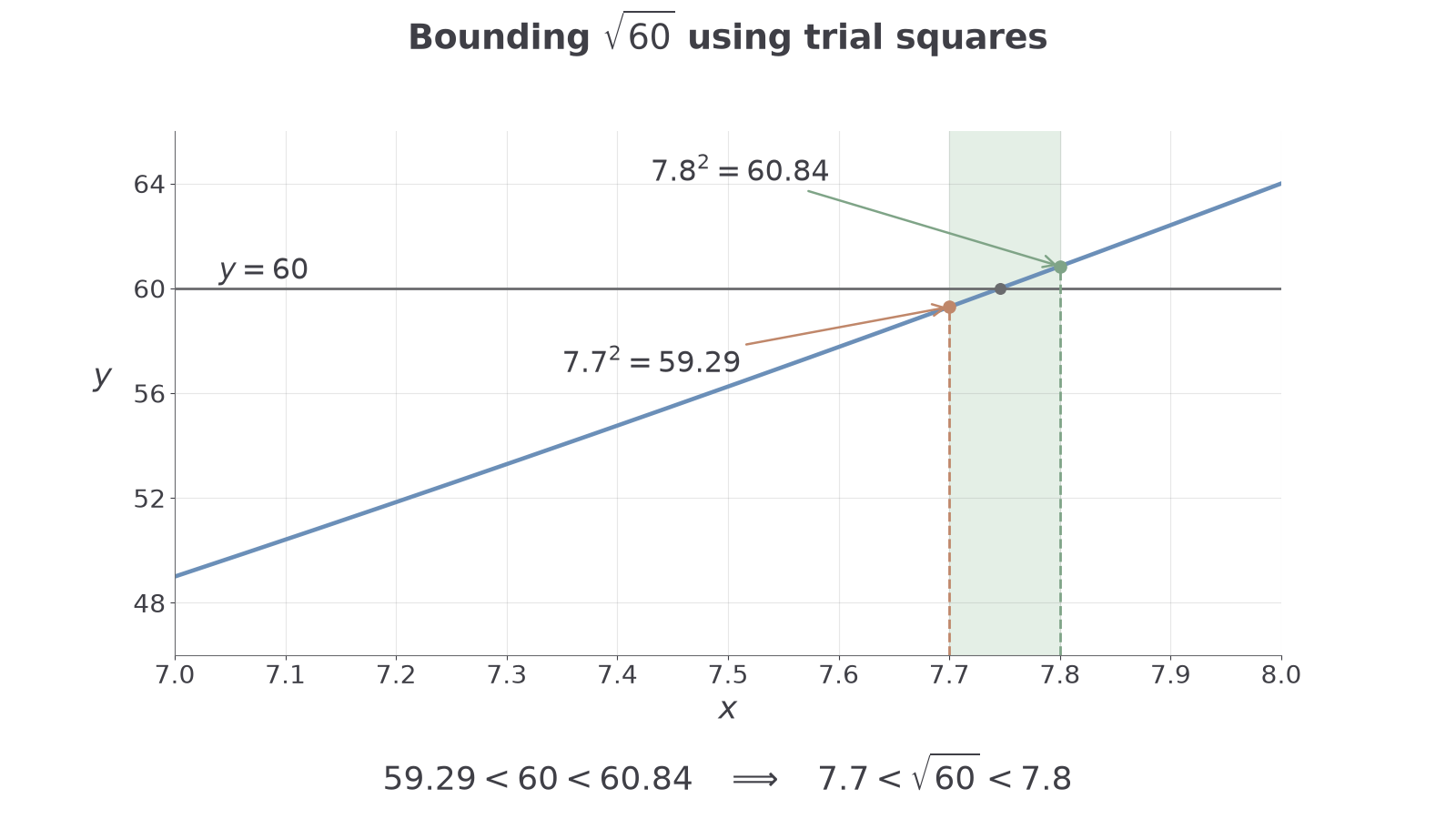
Change only the root's order from square root to cube root, keeping the input . Use cubes for the comparisons.
Worked example 6: estimating a cube root
Question. Bound between consecutive tenths, then give it to one decimal place.
Plan. Locate it between consecutive whole numbers, refine with tenths, then test their midpoint.
Why cube the midpoint? Cubing preserves order here, so its position relative to tells us which side of contains the root.
Answer. , and to one decimal place.
Check. is just below , while is above it. The lower tenth is therefore a credible approximation.
The method works for other inputs and roots. Since , the cube root of lies between and . The trials and refine this to . Also, gives .
Small positive values work too: , so . A number between zero and one becomes smaller when squared, while its square root is larger than itself.
You can bound powers in the opposite direction. If , then and . Using to estimate overestimates it. Powers are not linear: a root's position is not found by simply copying the input's fraction of the gap between consecutive powers.
Watch out
Knowing does not by itself justify rounding down. The interval crosses . Compare with to decide.
Keep the cube-root method from the second example, and change only its input.
Quick Recap
- Multiply successive choice counts when each earlier choice has the stated number of continuations.
- Split into disjoint cases when restrictions change those counts; check order, repetition and leading zero.
- Bound roots using corresponding powers, then test a rounding boundary when needed.
For the opening code, forbidding repeated letters removes codes.