N8, N9 - Exact multiples of pi and standard form
Keep exact values intact and write very large or small numbers compactly. N8 develops exact calculations with fractions and multiples of pi; N9 develops standard form, its four operations and sensible interpretation of calculator displays.
Exact values and multiples of pi
A circle has radius . Is its circumference exactly , exactly , or neither? The distinction matters whenever a question asks for an exact answer.
You already know
Equivalent fractions have the same value. To add fractions, use a common denominator; to simplify a fraction, cancel common factors.
An exact value preserves the exact quantity. Thus is exact, while is an approximation. Three copies of the fraction give exactly one; three copies of that finite decimal give . A small rounding error can survive a calculation.
Exact multiple of pi
An expression such as or keeps the circle constant exact. Neither nor equals ; both are approximations.
Treat as a common factor: add the coefficients, or cancel a factor appearing in numerator and denominator. For example, , , and .
Circle circumference
Here is the radius and the diameter of a circle.
On the formula sheet (2026 version; the 2027 sheet will have the same content).
Keeping in the working answers the opening question without guessing a final decimal digit.
Worked example 1: retaining an exact circumference
Question. Find the circumference of a circle of radius , exactly and to two decimal places.
Plan. Substitute into the circumference formula, retaining until the decimal answer is needed.
Why? Keeping avoids replacing the circle constant by a nearby number.
Answer. Exactly ; approximately .
Check. is close, but it is not the exact circumference.
Change only the radius to . The circumference should become ten times smaller.
Worked example 2: changing the scale of the circle
Question. Find the circumference for radius , exactly and to two decimal places.
Plan. Use the same formula and postpone rounding.
Why? A fractional coefficient is still an exact multiple of .
Answer. Exactly ; approximately .
Check. The exact answer is one tenth of , as expected.
The same care works when combining exact lengths: . Use for equal values and for rounded ones.
Watch out
Wrong: . Right: . An answer containing is complete when an exact value is requested.
Now change the radius once more and keep both kinds of answer distinct.
Writing large and small numbers in standard form
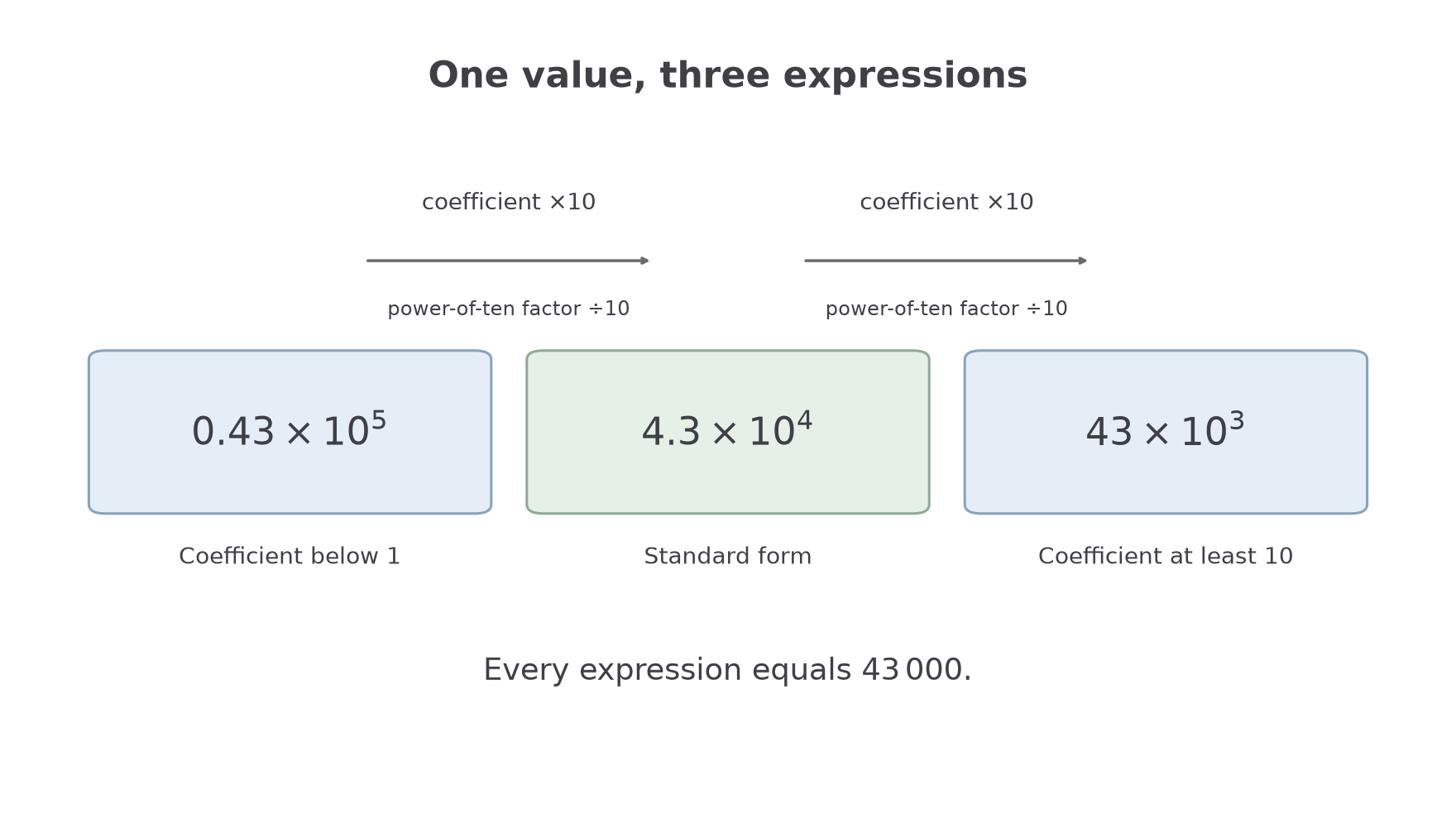
Standard form separates a number's digits from its scale. For , use multiplied by .
Standard form
A positive number in standard form is , where and is an integer. The coefficient carries the significant digits.
A negative exponent means division by a power of ten, not a negative value. The coefficient condition makes the representation unique.
[DIAGRAM: asset_name: Keeping a standard-form value unchanged; asset_slug: 1ma1_m07_standard_scale; caption: Multiplying the coefficient by ten requires dividing the power-of-ten factor by ten.; description: Three equal-value expressions 0.43 times 10 to the 5, 4.3 times 10 to the 4 and 43 times 10 to the 3 show coefficient changes opposite to exponent changes. Only the middle expression has coefficient at least one and below ten. All three equal 43000.]
Worked example 3: a large number
Question. Write in standard form, then convert it back.
Plan. Choose a coefficient between one and ten and count the power-of-ten scale.
Why? has the same value, but its coefficient is too large.
Answer. .
Check. Four place changes take to .
Change only the size: keep the digits , but use a number below one.
Worked example 4: a small number
Question. Write in standard form, then convert it back.
Plan. Keep the same coefficient and use a reciprocal power of ten.
Why? The value is positive and below one, so its exponent is negative.
Answer. .
Check. .
The same digits can describe numbers a hundred million times apart: . The exponent carries that enormous difference.
Values between one and ten use exponent zero: . One is an allowed coefficient; ten is not, so . For a negative quantity, put a minus sign before the standard form of its magnitude, such as . Zero has no representation satisfying the coefficient condition; write it normally.
Watch out
and both equal , but neither is standard form. Check value and coefficient separately.
The next conversion changes just the digits in the small number.
The four operations in standard form
The operation decides what happens to the powers. Products multiply coefficients and add exponents; quotients divide coefficients and subtract exponents. Sums and differences first need a common power of ten.
Powers of ten in products and quotients
Here and are integers. These rules apply to products and quotients.
Not on the formula sheet: learn it.
For addition and subtraction, . Similarly, . Matching scales is like finding a common denominator.
Worked example 5: choosing rules for four operations
Question. Let and . Work out , , and in standard form.
Plan. Use index laws for the product and quotient; rewrite on the scale for the sum and difference.
Why? Subtracting a negative exponent gives ; dividing by increases the number.
Answer. The four results are , , and .
Check. Ordinary numbers give and . Adding or subtracting barely changes .
Change only the exponent of , from to . This makes addition much easier, but the same rules still apply.
Worked example 6: changing one exponent
Question. Now let and . Find the same four results.
Plan. Keep the product and quotient rules; the sum and difference already have matching scales.
Why? The difference is negative because ; normalising must not lose that sign.
Answer. , , and .
Check. and .
In a longer calculation keep brackets around each complete standard-form value. For instance, . A difference can be zero; leave zero as zero.
Watch out
Wrong: . Addition does not add exponents. The correct sum is .
Change only the coefficient of in the matched question.
Scale, calculator displays and units
A calculator display still needs to be read as a quantity, with an exponent and a unit. “6.2E−5” means , not . Use your calculator's exponent-entry key and check a manageable entry first.
For positive standard-form values, compare exponents first, then coefficients if exponents match. Thus , while . A difference of two exponents suggests hundreds, but coefficients still affect an exact ratio: .
Worked example 7: reading a display and converting units
Question. An instrument displays “4.5E−3 mg”. Write the mass as an ordinary number in milligrams, then in grams. Use .
Plan. Interpret the display before converting its unit.
Why? Standard form changes notation; it does not itself change milligrams into grams.
Answer. .
Check. .
Change only the display exponent from to . Both masses should become ten times larger.
Worked example 8: checking a display's scale
Question. Convert “4.5E−2 mg” to ordinary numbers in milligrams and grams.
Plan. Use the same two separate steps.
Why? Increasing the exponent by one multiplies the value by ten, even when both exponents are negative.
Answer. .
Check. Each answer is ten times its counterpart in Example 7.
Units travel through calculations too: for the total energy of that many pulses. Retain digits until the end: , which is to three significant figures. Extra display digits do not make approximate inputs exact.
Watch out
Wrong: “4.5E−2 mg” means . The display still uses milligrams. Right: it means . Reading notation and converting units are separate steps.
The next display changes only its coefficient.
Quick Recap
- Keep fractions and exact until a decimal approximation is requested.
- Standard form is , with and integer .
- Products and quotients use index laws; sums and differences need matching scales.
- Interpret calculator exponents, retain units and round only at the end.
The opening circumference is neither decimal exactly: it is exactly , approximately .