A12, A13, A14 - Exponential, trigonometric and transformed graphs
A12 introduces graphs of repeated multiplication and repeating cycles. A13 moves and reflects a given graph, while A14 uses exponential graphs in context. You will recognise the shapes, find graph intersections and track important points without recalculating a whole table.
Exponential growth and decay (Higher)
A savings balance starts at £100 and is multiplied by 1.1 at each year end. When does it first exceed £125? Adding £10 each year would predict a different answer from multiplying the latest balance.
You already know
for , and . A negative exponent does not make a positive base's output negative.
An exponential function has its input in the exponent. For , equal increases of 1 in the input double the output. At inputs , the outputs are . The differences are not constant, so this is not a straight line.
For , the base is positive. If , the graph increases. If , it decreases. For , it is simply the horizontal line . Every such graph passes through . A growth or decay curve stays positive, approaching the asymptote in one direction without reaching it.
[DIAGRAM: asset_name: Exponential growth and decay; asset_slug: 1ma1_m26_exponentials; caption: Growth doubles and decay halves the output for each unit increase in input.; description: The graph plots y equals 2 to the power x in blue and y equals one half to the power x in sage, with their shared intercept (0,1), representative integer-input points and horizontal asymptote y equals 0.]
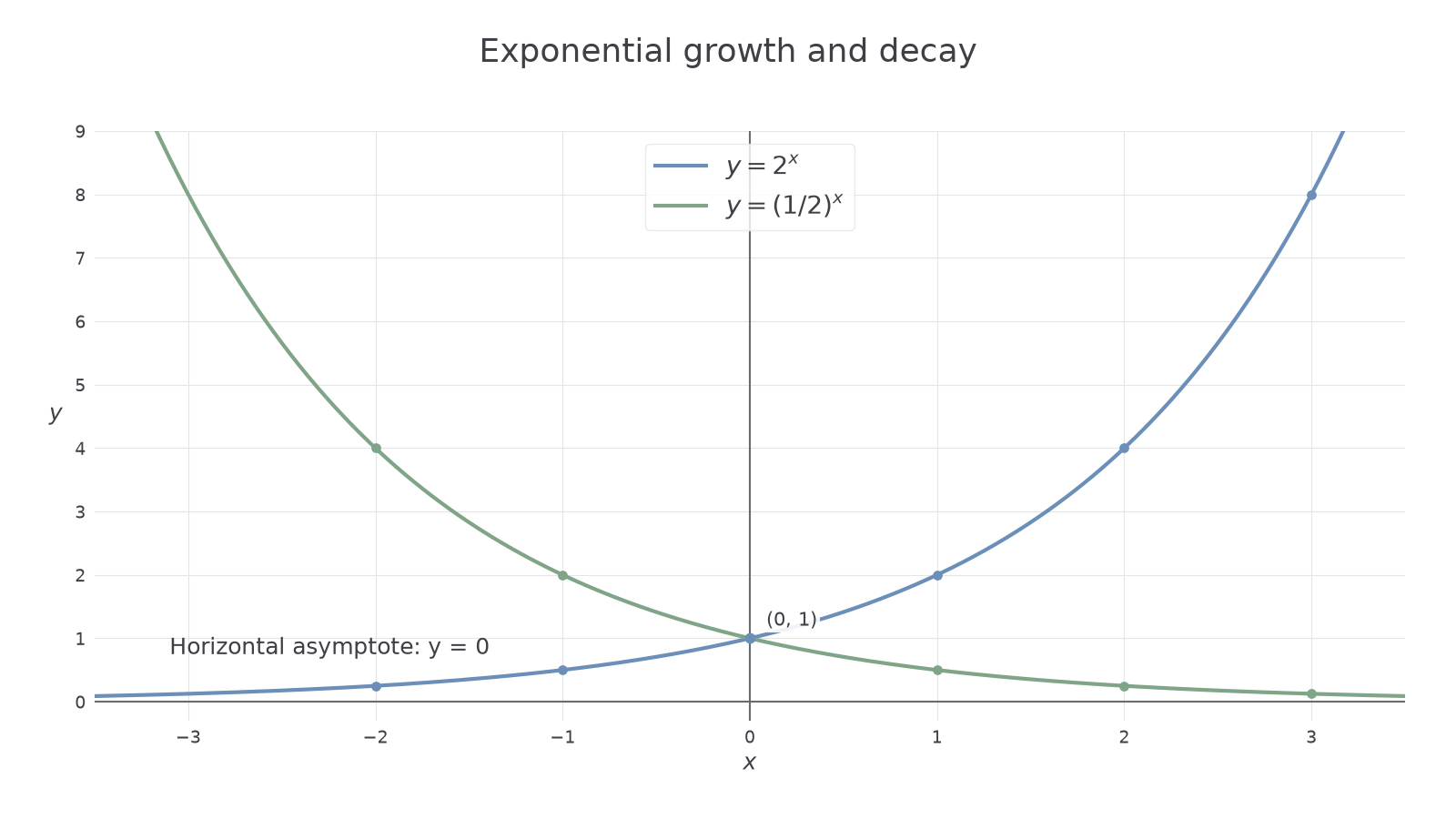
For the decay graph , the same inputs give . Notice that : these two curves are mirror images in the vertical axis.
Worked example 1: interpret exponential growth
Question. A balance is pounds, with interest added only at whole-year dates. When does it first exceed £125?
Plan. Calculate successive year-end balances until the target is passed.
Why this step? Only the payment dates count in this model; an intersection between them is not a payment date.
Answer. It first exceeds £125 after 3 years.
Check. £121 is below £125, but £133.10 is above it.
Change only the yearly multiplier, from 1.1 to 1.2. Keep the opening balance, target and payment dates.
Worked example 2: change the growth multiplier
Question. For pounds at whole-year dates, when does the balance first exceed £125?
Plan. Compare successive year-end values with the same target.
Why this step? Repeated multiplication adds a larger amount in the second year; it does not add a fixed £20 forever.
Answer. After 2 years.
Check. , so the second payment date is the first that works.
If a context explicitly defines continuous growth between dates, a smooth graph can estimate a fractional time. For the first rule, crosses near . That is different from asking for the first whole-year payment date.
To sketch a pure exponential, plot a table including negative, zero and positive inputs, then draw a smooth curve. Preserve the positive outputs and the intercept . Do not join a small output to the origin or confuse with .
A coordinate can also determine an unknown base. If passes through , then , so and . Substitute both coordinates before rearranging.
Watch out
The line confuses a negative exponent with a negative output. Use the reciprocal: .
Keep the target word “exceeds” in mind in the next savings model.
Sine, cosine and tangent in degrees (Higher)
Trigonometric graphs repeat because a full turn returns to the same direction. Use degrees, including degree mode on your calculator.
Period
The period is the smallest positive input shift that repeats the whole graph. Sine and cosine have period ; tangent has period .
Sine and cosine stay between and 1. These quarter-turn values anchor their smooth waves.
| , degrees | 0 | 90 | 180 | 270 | 360 |
|---|---|---|---|---|---|
| 0 | 1 | 0 | 0 | ||
| 1 | 0 | 0 | 1 |
Sine starts at zero and rises; cosine starts at its maximum. Repetition works for any angle: , , and . A negative input does not force a negative output; .
Tangent is where . It is undefined at , for integer , giving vertical asymptotes. It crosses zero at multiples of and increases along each separate branch. Useful points are . Tangent has no upper or lower output bound.
[DIAGRAM: asset_name: Degree-based trigonometric graphs; asset_slug: 1ma1_m26_trigonometry; caption: Sine and cosine repeat every 360 degrees, while tangent repeats every 180 degrees with vertical asymptotes.; description: Three aligned panels show sine and cosine from minus 180 to 540 degrees with key quarter-turn values, and tangent on separate intervals with dashed asymptotes at minus 90, 90, 270 and 450 degrees. Tangent branches are clipped to the displayed vertical range, not joined across asymptotes.]
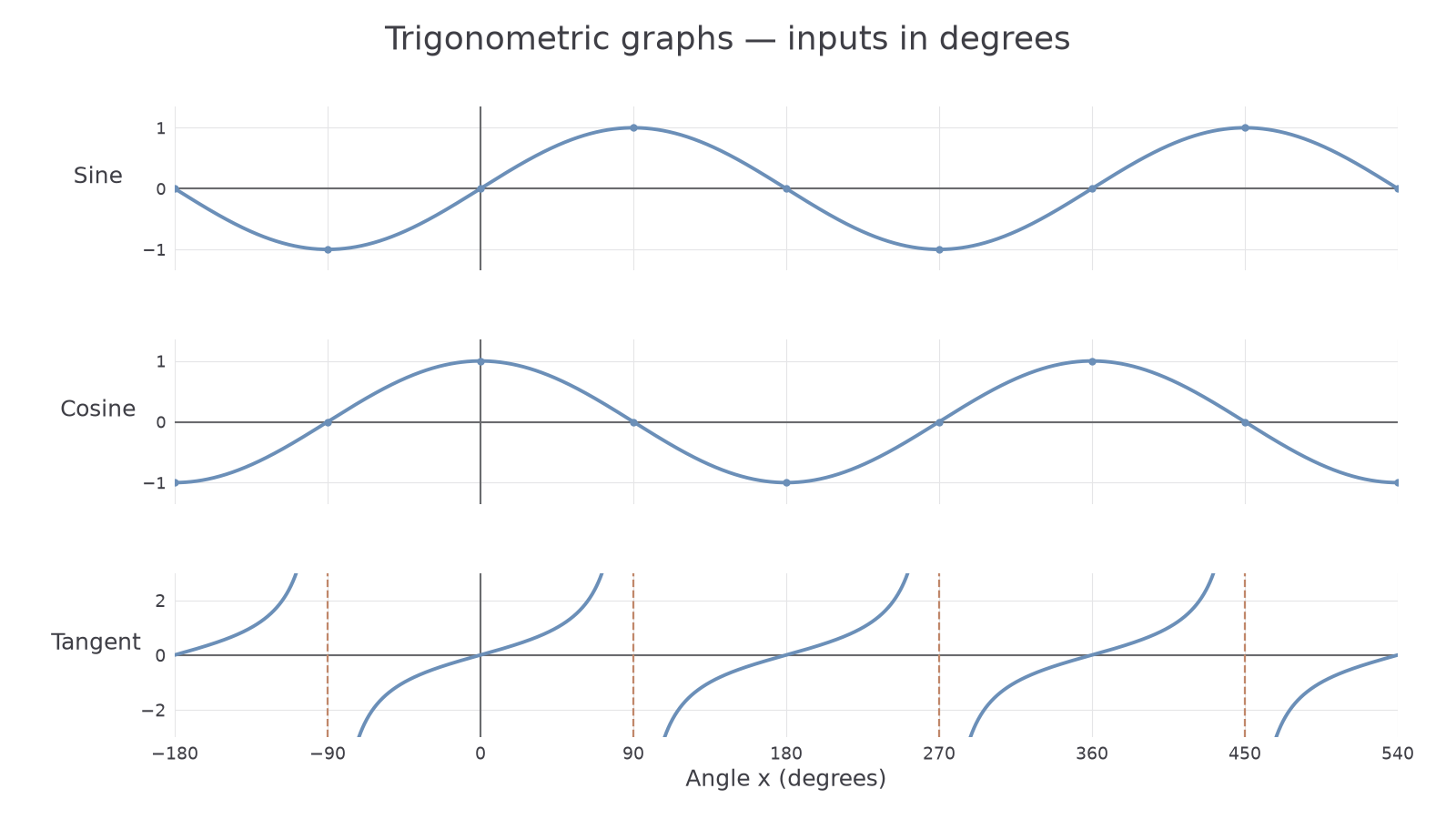
To solve an equation, imagine drawing its horizontal target level. Find every intersection inside the given interval, including endpoints if they work.
Worked example 3: both sine intersections
Question. Solve for .
Plan. Find a reference angle and use the positive parts of the sine wave.
Why this step? The inverse button supplies one angle, while the horizontal line crosses the wave twice.
Answer. and .
Check. Both have sine 0.5; neither endpoint has sine 0.5.
Change only the sign of the target. The reference angle stays the same, but the intersections move to the negative half of the wave.
Worked example 4: a negative sine target
Question. Solve for .
Plan. Use reference angle and the third and fourth quadrants.
Why this step? Using alone ignores the stated interval and misses an intersection.
Answer. and .
Check. The sine wave is below the axis at both positions, with value .
For a longer or negative interval, first find solutions in a full turn, then add or subtract periods and retain only values in range.
Worked example 5: cosine beyond one turn
Question. Solve for .
Plan. Find the two full-turn cosine solutions, then check shifted copies.
Why this step? The interval includes part of a previous turn. Stopping at the positive solutions misses one.
Answer. .
Check. Subtracting from 120 gives , outside the interval; all three retained values have cosine .
Continue this lesson.
You’re previewing NovaLearn without an account. Create a free account to read the rest.
Create free account