A22 - Regions and quadratic inequalities
Some inequalities select coordinate regions; others select intervals on a number line. You will use boundary lines, overlaps and quadratic signs to find these solutions, then express them clearly using set notation.
Boundary lines and half-planes (Higher)
A point passes the rules , , . Does pass too? We need a picture that combines all the rules, starting with the region for one inequality.
You already know
Two points determine a straight line. A strict inequality excludes equality; an inclusive inequality allows it. Dividing an inequality by a negative reverses its direction.
For , and lie on the boundary . The point is above it and satisfies the inequality, while does not.
Boundary and half-plane
A straight boundary divides the coordinate plane into two half-planes. A linear inequality selects one side. Use a dashed boundary for or , and a solid boundary for or .
“Above” and “below” are easiest after making the subject. Keep track of negative division.
Worked example 1: a strict half-plane
Question. Describe the boundary and solution region for .
Plan. Rearrange into -form, then use the sign to choose the side and line style.
Why reverse? Division by a negative reverses order.
Answer. Draw the dashed line , through and , and select the half-plane above it.
Check. The origin gives , true, and lies above the boundary.
Change only the strict sign to an inclusive one. The side remains the same.
Worked example 2: including the boundary
Question. Describe the region for .
Plan. Rearrange as before, retaining equality.
Why use a solid line? Every boundary point now satisfies equality.
Answer. The solid boundary is ; select on or above it.
Check. gives , so the boundary is included.
A test point works without rearranging. For , draw a solid line through and . The origin satisfies , so select its side. The point fails because . Never choose a test point on the boundary: it cannot distinguish the two sides.
For a vertical line, selects on and right of . For a horizontal line, selects below the dashed line . Draw a boundary with a ruler and label the permitted side clearly.
Watch out
Use a test point off the boundary. Decide the side and line style separately: the sign's equality bar affects inclusion, not which side is allowed.
Change only the right-hand constant from Worked example 2.
Common regions and feasible points (Higher)
Several simultaneous inequalities require their common overlap: every condition must hold.
For , , , draw each boundary and select its allowed side. The overlap is the triangle shown.
[DIAGRAM: asset_name: Intersection of three inequality regions; asset_slug: 1ma1_m33_feasible_region; caption: The shaded overlap is right of x = 1, above y = 1, and on or below x + y = 6.; description: Coordinate axes show a blue solid vertical boundary x = 1, clay dashed horizontal boundary y = 1 and blue solid descending boundary x + y = 6. A pale sage triangular overlap has open corners at (1, 1) and (5, 1), a filled corner at (1, 5), and a filled interior point (2, 3).]
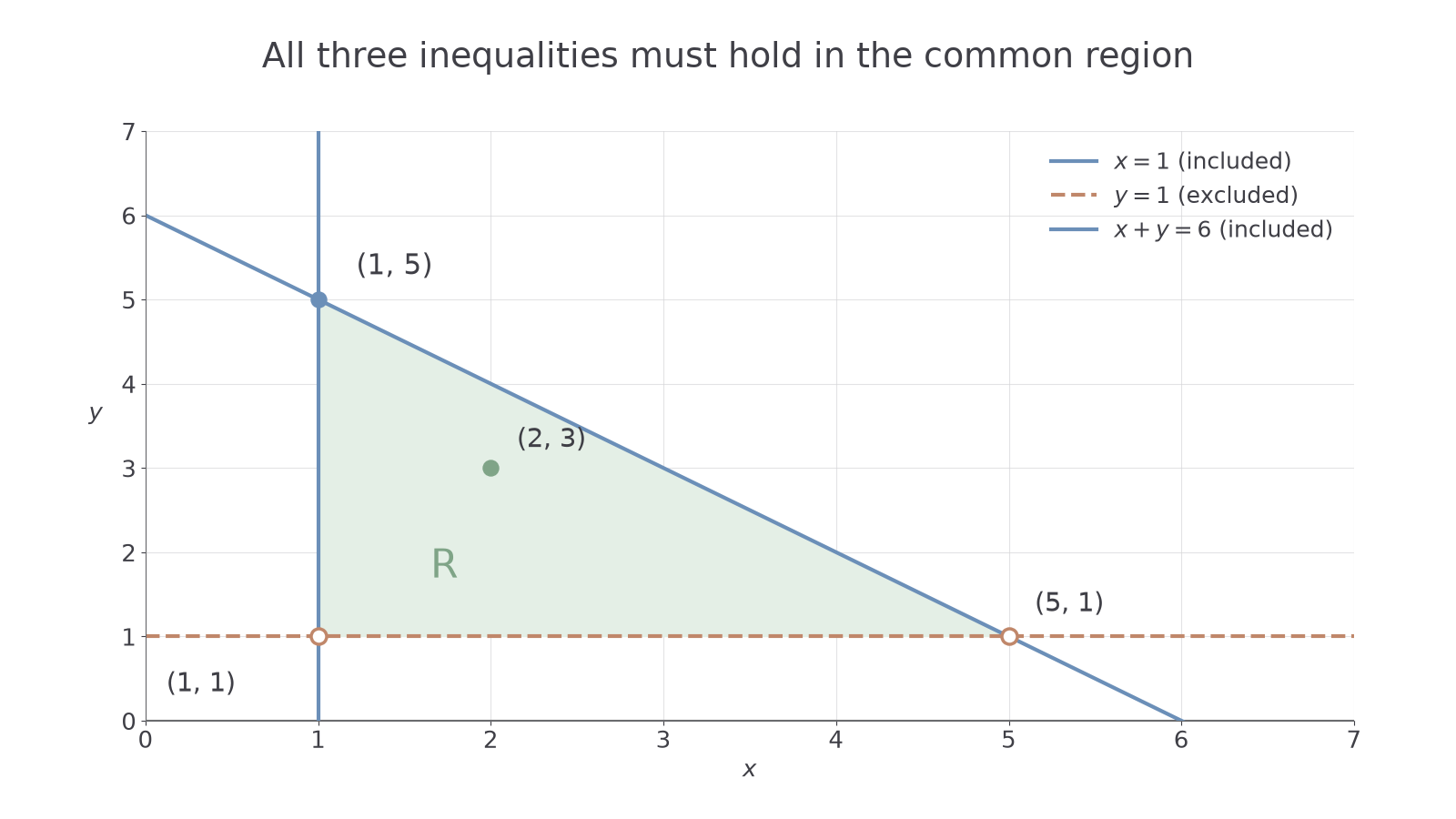
Its limiting corners are , and . The two on are excluded. The corner is included because it satisfies all three rules.
Feasible point
A feasible point satisfies every stated condition. The feasible region contains all such points. If the variables count objects, only integer-coordinate points in the region may be permitted.
To check a candidate, test every condition, even if its position looks convincing.
Worked example 3: passing all conditions
Question. Does satisfy , , ?
Plan. Substitute both coordinates into all three comparisons.
Why check all three? Membership requires their overlap.
Answer. Yes, the point is feasible.
Check. It lies inside the shaded triangle, away from excluded boundaries.
Change only the horizontal coordinate from 2 to 4.
Worked example 4: failing one condition
Question. Does satisfy the same inequalities?
Plan. Repeat the three substitutions.
Why stop short of calling it feasible? Passing two rules does not compensate for failing the third.
Answer. No; it lies beyond .
Check. At , the sum rule allows only ; the candidate has .
To draw this region yourself, plot the three boundaries on squared paper, mark solid and dashed lines and label their overlap R. State that your shading represents the permitted region. A point on one solid boundary is allowed only if it passes every other rule.
For integer-coordinate counts, work systematically by rows or columns. With , , , the possible -values are . They allow respectively integer -values. The total is . Points on are excluded.
Incompatible conditions can leave no region: and cannot hold together.
Watch out
Wrong: a point is feasible because it passes two of three rules. It must pass all three. An excluded boundary also stays excluded where it meets an included one.
Change only the horizontal coordinate again.
Continue this lesson.
You’re previewing NovaLearn without an account. Create a free account to read the rest.
Create free account