N11, R3, R4, R5, R6, R7, R8 - Ratios, fractions and proportional sharing
Ratios describe relative amounts rather than fixed totals. You will connect ratios to fractions and linear relationships, share quantities, combine linked ratios and track changes to mixtures. These methods help you keep a recipe's flavour while changing its size.
Ratio notation and multiplicative relationships
Can two drinks with different amounts of concentrate taste equally strong? A drink with concentrate to water and one with have the same composition: the second doubles both ingredients. Adding one part of each instead gives , which changes the flavour.
You already know
Equivalent fractions have equal values. Multiplying the numerator and denominator by the same non-zero number preserves a fraction's value; the same idea preserves a ratio.
The order of the names sets the order of the numbers. Concentrate to water means two equal-sized parts of concentrate for every three of water. It says nothing about the size of each part.
Equivalent ratios
Equivalent ratios compare the same quantities in the same order and are made by scaling every term by the same non-zero factor. For positive amounts use a positive factor. For example, , whereas is different.
The ratio also gives a multiplier: water is times concentrate, and concentrate is times water. To simplify comparable measurements, use the same unit first. To clear decimals, scale all terms by a power of ten: . For three terms, scale all three: . These ratio rules are not on the formula sheet: learn them.
Worked example 1: a ratio with equal units
Question. Simplify .
Plan. Convert metres to centimetres, then divide both terms by their highest common factor.
Why this step? A ratio of lengths compares equal units, so would compare the wrong amounts.
Answer. .
Check. and .
The second example changes the form of the given terms to fractions. Equal scaling still does the work.
Worked example 2: fractional terms and a leading one
Question. Express in simplest whole-number form and then in the form .
Plan. Clear both denominators, then divide both terms by the first term.
Why this step? The form requires the first term to be one; it does not require the second to be a whole number.
Answer. , then .
Check. Both ratios have first term divided by second equal to .
A ratio has to preserve a multiplier, rather than a difference.
Watch out
Wrong: , because one was added to both terms. The fractions and differ. Correct: multiply both terms by the same factor, for example .
Try the fractional version with a different first term.
Part-to-part and part-to-whole fractions
The denominator of a fraction tells you what you are comparing with, so name it before calculating.
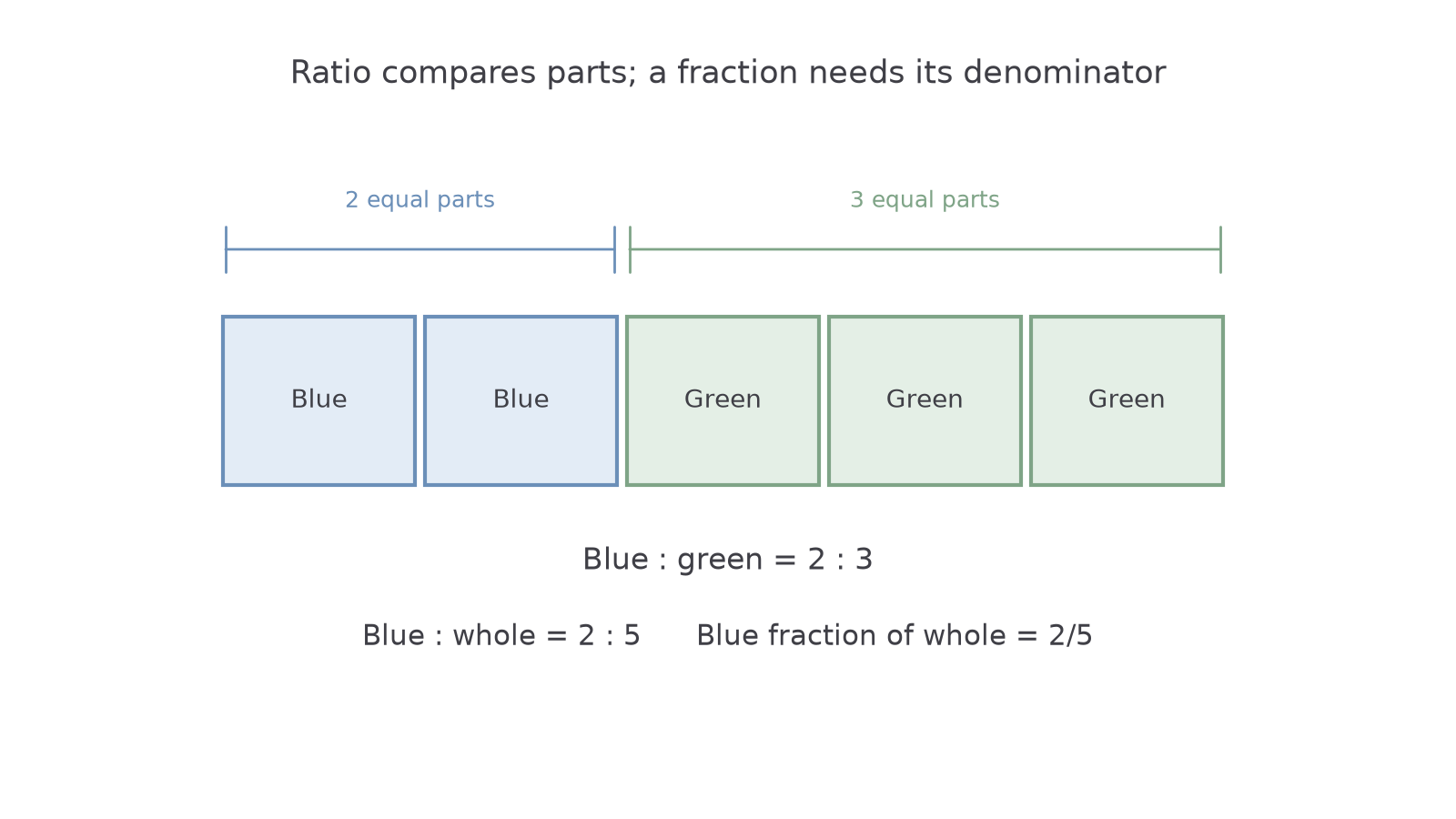
For blue to green , blue is of green but of the whole. Green is of blue: a comparison fraction can exceed one.
[DIAGRAM: asset_name: Part-to-part and part-to-whole ratios; asset_slug: 1ma1_m36_ratio_parts; caption: Two blue parts and three green parts make five parts altogether.; description: Five equal rectangles, the first two blue and the final three green, distinguish blue to green 2 to 3 from blue to total 2 to 5.]
One quantity as a fraction of another
Divide the first quantity by the comparison quantity, using common units. A part-to-whole fraction uses the complete total as its denominator; a part-to-part fraction uses the named other part.
If a collection contains only red and white beads and are red, the remaining are white. Thus red to whole is and red to white is . You need the word “only”: if there are other colours, their split cannot be inferred.
Worked example 3: choosing the denominator
Question. Two ribbons are and long. Express the shorter as a fraction of the longer and of the total.
Plan. Use the named comparison length as each denominator.
Why this step? The same numerator can give different fractions when the comparison changes.
Answer. of the longer and of the total.
Check. .
Now change just the direction of the comparison: the longer is the numerator.
Worked example 4: a fraction greater than one
Question. For the same ribbons, express the longer as a fraction of the shorter and of the total.
Plan. Keep the denominator meanings, but use the longer length as numerator.
Why this step? exceeds , so this first comparison must be greater than one.
Answer. and .
Check. The two whole-fractions add to .
Keep the denominator's label beside your working until the choice is secure.
Watch out
Wrong: blue to green means of all counters are blue. The 3 counts green parts, not all parts. Correct: the whole has parts, so blue is of the whole.
Change the ribbon lengths and make the two comparisons again.
Sharing quantities and recovering totals
Find the size of one equal part by matching the known amount to the correct number of ratio parts.
A total matches the sum of the terms; a difference matches their difference; a known share matches that share's term. For flour to sugar , of sugar gives one part , flour and total .
Worked example 5: sharing a total
Question. Divide £150 between A and B in the ratio .
Plan. Find one of the five total parts, then multiply for each share.
Why this step? Both shares use the same £30 part.
Answer. A gets £60 and B gets £90.
Check. and .
Change only what the given £150 represents: it is now the difference, rather than the total.
Worked example 6: recovering a total from a difference
Question. A and B share money in the ratio . B gets £150 more than A. Find the total.
Plan. Match the difference to one part, then find all five parts.
Why this step? The given money belongs to the gap between the shares.
Answer. £750.
Check. The shares £300 and £450 differ by £150 and total £750.
Part-to-whole language needs the same care: first share to total means first to second , since three of the five parts remain.
Watch out
Wrong: for a split with a £150 difference, divide £150 by . That treats the difference as the total. Correct: divide by , then multiply by five for the total.
The next difference changes the size of one part.
Equal proportions and linear relationships
Equal ratios describe the same multiplicative relationship, even when their numbers look different.
Proportion
Proportion is equality of ratios. For example, means , with . The pair fits; does not.
Multiplying by gives ; dividing by 5 gives . Cross-products and equal scaling describe the same relationship. This equality rule is not on the formula sheet: learn it.
Worked example 7: equal scaling
Question. Find if .
Plan. Scale the denominator from 5 to 15, and scale the numerator equally.
Why this step? Equal fractions require equal scaling of both terms.
Answer. .
Check. ; equivalently .
Change the numerical pair into variable quantities. The same multiplier now describes every matching pair.
Continue this lesson.
You’re previewing NovaLearn without an account. Create a free account to read the rest.
Create free account