N1, N2, N3 - Fractions, mixed numbers and cancellation
Compare fractions, convert mixed numbers and use all four operations with exact fractional values. Equal-sized parts and inverse operations explain why the methods work, including when a quantity is negative.
Equivalent fractions and their order
Which is larger: of a pizza or of an equal-sized pizza? Counting the pieces is not enough when the pieces have different sizes.
You already know
Numbers increase to the right on a number line. Among negative numbers, the one with the greater distance from zero is smaller. Multiplication and division by the same non-zero quantity reverse each other.
In , the denominator says that the whole is split into five equal parts. The numerator counts three of them. Denominators must be non-zero, and we will write them as positive numbers.
Proper and improper fractions
A proper fraction has a numerator smaller in magnitude than its positive denominator, so its magnitude is below one. An improper fraction has a numerator at least as large in magnitude as its denominator.
For example, is proper and is improper. The fraction is improper too.
Multiplying or dividing the whole numerator and denominator by the same non-zero number preserves their ratio. Thus : cutting each fifth into two pieces doubles both the pieces counted and the pieces per whole. Dividing and by their common factor gives . A fraction is in simplest form when numerator and denominator have no common factor greater than one.
[DIAGRAM: asset_name: Equivalent fraction bars; asset_slug: 1ma1_m02_equivalent_fractions; caption: Three fifths and six tenths cover the same fraction of equal wholes.; description: Two equal-length horizontal bars are divided respectively into five and ten equal parts. Three of the five parts and six of the ten parts are shaded blue, showing equal covered lengths.]
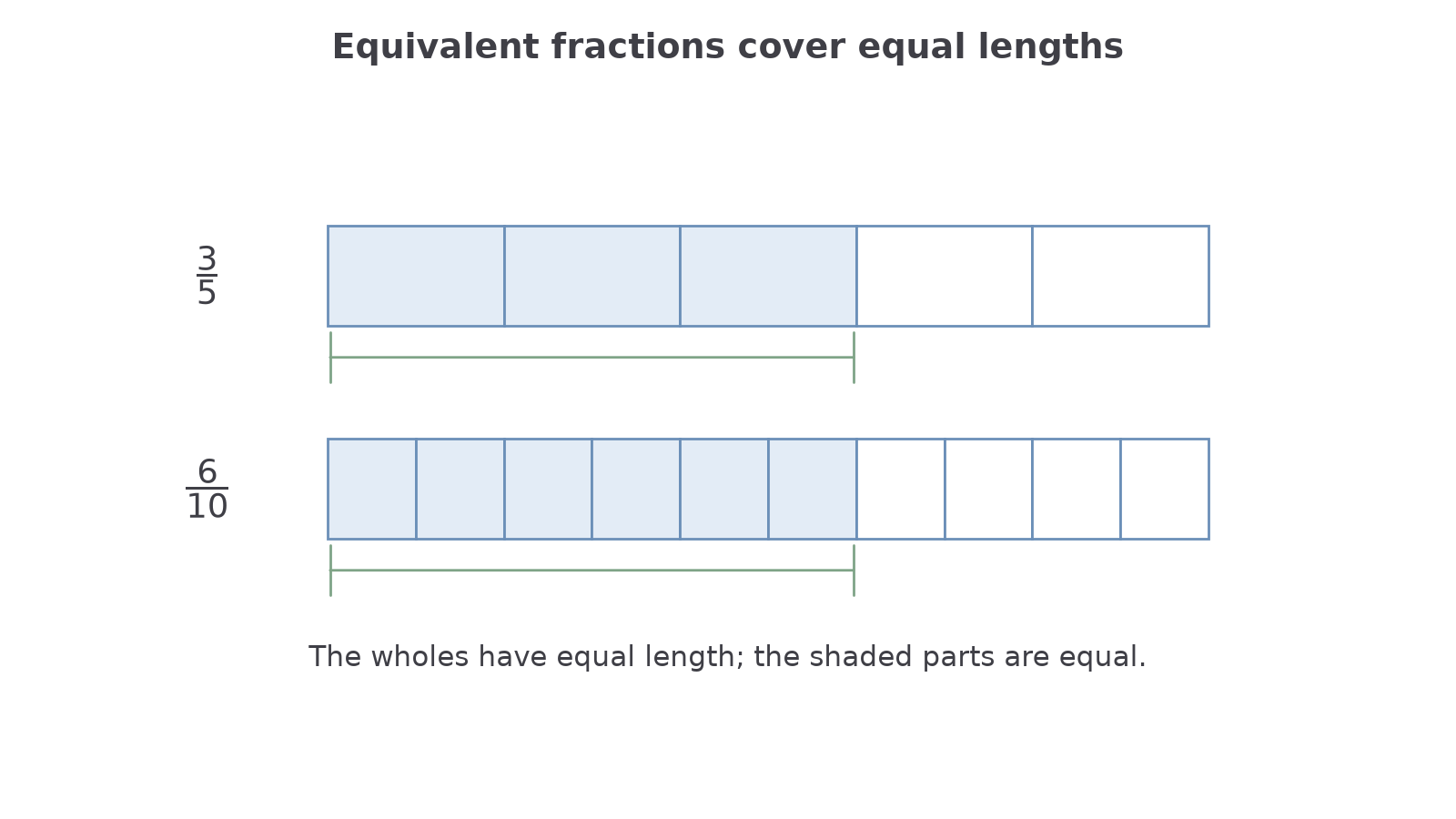
A common denominator lets us compare counts of the same-sized pieces.
Worked example 1: comparing positive fractions
Question. Which is larger, or ?
Plan. Express both fractions in eighteenths.
Why use ? It is a multiple of both denominators, so neither value needs rounding.
Answer. , so five sixths is larger.
Check. Five sixths is short of one; seven ninths is short of one.
Change only the signs of both fractions. Their distances from zero stay the same.
Worked example 2: comparing negative fractions
Question. Which is larger, or ?
Plan. Keep the common denominator and compare signed numerators.
Why does the larger magnitude give the smaller value? Its negative position is farther left on the number line.
Answer. is larger.
Check. Adding to both values gives and , preserving their order.
Benchmarks can save work when proper and improper fractions are mixed. For instance, , while and . Thus .
Watch out
Wrong: because . The ninths are smaller pieces. Compare equivalent fractions with the same denominator.
Change one numerator from the second example and compare again.
Mixed numbers and improper fractions
A mixed number combines whole units and a proper fraction. An improper fraction counts the same quantity using just one fractional unit.
Mixed number
means , not . A leading negative sign applies to the whole mixed number: .
Each whole contains five fifths, so two wholes contain ten fifths. This gives the conversion rule: multiply the whole-number part by the denominator, add the numerator, and keep the denominator. To convert back, divide the numerator by the denominator; the remainder becomes the new numerator. For example, , so . A zero remainder gives an integer.
Worked example 3: changing fraction forms
Question. Write as an improper fraction, then convert it back.
Plan. Count fifths, then divide the numerator by five to recover the wholes.
Why keep the denominator? Every counted piece is still one fifth; only the way we group the pieces changes.
Answer. , which converts back to .
Check. is between and , as the mixed number suggests.
Change only the sign. Convert the positive magnitude first and retain the negative sign around the whole value.
Worked example 4: a negative mixed number
Question. Write as an improper fraction, then convert it back.
Plan. Convert the magnitude to fifths and apply the sign to every part.
Why use brackets? They show that both the wholes and the fractional part are negative.
Answer. , which converts back to .
Check. The value is below and above . By contrast, , which is above .
Both forms are exact. An improper fraction is often easier for calculating; a mixed number makes the number of whole units easier to see.
Watch out
Wrong: . Right: . The sign belongs to the entire quantity.
Keep the sign and denominator, but change the whole-number part.
Adding and subtracting equal-sized parts
Add or subtract fractions by counting equal-sized parts of the same whole.
For equal denominators, : the denominator stays seven because the pieces remain sevenths. For different denominators, first use equivalent fractions. For example, . The result exceeds one because both inputs exceed a half.
Adding and subtracting fractions
For a non-zero common denominator ,
For different denominators, make equivalent fractions with a common denominator first.
Not on the formula sheet: learn it.
The lowest common multiple keeps the numbers small, although any common multiple works. Keep a negative sign attached to its numerator: .
Worked example 5: adding a signed mixed number
Question. Work out .
Plan. Convert to improper fractions, then add sixths.
Why convert first? Each term then has one numerator, making the sign of the complete quantity clear.
Answer. .
Check. Starting at and adding just over gives a value between and .
Change only addition to subtraction. The fraction conversions stay the same.
Worked example 6: subtracting instead
Question. Work out .
Plan. Convert to sixths, then subtract the second numerator.
Why does the magnitude grow? Subtracting a positive number moves farther left from an already negative value.
Answer. , or .
Check. , reversing the subtraction.
Subtracting a negative works differently: . Finally, simplify any common factor in the completed numerator and denominator.
Watch out
Wrong: . Right: . Denominators describe the size of the pieces; adding them does not combine the original quantities.
Change only the fractional part of the second mixed number in the subtraction example.
Products, reciprocals and cancellation
Multiplication takes a fraction of a quantity. Division asks how many copies of one quantity fit into another.
Two thirds of three fifths is . Multiplying denominators describes the finer equal parts; multiplying numerators counts the selected ones. No common denominator is needed.
Cancellation can shorten a product before multiplying:
Here and are divided by , and and by . The product is one fraction, so each cancellation divides a numerator factor and a denominator factor by the same non-zero number.
Reciprocal
The reciprocal of a non-zero number multiplies it to give one. The reciprocal of is , where and are non-zero. Zero has no reciprocal.
Dividing by a fraction reverses multiplying by it. For instance, . The quotient exceeds , because the divisor is positive and below one.
Fraction products and quotients
Denominators must be non-zero; the divisor must also be non-zero.
Not on the formula sheet: learn it.
Convert mixed numbers before using these rules. This also avoids ambiguity about negative signs.
Worked example 7: a negative fraction division
Question. Work out .
Plan. Convert the mixed number, multiply by the reciprocal of the divisor, then cancel.
Why reciprocate only the divisor? Multiplication by its reciprocal undoes multiplication by that divisor; the starting quantity stays fixed.
Answer. .
Check. , the original dividend.
Change only the divisor's sign. The reciprocal's magnitude is the same, but the sign of the quotient changes.
Worked example 8: dividing by a negative fraction
Question. Work out .
Plan. Convert, reciprocate the signed divisor, then simplify.
Why is this answer positive? A negative quotient would give a positive dividend when multiplied by the negative divisor.
Answer. .
Check. , as required.
The numerator and denominator must be treated as complete products. You cannot cancel two numerator factors against one another, or cancel part of a sum. Nor is cancellation deleting matching digits: follows from dividing both numbers by .
Watch out
Wrong: , cancelling the in just one term. Right: . A factor must divide the whole numerator and the whole denominator.
An exact fraction can be very large even with numerator one: . Dividing by a small positive fraction counts many small pieces. The opening comparison is also settled: five sixths covers more pizza than seven ninths.
Quick Recap
- Equivalent fractions preserve the ratio by scaling numerator and denominator together.
- A negative mixed number has a negative whole quantity.
- Add and subtract equal-sized parts; multiply numerators and denominators for products.
- Divide by a non-zero fraction by multiplying by its reciprocal; cancel whole factors only.
Five sixths is larger than seven ninths because .