A4, A18 - Quadratic expansion, factorisation and roots
Two brackets can hide a quadratic expression, and a quadratic can hide two brackets. Learn to move between these forms, recognise a difference of squares and use factorisation to find the values that make a quadratic equation true.
Expanding two binomials
A rectangle has width centimetres, length centimetres and area . How can its area tell you its dimensions?
Its area equation is . We will return to that problem after learning how products and quadratics fit together. Begin with an easier product you can see as an area.
You already know
The distributive law multiplies every term in a bracket. For example, . Factorising reverses that expansion.
When both factors contain two terms, each term in one bracket must multiply both terms in the other.
Binomial and quadratic
A binomial has two terms. A quadratic expression in has a non-zero term and no higher power of . For example, is quadratic; is linear.
For positive , split a rectangle of sides and into four smaller rectangles. Its area is the product of the outside lengths and also the sum of the four inside areas.
[DIAGRAM: asset_name: Four products in a quadratic expansion; asset_slug: 1ma1_m14_area_expansion; caption: For positive x, the rectangle's four areas add to the product of its two outside lengths.; description: A schematic rectangle has width x plus 3 and height x plus 2, split into four rectangles with areas x squared, 3x, 2x and 6. Blue denotes x squared, clay denotes the two linear areas and sage denotes the constant area.]
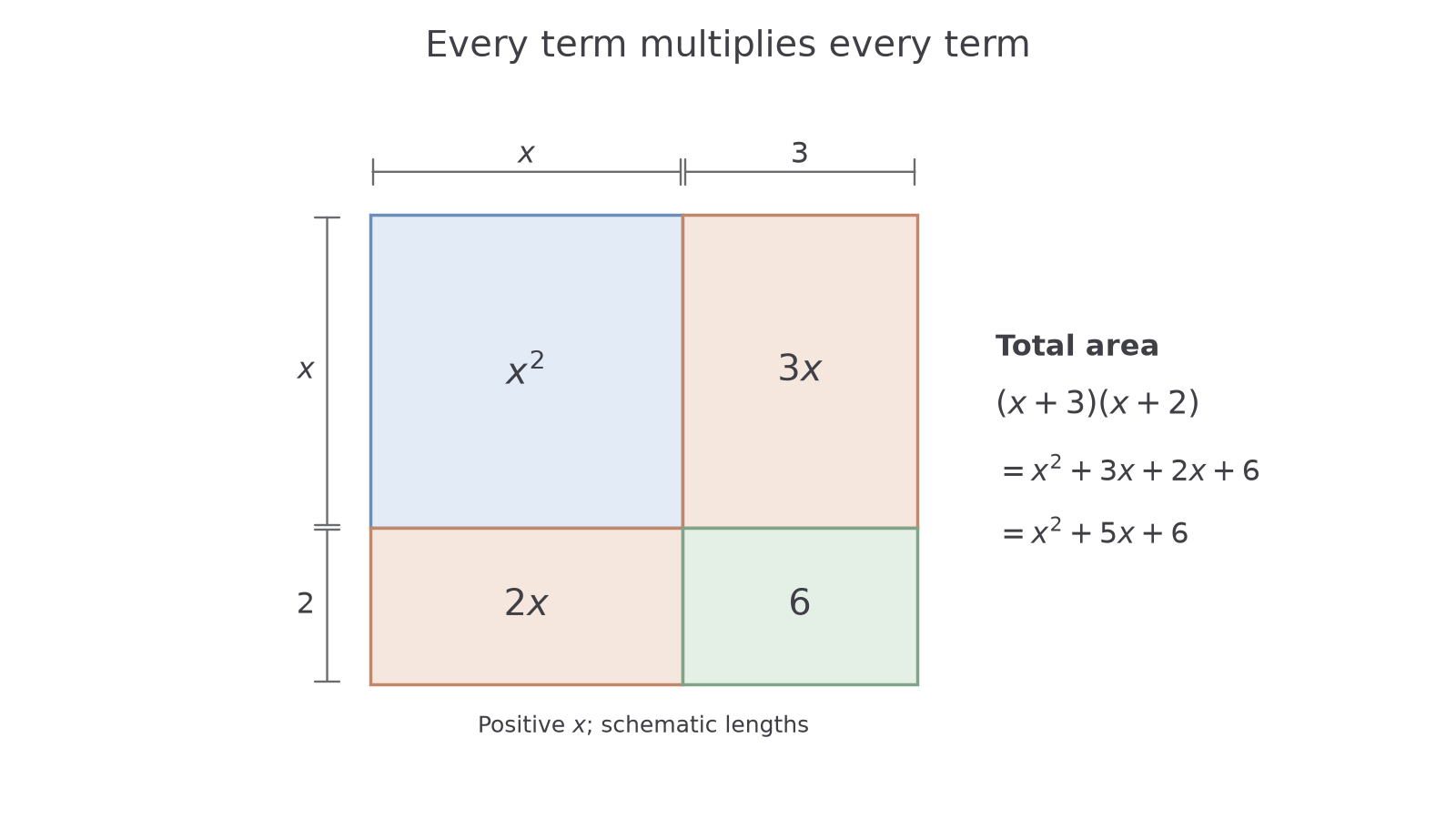
The four pieces explain why you must keep all four products before collecting the middle terms.
Worked example 1: four products from two brackets
Question. Expand and simplify .
Plan. Distribute and across the second bracket, then collect like terms.
Why this step? The term comes from , while both cross products contribute to the coefficient of .
Answer. .
Check. At , the product is ; the expansion gives .
Change only the sign of . The area picture no longer represents all real inputs, but the distributive law still works.
Worked example 2: a negative bracket constant
Question. Expand and simplify .
Plan. Treat the first bracket as , keeping the negative sign in both products.
Why this step? multiplies both and ; the sign affects the constant as well as the middle term.
Answer. .
Check. At , , and .
The same method gives and . The coefficient on the squared term comes from multiplying the two letter terms.
Watch out
Wrong: . A square means two identical brackets: .
Change only the positive constant in Worked example 2.
Factorising quadratics with leading coefficient one
Factorising a quadratic reverses the multiplication of two brackets.
The numbers in the brackets produce the constant by multiplication and the middle coefficient by addition. For instance, , because and .
Sum and product for a monic quadratic
For , find and . Monic means the coefficient of is .
Not on the formula sheet: learn it.
You need both conditions. A factor pair that gets only the constant right is not enough.
Worked example 3: choosing a factor pair
Question. Factorise .
Plan. List factor pairs of and select the pair adding to .
Why this step? The two cross products must add to , so the sum chooses the correct pair.
Answer. .
Check. Expansion gives .
Change only the sign of the middle coefficient. The product remains positive, so both constants must now be negative.
Worked example 4: two negative bracket constants
Question. Factorise .
Plan. Choose two constants with positive product and negative sum .
Why this step? A positive product allows equal signs; the negative sum tells you to choose two negatives.
Answer. .
Check. .
A negative constant needs opposite signs. For , use and , giving . For , use and .
Some expressions have no integer pair that works. In , the integer pairs giving product have sums or , neither . Do not force an integer factorisation by changing a coefficient.
Watch out
Wrong: . The product is right, but the sum is . Check both the middle coefficient and the constant.
Change only the middle coefficient in Worked example 4.
The difference of two squares
Opposite bracket signs can make the two middle products cancel completely.
Expand : the products and cancel, leaving . This gives a useful factorisation pattern.
Difference of two squares
This identity holds for real and ; identify the complete quantities being squared.
Not on the formula sheet: learn it.
The word “difference” matters: it means subtraction between the squares.
Worked example 5: recognising two squares
Question. Factorise .
Plan. Write the constant as a square, then use opposite bracket signs.
Why this step? Opposite signs produce middle terms and , which cancel.
Answer. .
Check. Expanding gives .
Change only the coefficient of from to . The squared quantity is now .
Worked example 6: squaring a whole letter term
Question. Factorise .
Plan. Identify and , then apply the same identity.
Why this step? ; writing in each bracket would give .
Answer. .
Check. .
A common factor may come first: , and . Keep the outside factor. The same pattern works in arithmetic: . Two large squares can have a surprisingly small difference.
Watch out
is a sum, so is not its factorisation. Nor is a difference of two squares: it has a middle term and equals .
Change only the squared-term coefficient in Worked example 6.
Solving equations with the zero-product principle
A product equals zero only when at least one factor equals zero.
If and , dividing by gives . If , the first factor already explains the zero product. These are the only possibilities.
Root and zero-product principle
A root is a value of the unknown that satisfies an equation. For real numbers,
This rule applies to a product equal to zero, not a product equal to another number.
Not on the formula sheet: learn it.
For example, becomes , so or . Each root makes one bracket zero.
Worked example 7: factorising an equation equal to zero
Question. Solve .
Plan. Factorise using sum and product , then set each factor to zero.
Why this step? A zero product guarantees a zero factor, so both possible brackets must be considered.
Answer. or .
Check. , and .
Change only the arrangement of the equation: put the constant on the other side. You must restore a zero before applying the principle.
Worked example 8: making one side zero first
Question. Solve .
Plan. Subtract from both sides, then use the same factorisation.
Why this step? Setting factors of equal to zero would not solve the original equation.
Answer. or .
Check. , and ; both roots satisfy the original form.
In , factorising gives , with roots and . Dividing by would lose the zero root. Identical factors, as in , give one distinct root , called a repeated root.
Return to the rectangle: gives . The algebraic roots are and , but a length must be positive. Its width is , its length is , and checks the area.
Watch out
A root may satisfy the algebra but fail the context. Keep both roots while solving, then use the stated conditions to decide which are allowed.
Change only the right-hand constant from Worked example 8.
Quick Recap
- Two binomials produce four products before like terms are collected.
- For a monic quadratic, bracket constants have the required sum and product.
- A difference of squares has opposite-sign factors; a sum of squares does not use that pattern.
- To solve by factorising, make one side zero, factorise and set each factor to zero. Check roots against the context.
The opening rectangle has width and length ; the negative algebraic root cannot be a length.