A23, A24, A25 - Sequence rules and linear nth terms
A23 gives rules for generating terms, A24 develops familiar number patterns and A25 gives direct rules for arithmetic sequences. You will distinguish position from value, recognise sequences and find terms without writing every earlier one.
Term rules and position rules
A pattern starts , adding 3 each time. How could you find its twentieth term without listing all twenty? A rule using the position gives a direct route.
You already know
Substitute an input into an algebraic expression using brackets. For example, . A power such as means .
The position and the value play different roles.
Sequence rules
A sequence is an ordered list of terms. A term-to-term rule finds a new term from previous terms and needs starting values. A position-to-term rule finds a term directly from its position.
In , the term at position 4 has value 13. Unless told otherwise, positions start at 1 and are positive integers. The notation means the term at position , not multiplied by .
Worked example 1: a direct position rule
Question. For , find the first three terms and the twentieth term.
Plan. Substitute positions 1, 2, 3 and 20 into the rule.
Why substitute 20? It is the position we want, rather than the previous term's value.
Answer. ; the twentieth term is 61.
Check. Nineteen additions of 3 from 4 give .
Change only the constant in the rule from 1 to 2. Every term moves up by 1.
Worked example 2: shifting a position rule
Question. For , find the first three terms and the twentieth term.
Plan. Substitute the same positions into the new rule.
Why does the gap stay 3? Increasing by 1 increases by 3.
Answer. ; the twentieth term is 62.
Check. , and each answer is 1 above Worked example 1.
A term-to-term rule works differently. Starting at 3 and multiplying the previous term by 2 gives . Multiplying the position by 2 gives . Similarly, gives ; it does not square the previous output.
The supplied rule matters. A finite list alone can fit several continuations; use the stated rule, sequence class or diagram and check every given term.
Watch out
Wrong: feed 5 into to find the second term. Right: use , giving 8. The rule uses the position; it is not a recurrence.
Change only the constant again.
Triangular, square, cube and Fibonacci patterns
Named sequences come from particular constructions or relationships. Recognising the reason behind a pattern is more reliable than recognising one number.
[DIAGRAM: asset_name: Building the first triangular numbers; asset_slug: 1ma1_m34_triangular_numbers; caption: Adding a row of increasing length produces 1, 3, 6 and 10 dots.; description: Four triangular dot arrangements have one, two, three and four rows, containing respectively 1, 3, 6 and 10 dots. Blue dots show previous rows and sage dots show the newly added bottom row. Each arrangement is labelled with its position and total.]
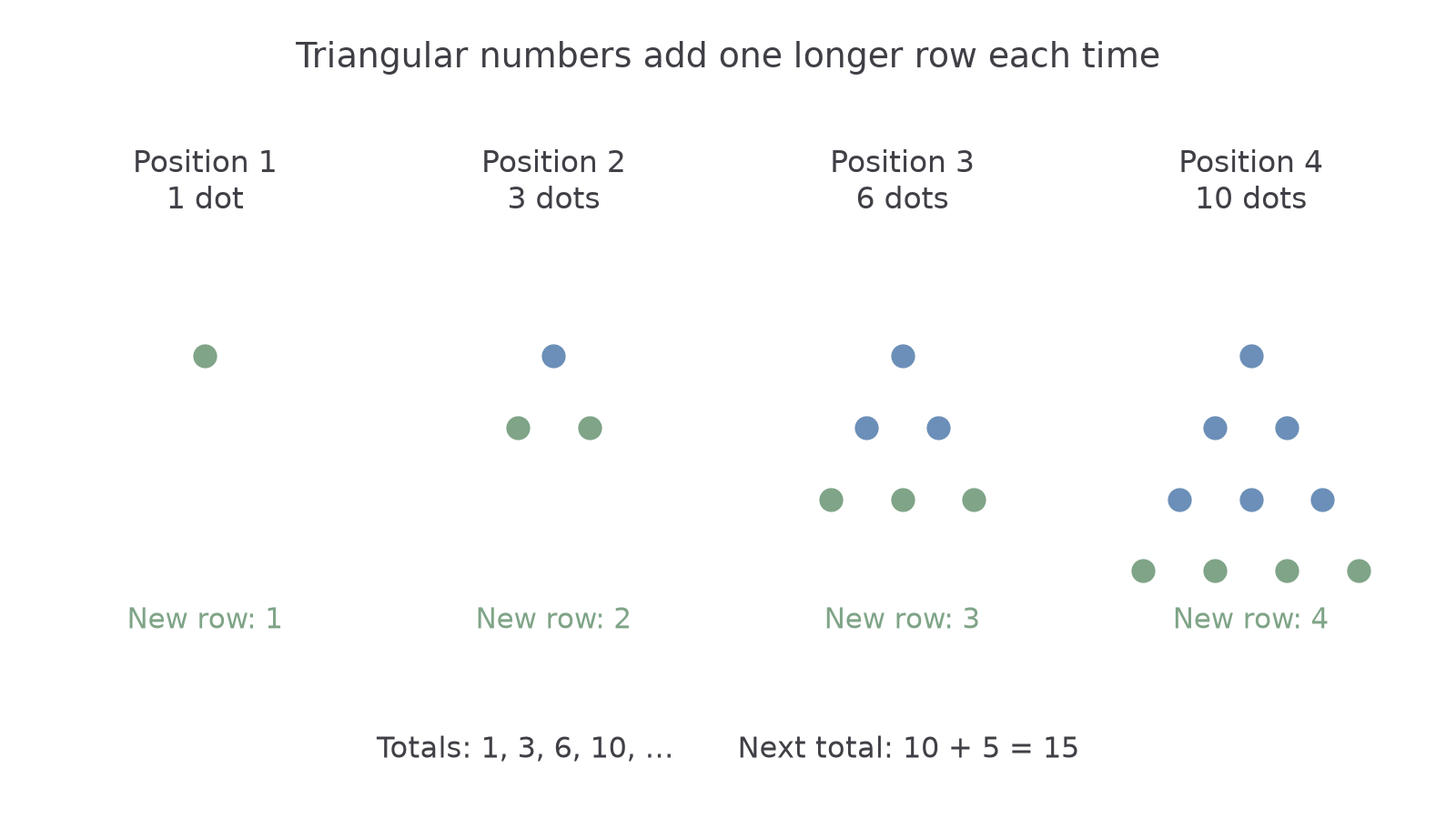
A triangular arrangement adds rows of lengths 1, 2, 3 and so on. Its totals are . To reach the fifth triangle from the fourth, add 5: . The gaps increase, so this is not an arithmetic progression.
Square, cube and Fibonacci-type sequences
Square numbers are : . Cube numbers are : . In a Fibonacci-type sequence, each term after the first two is the sum of the previous two.
A square counts an -by- array. A cube counts an -by--by- arrangement. Their values differ: the fourth square is , while the fourth cube is .
Square and cube position rules
For positive integer positions starting at 1,
Not on the formula sheet: learn it.
Square numbers increase by consecutive odd numbers. Enlarging a square adds an outside row and column, sharing one corner:
There is also a neat link between square and triangular numbers: two consecutive triangles make a square. For example, and . The rows of the two triangles fit together into a square array.
Fibonacci-type sequences need two starting terms. Starting with 1 and 1 gives . Starting with 2 and 3 gives . The familiar two 1s occupy different positions; the rule does not require all such sequences to start with 1 and 1.
Key idea
Identify a sequence from its relationships, not one isolated term. The number 8 is both a cube number and a Fibonacci number.
Use the constructions to answer this check.
Unknown terms in Fibonacci-type sequences
The add-the-previous-two rule works with algebraic terms as well as numbers.
If the third and fourth terms are 11 and 18, work backwards by subtraction. The second term is ; the first is . Checking forwards gives .
To find an unknown starting value, generate expressions before substituting the later given term.
Worked example 3: an unknown start
Question. A Fibonacci-type sequence starts . Its fifth term is 104. Find and the first two terms.
Plan. Express the fourth and fifth terms in terms of , then solve.
Why generate the expressions first? They show exactly how the fifth term depends on the start.
Answer. ; the first two terms are 13 and 26.
Check. follows the rule and reaches the given fifth term.
Change only the fifth term to 120.
Worked example 4: a new fifth-term value
Question. The same form has fifth term 120. Find and the first two terms.
Plan. Keep the generated fifth-term expression and solve the new equation.
Why keep ? The generating rule and starting expressions have not changed.
Answer. ; the first two terms are 15 and 30.
Check. has the required fifth term.
You can also recover an earlier algebraic term by subtraction, just as with 11 and 18.
Watch out
Wrong: the fourth term after is . Right: add the previous two, so it is . This is a Fibonacci-type sequence, not an arithmetic sequence.
Change only the fifth term again.
Linear rules for arithmetic progressions
A constant difference makes a sequence arithmetic. That same difference becomes the coefficient of in its direct rule.
For , the difference is 3. The values are always 2 too small, so the rule is .
Arithmetic progression
An arithmetic progression has the same difference between each pair of consecutive terms. The difference may be positive, negative or zero.
There are equal steps from position 1 to position .
Arithmetic nth term
If the first term is at position 1 and the common difference is , then
Not on the formula sheet: learn it.
Use the rule forwards for a term, or backwards for a position. A valid position must be a positive integer.
Continue this lesson.
You’re previewing NovaLearn without an account. Create a free account to read the rest.
Create free account