G3 - Angle facts, parallel lines and polygons
You can find an angle without putting a protractor on a diagram. You will use straight lines and parallel lines to calculate angles, explain why every triangle totals , and build polygon rules from that result.
Angles at a point and on a line
Could a regular polygon have an interior angle of ? You will find its number of sides by starting with the simplest angle facts.
You already know
An angle measures a turn. A right angle is , and an angle's middle letter names its vertex, as in .
A complete turn is ; a straight angle is half of this, . An acute angle lies between and , an obtuse angle between and , and a reflex angle between and . The reflex turn between two rays is minus their smaller angle.
Angles on a line and around a point
Adjacent angles filling a straight angle total . Angles filling one complete turn around a point total .
Not on the formula sheet: learn it.
Check that the named angles fill exactly the required turn: no gap and no overlap. For example, angles , and filling a point give .
When two straight lines cross, vertically opposite angles are equal. If adjacent pairs satisfy and , subtracting the shared gives . This result is not on the formula sheet: derive it from the straight-line angle sum. “Vertically” refers to a common vertex, not the page's orientation.
Worked example 1: a straight angle
Question. Two adjacent angles fill a straight angle. One is ; the other is . Find .
Plan. Subtract the known angle from the straight-angle total.
Why use ? These angles fill a half-turn, not the whole point.
Answer. .
Check. .
Change only the way the unknown angle is labelled: it is now degrees. First find the angle, then find the variable.
Worked example 2: an algebraic angle label
Question. Adjacent angles of and degrees fill a straight angle. Find .
Plan. Form the same angle sum, then divide the remaining angle by two.
Why is not ? The actual angle is labelled , twice the variable.
Answer. ; the angle is .
Check. .
The same care applies to more involved labels. Adjacent angles and degrees give , so and the actual angles are and . At an intersection with one angle , its opposite angle is and its neighbours are .
Watch out
Wrong: . This uses a full-turn total for only two angles on one side of a straight line. Use ; reserve for angles that fill the whole point.
Change only the coefficient of the unknown label for your turn.
Angles on parallel lines
A transversal crosses two lines; when those lines are parallel, it links angles at the two crossings.
Corresponding angles occupy matching positions, such as above each parallel line and to the right of the transversal. Alternate interior angles lie between the parallel lines on opposite sides of the transversal. Both pairs are equal on parallel lines. Alternate exterior angles, outside the parallels on opposite sides of the transversal, are equal too.
Co-interior angles are between the parallels on the same side of the transversal. They add to : transfer one by the alternate-angle rule, then use a straight angle. F and Z shapes can help you spot positions, but the parallel condition and the angle positions supply the reason. These parallel-line rules are not on the formula sheet: learn them.
[DIAGRAM: asset_name: Parallel-line angle positions; asset_slug: 1ma1_m46_parallel_angles; caption: Corresponding and alternate angles are equal; co-interior angles add to 180 degrees.; description: Three panels show a sloping transversal crossing marked parallel horizontal lines. Coloured arcs identify corresponding angles, alternate interior angles and a co-interior pair. A 60-degree example gives equal 60-degree pairs and a 60-degree plus 120-degree co-interior pair.]
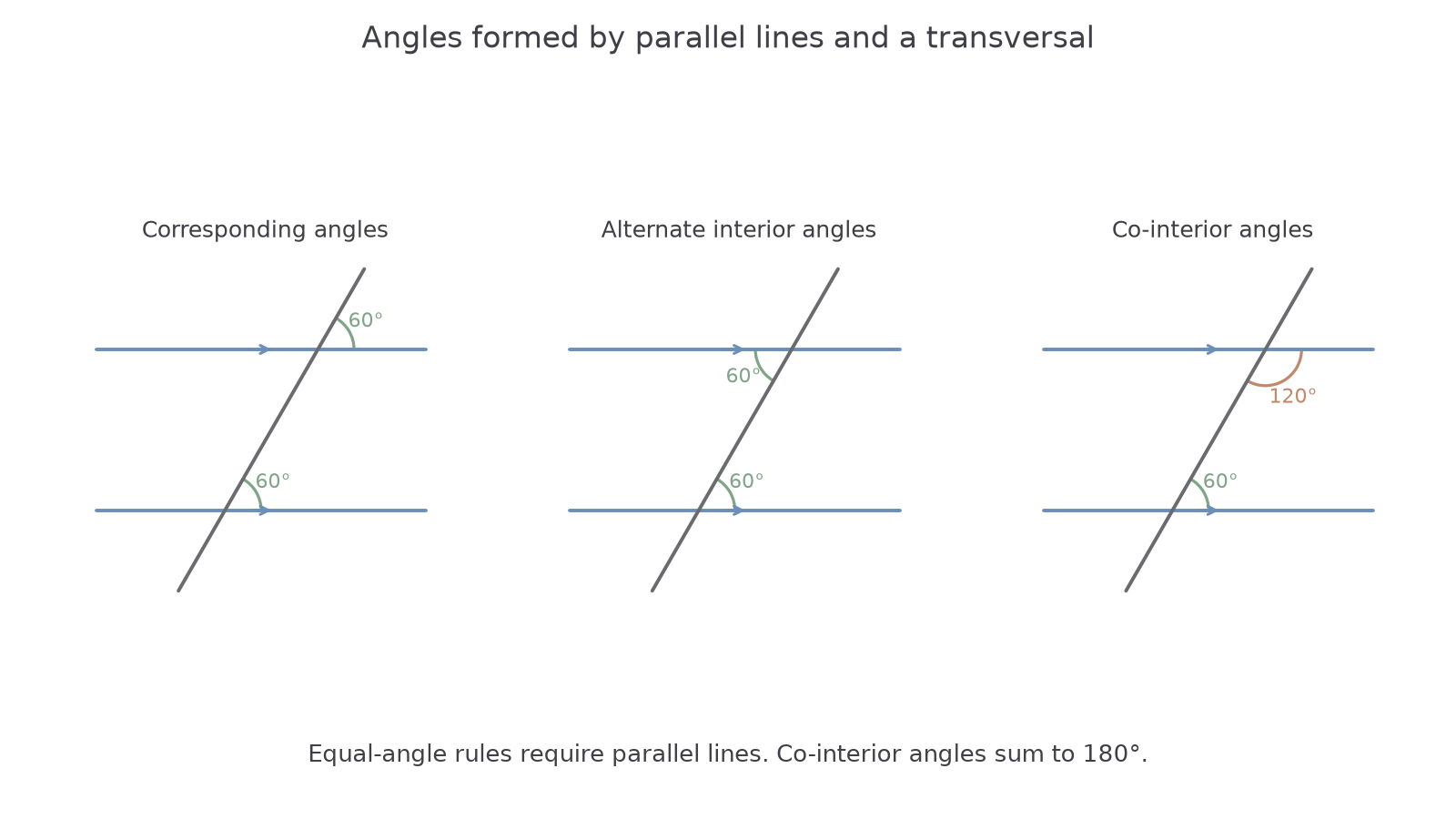
For instance, a corresponding angle to is , and its neighbour is . State the particular rule, not just “parallel lines”.
Worked example 3: co-interior angles
Question. A transversal crosses two parallel lines. Co-interior angles are and . Find .
Plan. Use their total.
Why subtract instead of copying ? Co-interior angles add to a straight angle; they are not an equal-angle pair.
Answer. .
Check. .
Change only the label of the second angle to degrees. The geometrical reason remains the same.
Worked example 4: a co-interior equation
Question. Co-interior angles on parallel lines are and degrees. Find and the second angle.
Plan. Form the co-interior sum before solving the equation.
Why substitute back? The question asks for both the variable and the angle it labels.
Answer. , and the second angle is .
Check. .
The rules work backwards too. Equal corresponding angles, equal alternate angles, or co-interior angles totalling establish that the two lines are parallel. Thus co-interior angles of and prove parallelism even if no parallel arrows were supplied. The angle positions relative to the same transversal are essential evidence.
Watch out
Wrong: “The lines look parallel, so these angles are equal.” A sketch is not proof. Use given parallel arrows, or establish parallelism from a correctly identified equal corresponding/alternate pair or a co-interior sum of .
In a reasoned solution, identify the angles clearly using three letters when a vertex has several angles. This makes each stage unambiguous. The next question changes only the coefficient in the unknown label.
Deriving the triangle angle sum
You can prove the triangle angle sum with one extra parallel line, so you do not need to measure thousands of triangles.
In triangle , draw a line through parallel to . Alternate angles transfer angle to one side of , and angle to the other. These transferred angles and the original apex angle fill a straight angle at .
Continue this lesson.
You’re previewing NovaLearn without an account. Create a free account to read the rest.
Create free account