N1, N2 - Integers, decimals and written arithmetic
Compare positive and negative numbers, understand what each digit is worth, and calculate with integers and decimals. Written methods and simple checks will help you spot an answer with the wrong sign or size.
Ordering numbers and comparison symbols
Which is warmer: or ? The digits alone can tempt you into the wrong answer. Their positions on a number line settle it.
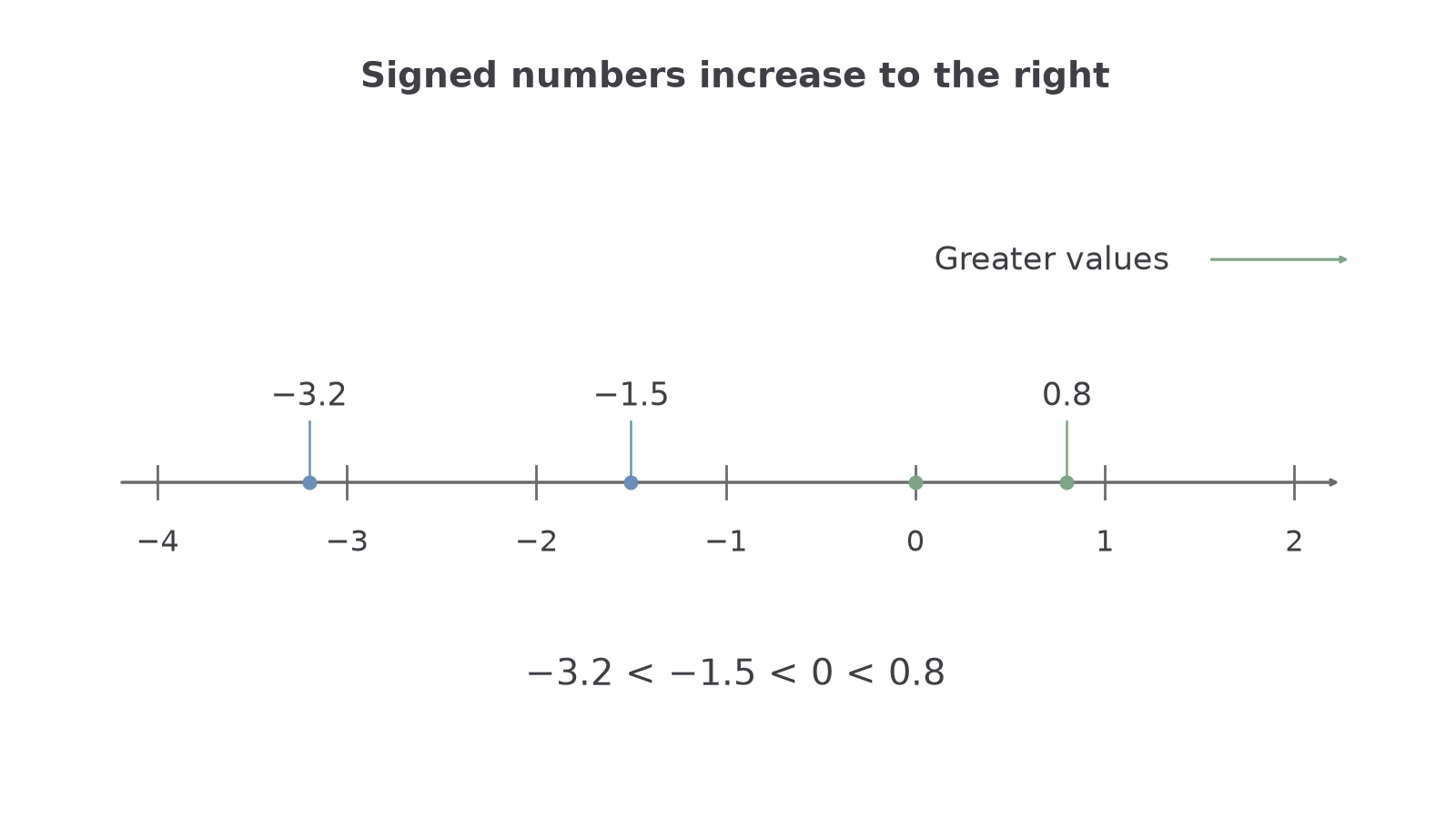
An integer is a whole number, including zero and negative whole numbers. A decimal can lie between integers: is between and . Numbers increase to the right. Thus , even though is farther from zero. Distance from zero and numerical order are different ideas.
[DIAGRAM: asset_name: Signed numbers on a number line; asset_slug: 1ma1_m01_signed_order; caption: Numbers farther right are greater, including negative decimals.; description: A number line from minus 4 to 2 marks minus 3.2, minus 1.5, zero and 0.8 in increasing order, with an arrow showing that values increase to the right.]
Use these symbols to express the comparison precisely.
Comparison symbols
means equal to; means not equal to; means less than; means greater than; means less than or equal to; means greater than or equal to.
For example, , and . The statement allows ; does not.
The open end of an inequality faces the larger value. Reversing the numbers reverses the sign: and say the same thing. To compare positive decimals, align decimal points and use trailing zeros to make the columns visible.
Worked example 1: ordering positive decimals
Question. Write , and in increasing order.
Plan. Write each value to three decimal places, then compare the first different column.
Why this step? Equal-length decimal forms let you compare the same place values, rather than counting digits.
Answer. .
Check. All three are between and ; the extra thousandths makes just greater than .
Now change only the signs. The positive magnitudes have the same order, but the negative values lie to the left of zero.
Worked example 2: ordering the negative versions
Question. Write , and in increasing order.
Plan. Compare the positive magnitudes, then reverse their order.
Why reverse the order? The greatest positive distance becomes the farthest position to the left when its sign is negative.
Answer. .
Check. Starting at , moving right reaches , then , then zero.
A longer decimal need not be larger: there is even no greatest decimal below . Given any number , its midpoint with is larger than but still below .
Watch out
Wrong: because . Right: . Compare place values and then account for the negative signs.
Try the same comparison with a different final digit in one value.
The value of a digit
A digit's position tells you its contribution to the number. Each move one column left makes that contribution ten times as large; each move right divides it by ten.
In , the contributes four million, the contributes seventy thousand and the contributes three hundred. Zeros hold empty places. Removing the zero between and would change the value. Commas group digits for reading; they do not change the number.
Place value
Place value is the value given to a digit by its position. To the right of units come tenths, hundredths, thousandths, ten-thousandths and hundred-thousandths.
For example, . The is worth , not .
The first column after the decimal point is always tenths. In , the is in the ten-thousandths column, so its value is .
| Units | Tenths | Hundredths | Thousandths | Ten-thousandths | Hundred-thousandths |
|---|---|---|---|---|---|
Scaling changes the values of all the digits together.
Worked example 3: scaling a small decimal
Question. Work out .
Plan. Move each digit three place-value columns left.
Why three columns? , so every digit's contribution is multiplied by ten three times.
Answer. .
Check. , which reverses the scaling.
Change only multiplication to division. The digits move in the opposite direction.
Worked example 4: dividing the same decimal
Question. Work out .
Plan. Divide each digit's contribution by .
Why add places on the right? Division makes this positive number smaller; moving digits left would multiply it instead.
Answer. .
Check. Multiplying the answer by recovers .
The same reasoning gives : six tens become six hundredths and two units become two thousandths.
Watch out
Trailing decimal zeros preserve value: . Appending a zero to an integer changes its place values: . Do not treat every zero as removable.
Use the same division with one changed digit.
Written operations and negative integers
Written methods keep units aligned and record exchanges, so you can handle large calculations one small step at a time.
You already know
Ten units make one ten, and ten tens make one hundred. Addition combines quantities; subtraction reverses addition. Multiplication and division are another inverse pair.
For addition, align units under units. In , : write units and carry ten. Then : write tens and carry hundred. Finally , giving .
For , exchange a hundred for ten tens, then one ten for ten units. This preserves the value of :
The inverse check is . For signed addition, moving right adds a positive value and moving left adds a negative value. Thus and . Subtracting a negative reverses that leftward move: .
For multiplication or division, matching signs give a positive answer and different signs give a negative answer. Work out the magnitude first.
Worked example 5: long multiplication
Question. Work out without a calculator.
Plan. Multiply by the units and tens separately, then add the partial products.
For the units row, : write , carry . Next : write , carry . Finally .
Why , rather than ? The in is in the tens column; its row must be ten times .
Answer. .
Check. and ; their sum is .
Change only the sign of the first factor. The written multiplication is unchanged.
Worked example 6: applying a negative sign
Question. Work out .
Plan. Calculate the positive magnitude, then use the different-sign rule.
Why is the result negative? Twenty-four copies of a negative quantity have a negative total.
Answer. .
Check. , reversing the multiplication.
Long division uses the same place values. To find , goes into three times. Write in the tens column and subtract , leaving tens. Bring down to make . Nine lots of give , so the quotient is . Check . Therefore too.
With a positive divisor, a remainder must be at least zero and less than the divisor. You can continue into decimal places when appropriate. Division by zero is undefined: for example, no number multiplied by zero gives .
Watch out
“Two negatives make a positive” applies to multiplication and division. It does not apply to addition: , whereas .
Change the magnitude of the negative factor and keep the multiplication method.
Calculating with decimals
Decimal calculations use integer methods once you keep track of each digit's place value.
For addition and subtraction, align decimal points. Write as . Similarly, . The added zeros allow exchanges in the hundredths column. Adding less than one to cannot produce a result near .
For multiplication, first use integers, then restore the scale. For division, scale both numbers by the same power of ten until the divisor is an integer. These rules are not on the formula sheet; learn them through place value.
Worked example 7: multiplying decimals
Question. Work out without a calculator.
Plan. Multiply by , then divide by the combined scale factor.
Why divide by ? Replacing by multiplies one factor by ; replacing by multiplies the other by .
Answer. .
Check. is between and , so the product is between and . It is smaller than , as multiplying by a positive number below one should be.
Change only the sign of . The scale and positive magnitude stay the same.
Worked example 8: a signed decimal product
Question. Work out .
Plan. Use the integer product, restore its scale, then choose the sign.
Why keep the sign separate? The sign rule and the decimal scale are two different decisions; checking each prevents one from hiding an error in the other.
Answer. .
Check. . If both factors were negative, the result would instead be .
For division, . Multiplying both numbers by preserves their ratio. Multiplying just one would change it. Check ; changing the dividend to gives quotient .
When the divisor is already whole, keep the quotient's decimal point aligned with the dividend's. For , divide units to get unit with left. The remainder and tenths make tenths: divide to get tenths with tenths left. Together with hundredths this is hundredths, giving hundredths. The result is , and .
Watch out
Wrong: . Right: . Scale the dividend and divisor together.
The next product changes only the magnitude of the negative factor in the second example.
Quick Recap
- Compare place values first; negative values farther left are smaller.
- The six comparison symbols distinguish equality, inequality and whether equality is allowed.
- Written arithmetic aligns like places and records exchanges or partial products.
- Decimal multiplication restores both scales; decimal division scales both inputs together.
- Inverse operations and rough size checks help catch sign and place-value errors.
The warmer temperature is , because .