A22 - Linear inequalities and number lines
An inequality describes a range of possible values. You will solve linear inequalities, explain negative division, show solutions on number lines and choose permitted whole-number answers in a context.
Ranges satisfying a linear inequality
A minibus costs £40 plus £8 per passenger. With £100 to spend, can you afford eight passengers? An inequality will give the whole range of affordable counts, rather than just one trial.
You already know
To solve a linear equation, perform the same operation on both sides. Addition, subtraction and division by a positive number work in the same way for an inequality.
An inequality sign compares values. The difference between strict and inclusive signs matters at the boundary.
Strict and inclusive inequalities
means is strictly less than 4, so 4 is excluded. includes 4. Similarly, excludes equality and includes it. A solution set contains every value making the comparison true.
Unless a domain is stated, do not assume the unknown is an integer. For example, allows 3.9, zero and negative numbers.
Worked example 1: a strict comparison
Question. Solve .
Plan. Undo the addition, then divide by the positive coefficient.
Why keep the direction? Both operations preserve numerical order.
Answer. .
Check. gives , true. The boundary gives , false.
Change only to . The algebra is unchanged, but the endpoint is now included.
Worked example 2: including the boundary
Question. Solve .
Plan. Use the same two inverse operations.
Why retain the equality bar? The original comparison allows equality.
Answer. .
Check. At , is true. At , is false.
Variables on both sides use the same collection method. For , subtracting and 1 gives , hence .
Brackets and fractions also follow the equation methods. Expanding gives , then . Multiplying by positive 3 gives , hence .
Watch out
Writing instead of loses the other solutions. A boundary value is not usually the entire solution set.
Change only the right-hand number from Worked example 2.
Negative multiplication reverses order
Multiplying or dividing both sides by a negative number reverses their order.
Start with . Multiplying by gives : the points have reflected across zero. The greater original number becomes the smaller negative number. Every negative multiplier includes this reversal.
For example, gives after dividing by . A permitted input gives . A wrong-side input gives , false.
Worked example 3: dividing by a negative
Question. Solve .
Plan. Isolate the negative multiple of , then reverse the comparison when dividing.
Why reverse only at the last step? Subtracting 7 preserves order; division by reverses it.
Answer. .
Check. gives ; gives . Both are allowed.
Change only the comparison to a strict one. The endpoint will be excluded.
Worked example 4: a strict reversed comparison
Question. Solve .
Plan. Subtract 7, then divide by the negative coefficient.
Why is the answer greater than 3? Larger makes smaller.
Answer. .
Check. gives , false; gives , true.
You can avoid negative division by moving the variable instead. From , add , subtract 1 and divide by 2:
This is the same range as .
Watch out
A negative sign somewhere in the question does not trigger reversal. From , add 5 to get . Reverse only when multiplying or dividing both sides by a negative number.
Do not divide by an unknown unless its sign is known. In , the direction after dividing by would depend on whether is positive or negative; division is impossible if .
Now change only the right-hand number from Worked example 4.
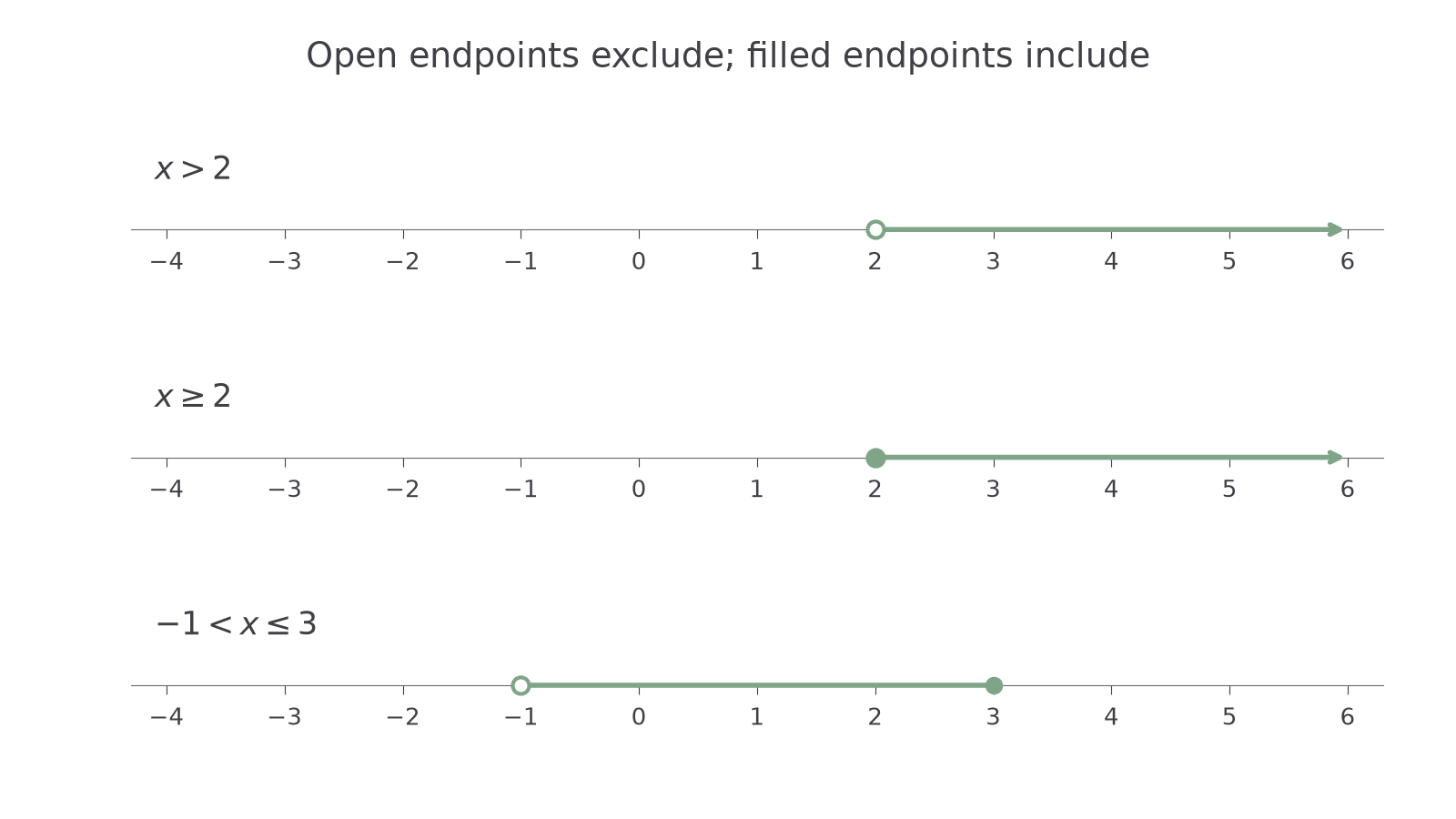
Open and closed number-line endpoints
A number line shows the allowed values and whether each endpoint belongs to the solution.
[DIAGRAM: asset_name: Strict and inclusive number-line solutions; asset_slug: 1ma1_m32_number_lines; caption: Endpoint style records inclusion, while the shaded direction records the allowed values.; description: Three horizontal number lines show x > 2 with an open circle and a right arrow, x ≥ 2 with a filled circle and a right arrow, and −1 < x ≤ 3 with an open circle at −1, filled circle at 3 and a highlighted segment between them.]
Continue this lesson.
You’re previewing NovaLearn without an account. Create a free account to read the rest.
Create free account