G7, G24 - Reflections, rotations, translations and enlargements
A shape can move, turn, reflect or change size in a precisely controlled way. You will construct images vertex by vertex, describe each transformation completely, use column vectors for translations, and recognise which properties stay unchanged.
Reflections in a mirror line
Can an enlargement make a shape smaller? Keep that question in mind as you first explore transformations that preserve its size.
You already know
A coordinate pair gives horizontal position first, then vertical position. Congruent shapes have the same size and shape, even if one faces a different way.
A reflection puts a point and its image at equal perpendicular distances on opposite sides of a mirror line. The mirror is the perpendicular bisector of each joining segment . Points on the mirror stay fixed.
To construct a polygon's reflection, draw a perpendicular from each vertex to the mirror. Count or measure its distance, continue by the same distance on the other side, and mark the image with a prime. Join image vertices in the original order. With a sloping mirror, a horizontal move usually fails because the distance must be perpendicular.
Reflection in the -axis sends to ; in the -axis it gives . Reflection in swaps coordinates, and in it gives . These rules are not on the formula sheet: learn them, and check using equal perpendicular distances.
[DIAGRAM: asset_name: Reflections in vertical and diagonal mirror lines; asset_slug: 1ma1_m49_reflections; caption: Each reflected vertex lies at the same perpendicular distance on the opposite side of its mirror.; description: Two coordinate panels show triangle A(3,1), B(5,1), C(3,3) reflected in x equals 2, and triangle P(1,3), Q(2,5), R(3,3) reflected in y equals x. Dashed connecting segments are perpendicular to the mirror lines, and images carry prime labels.]
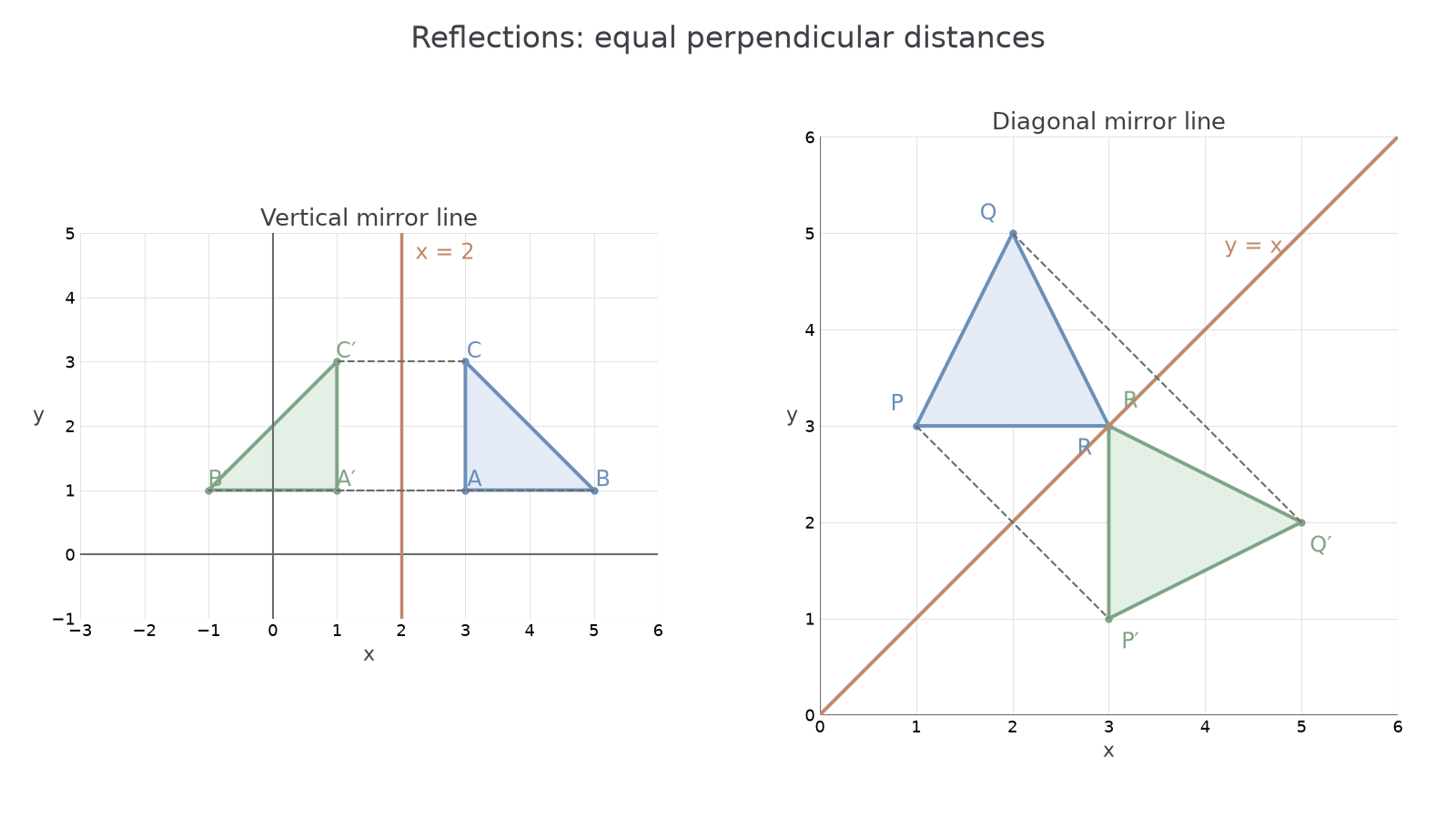
The diagonal panel deliberately includes a vertex on the mirror: stays fixed. Every other vertex still needs its own reflected position.
Worked example 1: a vertical mirror
Question. Reflect in .
Plan. Find the horizontal distance to this vertical mirror, then go equally far beyond it.
Why subtract from 2? The image lies 3 units to the left of the mirror, not 3 units left of the original point.
Answer. .
Check. The midpoint has , on the mirror.
Change only the mirror to . The original point stays fixed, but the image must be equally far from the new line.
Worked example 2: moving the mirror
Question. Reflect in .
Plan. Measure from the new mirror, then cross it by the same distance.
Why does the image move farther left? The mirror has moved left, increasing the original point's distance from it.
Answer. .
Check. , the new mirror position.
For a diagonal example, reflected in becomes . Their midpoint lies on the mirror, and the joining segment is perpendicular to it.
To identify an unknown reflection, construct the perpendicular bisector of a corresponding-vertex joining segment, then check a second pair. Give the mirror's equation, such as “reflection in ”. On squared paper, practise reflecting triangle separately in and , using perpendicular distances. A typed coordinate answer does not check drawing accuracy.
Watch out
Wrong: reflect in by moving 3 units left to . That stops at the mirror. Continue another 3 units to , making the mirror the midpoint.
Use a new mirror position for your turn.
Rotations about a centre
A rotation turns every point through the same angle and direction about a fixed centre.
A complete description gives centre, angle and clockwise or anticlockwise direction. A turn gives the same image in either direction, so its direction is unnecessary. The centre stays fixed; other points travel round circles about it. Rotations preserve lengths, angles and the order of labelled vertices.
To construct , join , turn a ray through the required angle at , then mark on the turned ray. Use a protractor for the angle and a compass for the radius. Repeat for each vertex. On a square grid, count offsets for quarter-turns and half-turns.
About the origin, anticlockwise sends to ; clockwise gives ; gives . These rules are not on the formula sheet: learn them. For another centre, subtract its coordinates before turning the offset and add them back afterwards.
Worked example 3: an anticlockwise quarter-turn
Question. Rotate through anticlockwise about .
Plan. Find the offset from , turn it, then return to the grid's coordinates.
Why turn the offset? The rotation is about , rather than the origin.
Answer. .
Check. Both squared radii equal , so the distance from the centre is unchanged.
Change only the direction to clockwise. The radius stays the same, but the point turns to the other side.
Worked example 4: reversing the direction
Question. Rotate through clockwise about .
Plan. Turn the same offset clockwise instead.
Why does the second component become negative? An offset pointing right turns down in a clockwise quarter-turn.
Answer. .
Check. The squared radius remains ; turning the offset back recovers .
For a half-turn, about has offset , which becomes . Adding gives . Their midpoint is , checking the centre.
To find an unknown rotation centre, intersect perpendicular bisectors of two corresponding-vertex joining segments. Check the angle and direction from that centre. For a half-turn, every pair's midpoint is the centre. On paper, rotate triangle by anticlockwise about . The image is , as shown in the later diagram.
Watch out
Wrong: rotate about by directly writing . That rule turns about the origin. Subtract , turn the offset, then add back.
Use the clockwise method again with new coordinates.
Translations and column vectors
A translation moves every point by the same horizontal and vertical amounts, without turning or changing the shape.
Column vector
The translation vector
means move horizontally and vertically. Positive entries mean right and up; negative entries mean left and down. A vector is a displacement, not a point's position.
Thus means 3 left and 2 up wherever a vertex starts. Add the top entry to every -coordinate and the bottom entry to every -coordinate. Join the image vertices in order. This coordinate rule is not on the formula sheet: learn it.
Worked example 5: translating a triangle
Question. Translate , , by .
Plan. Add the same two components to each vertex.
Why use the same move three times? Different moves would change the relative positions of the vertices and distort the triangle.
Answer. , , .
Check. Each image minus original gives .
Continue this lesson.
You’re previewing NovaLearn without an account. Create a free account to read the rest.
Create free account