A19, A21 - Simultaneous linear equations
A19 finds a pair of values that satisfies two linear equations at once. A21 uses those equations to model linked quantities. You will solve by elimination, substitution and graph intersections, then interpret both values in context.
Eliminating an unknown
Two notebooks and three pens cost £9. Three notebooks and two pens cost £11. Can we recover both prices? One total allows many price pairs, so we need to use both purchases together.
Simultaneous solution
A simultaneous solution is one pair of values satisfying both original equations at the same time.
For example, allows and . A second independent relationship may select just one pair. Elimination adds or subtracts complete equations so that one unknown cancels.
Worked example 1: subtract matching terms
Question. Solve and .
Plan. Subtract the second equation from the first to remove , then substitute back.
Why this step? Equal coefficients cancel by subtraction. Both sides of each equality must take part.
Answer. .
Check. and .
Change only the sign of the -term in the second equation. This changes the useful operation from subtraction to addition.
Worked example 2: add opposite terms
Question. Solve and .
Plan. Add the equations to cancel the opposite -terms.
Why this step? Subtracting would double the -term here; addition removes it.
Answer. .
Check. and .
If coefficients do not match, multiply every term of one or both equations. For and , multiply the first by 2 and the second by 3:
Checking gives and . Matching the -coefficients instead would also work.
Watch out
From , multiplying by 2 gives , not . The complete equation is multiplied.
A pair must satisfy both originals. Finding one value is only the first half of the solution.
Substitution between equations
Substitution replaces an unknown by an equal expression from the other equation. It is especially useful when one unknown is already isolated.
You already know
A bracket keeps a whole expression together. If , then , not .
The replacement uses both conditions without guessing a value. After finding one unknown, return to an original equation to find the other.
Worked example 3: a subject already isolated
Question. Solve and .
Plan. Replace in the second equation by .
Why this step? Every simultaneous solution obeys , so the replacement keeps both conditions.
Answer. .
Check. , and .
Change only the total in the second equation, from 16 to 21. The substitution expression stays unchanged.
Worked example 4: a changed second total
Question. Solve and .
Plan. Substitute the same expression for .
Why this step? A new total changes both values, even though the relationship between them is unchanged.
Answer. .
Check. and .
Sometimes rearrange first. For and , write :
Both and check. Substitution suits an isolated unknown; elimination suits easily matched coefficients. Either can produce exact fractions: , give .
If two numbers are integers, their sum and difference have the same parity: subtracting the difference from the sum gives , an even number. That explains why an odd sum of 3 and an even difference of 2 could not produce two integers here.
If all unknown terms cancel, inspect what remains. The equations and give a true identity, so every point on that line works. The equations and give , so no pair works.
Watch out
For , the replacement misses a factor. Use .
Keep the full replacement expression together until you have expanded correctly.
Intersections and numbers of solutions
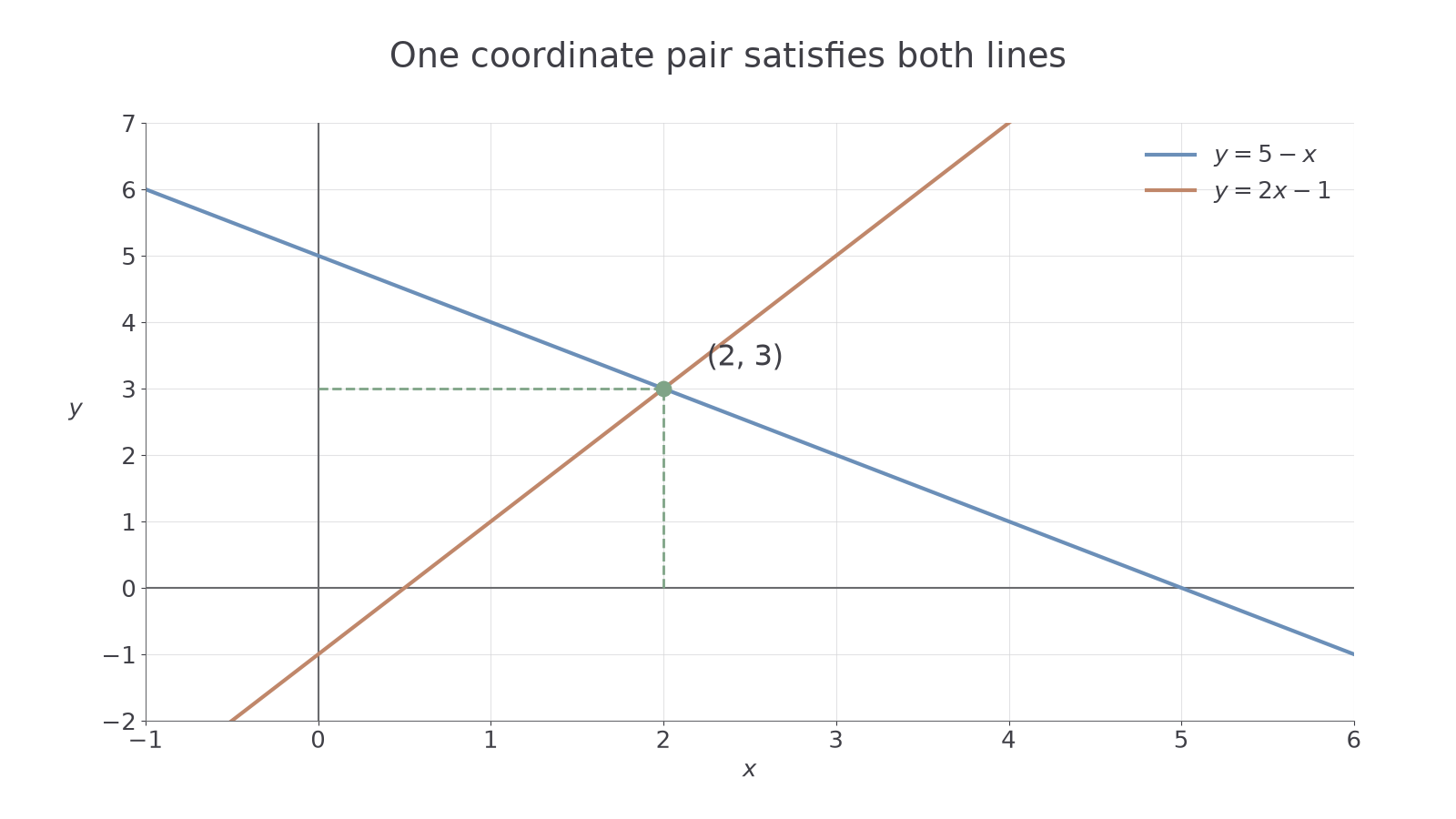
Each linear equation describes a straight line. A common point lies on both, so its two coordinates form a simultaneous solution.
For , use , with points . For , use . Plot both on the same axes with the same scales and draw each line with a ruler.
[DIAGRAM: asset_name: Common point of two linear equations; asset_slug: 1ma1_m29_linear_intersection; caption: The common point (2, 3) satisfies both straight-line equations.; description: A blue line y = 5 − x and clay line y = 2x − 1 meet at a sage point labelled (2, 3). Dashed guides project to x = 2 and y = 3 on labelled coordinate axes.]
Continue this lesson.
You’re previewing NovaLearn without an account. Create a free account to read the rest.
Create free account