G16, G17 - Volumes and surface areas of solids
Volume measures the space inside a solid; surface area measures its boundary. You will calculate both for prisms, cylinders, pyramids, cones and spheres, then decide which volumes and surfaces count when solids are joined or cut.
Volumes of right prisms
Can joining two solids increase their volume but reduce the surface area you can touch? Picture a cylinder with a cone fitted exactly onto its top. We will find what happens to their shared circular faces.
You already know
Area uses square units. Multiplying area by a length gives cubic units. A triangle's area is , and a circle's area is .
A right prism has a constant cross-section repeated along a perpendicular length. A cuboid is one example; a cylinder has the same constant-slice volume relationship. Ten thick slices of area occupy . Fractional lengths work too: the slices are a way to picture the space, not a requirement to cut it up.
Volume of a right prism
is the perpendicular distance between matching ends. Use consistent length units.
On the formula sheet (2026 version; the 2027 sheet will have the same content).
For a cuboid, the cross-section is a rectangle, so . For a cylinder it is a circle, so . These special forms are not separately printed: derive them from the prism-volume and rectangle/circle-area results.
Worked example 1: a triangular cross-section
Question. A right prism has triangular ends with perpendicular sides , , and length . Find its volume.
Plan. Find one end's area, then multiply by the prism length.
Why this step? The runs between the triangular ends; it is not a side of the triangle.
Answer. .
Check. A rectangular prism with the same by end would have twice this volume.
Change only the cross-section: use a circle of radius , keeping the length .
Worked example 2: a circular cross-section
Question. Find the exact volume of a cylinder of radius and height .
Plan. Multiply the circular end area by the height.
Why this step? Every horizontal slice has the same radius, so one cross-sectional area works throughout.
Answer. .
Check. Using gives about ; the calculator gives about .
At the same radius but height , the volume is , about . You can reverse the relationship too: volume divided by cross-sectional area gives length .
Watch out
Wrong: a diameter- cylinder uses . The formula needs radius, half the diameter. Use ; squaring the diameter would make the cross-sectional area four times too large.
For capacity, and litre. Use internal dimensions for the space a container can hold.
Pyramids, cones and their heights
A pyramid or cone narrows towards an apex, so it occupies less space than the matching prism or cylinder.
Its volume is exactly one third of the solid with the same base area and perpendicular height that does not taper. It is not one half: the cross-sections shrink in two directions. A cone's section halfway between its base and apex has half the radius, so its area is only one quarter of the base area.
Volumes of pyramids and cones
is the perpendicular distance from the apex to the base plane.
Provided in the question when needed; it is not on the formula sheet.
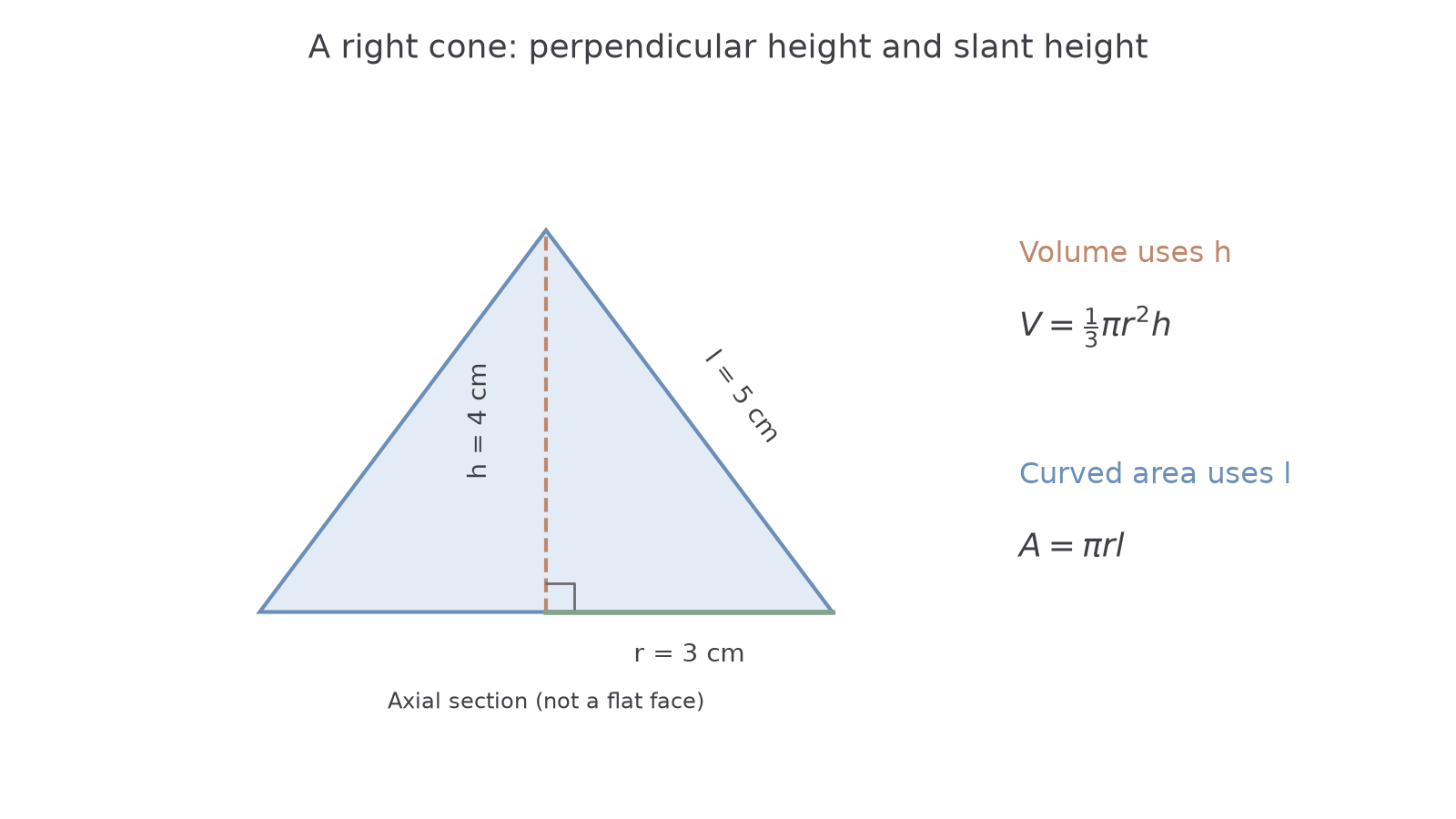
The height straight down through the solid differs from the slant height along its surface.
[DIAGRAM: asset_name: Perpendicular and slant heights of a right cone; asset_slug: 1ma1_m56_cone_heights; caption: Volume uses perpendicular height while curved area uses slant height; description: An axial section of a right circular cone shows a base radius of 3 cm, vertical perpendicular height h of 4 cm and slant height l of 5 cm along the right generator. A right-angle mark connects the radius and perpendicular height. The drawing is labelled as an axial section, not a triangular flat face.]
Worked example 3: a square-based pyramid
Question. A pyramid has a square base of side and perpendicular height . Use to find its volume.
Plan. Find the base area before applying the one-third factor.
Why this step? The formula takes an area, so the base side must first be squared.
Answer. .
Check. The matching cuboid has volume , three times as much.
Change the base from a square of side to a circle of diameter , keeping perpendicular height .
Worked example 4: a cone and its two heights
Question. A right cone has radius , perpendicular height and slant height . Use to find its exact volume.
Plan. Choose the perpendicular height for the volume formula.
Why this step? Slant height measures a journey along the surface; it does not measure how far the apex is from the base plane.
Answer. .
Check. The matching cylinder has volume , three times as much.
For a right square-based pyramid, distinguish three lines: perpendicular height to the base centre, face height to the midpoint of a base edge, and sloping edge to a vertex. Triangle-face area uses the face height. With base side and face height , the four faces have total area ; adding the base gives .
Watch out
Wrong: cone volume . This substitutes slant height. Use perpendicular height , giving .
The next cone changes the dimensions, while keeping the same choice of height.
Spheres and hemispheres
A sphere's radius runs from its centre to its curved surface; its diameter is twice the radius.
Sphere area and volume
These apply to a sphere of radius , with consistent units.
Provided in the question when needed; it is not on the formula sheet.
A hemisphere is half a sphere, cut through the centre. Halve the volume and the curved area. A solid hemisphere also has a new flat circular face; include it if it is exposed.
Worked example 5: a complete sphere
Question. Find the surface area and volume of a radius- sphere, using and .
Plan. Use a square for area and a cube for volume.
Why this step? Area and volume are different measurements; their powers of radius and their units must differ.
Answer. Area , volume .
Check. The volume is less than the enclosing side- cube's .
Change only the solid: cut the sphere in half and expose the cut face.
Worked example 6: a solid hemisphere
Question. Find the volume and total exposed area of a radius- solid hemisphere. Use the sphere results above and circle area .
Plan. Halve the sphere values, then add the flat circle to area only.
Why this step? Cutting creates a new boundary face, but it does not create extra solid volume.
Answer. Volume , area .
Check. Two separated hemispheres have more surface area than the sphere: their two cut faces are now exposed.
In general, hemisphere volume is , curved area is , and total area including the base is . These are not on the formula sheet: derive them from the supplied sphere results and circle area. An open bowl may ask for a different set of surfaces; read which ones count.
Watch out
Wrong: total hemisphere area . That counts only the curved surface. Add the exposed base to obtain .
A small numerical coincidence helps distinguish the units: a diameter- sphere has area and volume . The coefficients match, but the quantities do not.
Adding flat and curved areas
Surface area comes from listing the exposed faces and curved surfaces, then adding each once.
A cuboid has three pairs of equal faces. Dimensions , , give . A side- cube has six squares, giving . These are face additions, not volume formulae.
A prism's rectangular side faces have combined area equal to cross-section perimeter times length. Add both end areas. For a triangular end with sides and prism length , this gives
The area of an end and its perimeter do different jobs.
Cylinder and cone surfaces
Unroll a cylinder's curved surface into a rectangle, with width equal to circumference:
Not on the formula sheet: derive it from circle circumference and rectangle area.
For a right cone of radius and slant height :
Provided in the question when needed; it is not on the formula sheet.
Continue this lesson.
You’re previewing NovaLearn without an account. Create a free account to read the rest.
Create free account