G25 - Vector notation and arithmetic
A vector records a movement, including its direction. You will connect arrows with column notation, add and subtract displacements, scale them, and use routes to find missing vectors. These ideas describe the same movement even when the arrow is drawn in a different place.
Arrows, components and scalars
If you walk three steps right and two up, then later make exactly the same movement elsewhere, are the two arrows equal? Yes: their starting points differ, but the movements are identical. That distinction between a position and a movement is the heart of this lesson.
You already know
Coordinates give horizontal position first, then vertical position. A translation moves every point by the same horizontal and vertical amounts.
The column tells you to move three units right and two up. A negative top component means left; a negative bottom component means down. It does not mean “finish at ” unless you started at the origin.
Vector and scalar
A vector has both magnitude, meaning size, and direction. A displacement is a vector: specifies a movement. A scalar is a number with no direction attached, such as the multiplier . Equal vectors have equal magnitudes and the same direction, wherever they are drawn.
Write for the displacement from to . For each component, subtract the starting coordinate from the finishing coordinate. This coordinate-to-vector rule is not on the formula sheet: learn it. Reversing the arrow reverses both component signs.
Worked example 1: a vector from coordinates
Question. and . Find .
Plan. Calculate finish minus start in each coordinate.
Why subtract? A displacement measures the change from the starting point, not the finishing position alone.
Answer. .
Check. Starting at , moving right and up reaches .
Change only the arrow direction. The same two points are now visited in the opposite order.
Worked example 2: reversing the arrow
Question. and . Find .
Plan. Treat as the start and as the finish.
Why do both signs change? Returning along an arrow reverses every part of the movement.
Answer. .
Check. Adding this displacement to returns to .
Another arrow from to represents too. Its position changes, but its size and direction do not. The components are not lengths to add: a displacement of right and down has straight-line length , not , by Pythagoras. The original -right, -up vector similarly has magnitude .
Watch out
Wrong: because . Those are the finish coordinates, so the calculation ignores . Correct: subtract the start to get .
Keep the reverse-arrow task, changing just point .
Adding and subtracting displacements
Add vectors when one movement follows another. Their combined movement is the resultant.
For followed by , the horizontal changes add to , and the vertical changes add to . Draw the second arrow's tail at the first arrow's head, preserving its direction and length. The resultant joins the original start to the final finish.
[DIAGRAM: asset_name: Head-to-tail vector addition; asset_slug: 1ma1_m62_addition; caption: The two successive arrows have the same net displacement as the resultant arrow.; description: Coordinate graph with vector a from (0,0) to (3,2), vector b from (3,2) to (2,5), and resultant a plus b from (0,0) to (2,5). Blue represents a, clay b, and sage the resultant.]
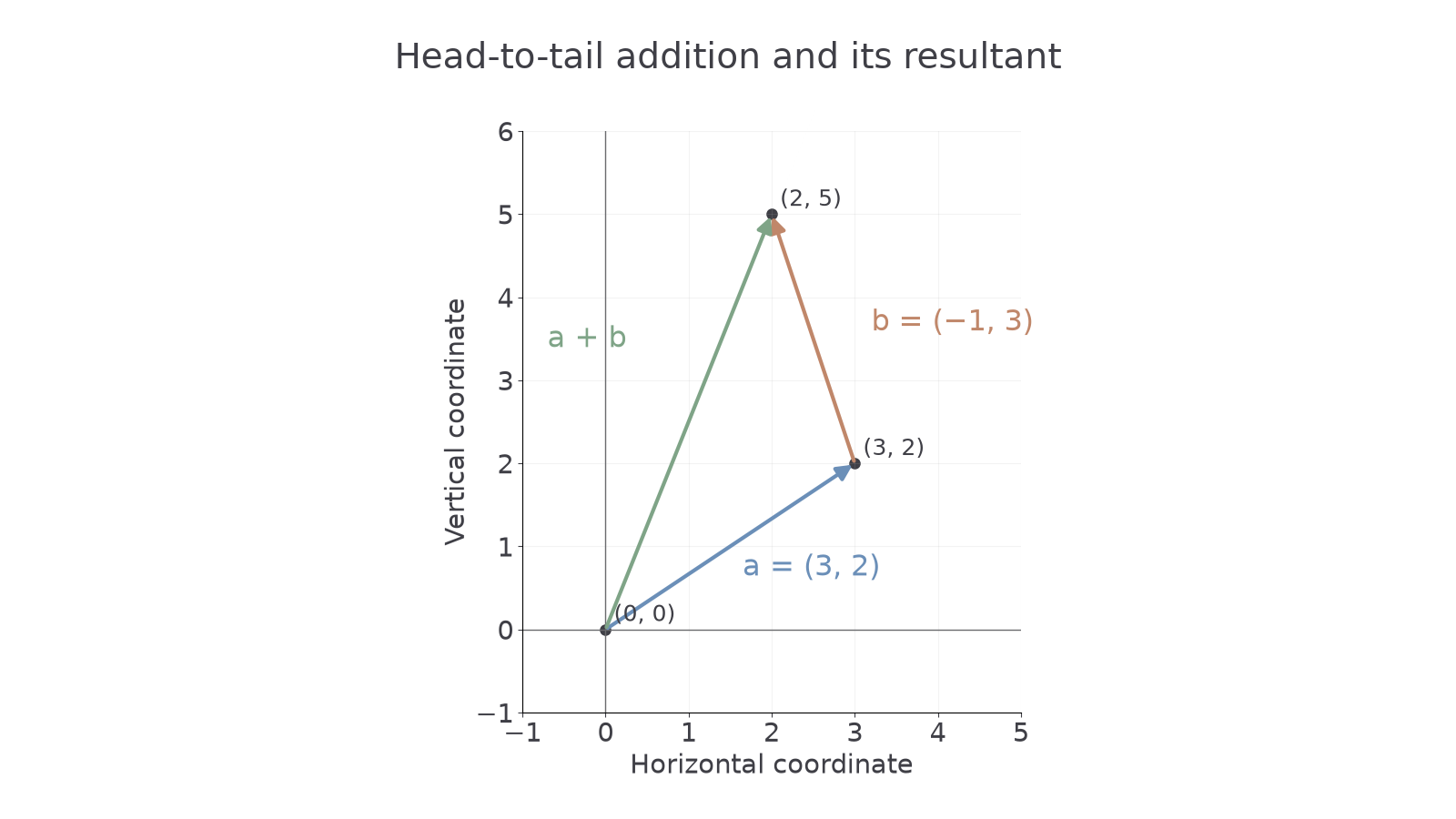
Moving an arrow parallel to itself preserves its vector. Rotating it changes its direction. Addition can be reordered because the component sums are unchanged, even though the intermediate route changes.
Vector addition and subtraction
Add or subtract matching components:
Subtraction adds the opposite vector: .
Not on the formula sheet: learn it.
The operation sign tells you whether to follow the second arrow forwards or backwards.
Worked example 3: adding two movements
Question. and . Find .
Plan. Add horizontal components, then vertical components.
Why pair the rows? Horizontal movement combines with horizontal movement, and vertical with vertical.
Answer. .
Check. The diagram ends at when the route begins at the origin.
Change only the operation from addition to subtraction. Keep the two vectors fixed.
Worked example 4: subtracting a movement
Question. For the same , find .
Plan. Reverse , then add it to .
Why does the top component increase? Subtracting is adding .
Answer. .
Check. Adding back gives .
The order matters for subtraction: is the opposite of .
Watch out
Wrong: the top component of is . This discards the negative sign in . Correct: write brackets first, . Subtract each signed component.
Change just the second vector from example 4 for your turn.
Continue this lesson.
You’re previewing NovaLearn without an account. Create a free account to read the rest.
Create free account