G19, R12 - Congruence and similarity of lengths
Congruent figures have the same size and shape; similar figures keep the same shape while allowing a change of size. You will match corresponding sides, use length scale factors in either direction, and explain why similar right triangles have equal side ratios.
Congruent and similar figures
A photo is wide and high. If you print it wide, what height keeps the picture from looking stretched? Matching just the width is not enough: every corresponding length needs the same multiplier.
You already know
Translation, rotation and reflection preserve lengths and angles. An enlargement multiplies every length by its scale factor. A triangle's angles sum to .
Two figures can face different ways and still match. Turn or reflect them mentally before deciding which vertices correspond.
Congruence and similarity
Congruent figures fit exactly after a combination of translations, rotations or reflections: corresponding lengths and angles are equal.
Similar figures have equal corresponding angles and corresponding lengths in one common ratio. Congruent figures are the scale-factor- case of similarity.
Corresponding means matching positions. If is similar to in that order, matches , matches , and matches . Thus matches , not whichever side happens to be nearest it on the page.
Recall the triangle congruence tests: SSS, SAS with the included angle, ASA, and RHS with a right angle, hypotenuse and another side. For triangle similarity, use:
| Test | What must match |
|---|---|
| AA | Two corresponding angles; the third then follows from the angle sum |
| SSS similarity | All three corresponding side ratios |
| SAS similarity | Two corresponding side ratios and their equal included angle |
These criteria are not on the formula sheet: learn them. For example, two angles of and fix the third at , whatever the triangle's size.
Worked example 1: a common side multiplier
Question. Are triangles with sides and similar? Are they congruent?
Plan. Match sides by length order and compare all three ratios.
Why this step? One matching ratio does not establish that the whole shape has been scaled consistently.
Answer. They are similar by SSS similarity. They are not congruent because their corresponding lengths differ.
Check. Every larger side is twice its partner, while the factor is not .
Change just the longest side of the second triangle, from to . This tests whether two correct ratios are enough.
Worked example 2: one mismatched side
Question. Are triangles with sides and similar?
Plan. Compare the third side ratio with the first two.
Why this step? Similarity needs the same multiplier for every corresponding length; two equal ratios do not make the third one equal.
Answer. The triangles are not similar.
Check. Doubling the first triangle's longest side gives , not .
AA is special to triangles. Rectangles of dimensions by and by both have four right angles, but their length ratios are and . Equal angles alone do not make these rectangles similar.
Watch out
Wrong: “Both rectangles have right angles, so they are similar.” Their widths changed by a different factor from their heights. Check both dimensions; these rectangles are not similar.
Now change just one side in the second triangle again.
Scale factors and corresponding lengths
A scale factor has a direction: divide a destination length by its corresponding starting length.
For the opening photo, width changes by . The height must change by that same factor, from to . Adding to both dimensions would distort it.
Corresponding-length scale factor
Use matching lengths in the same unit. Reversing direction uses . Perimeters also multiply by , because every boundary segment does.
Not on the formula sheet: learn it.
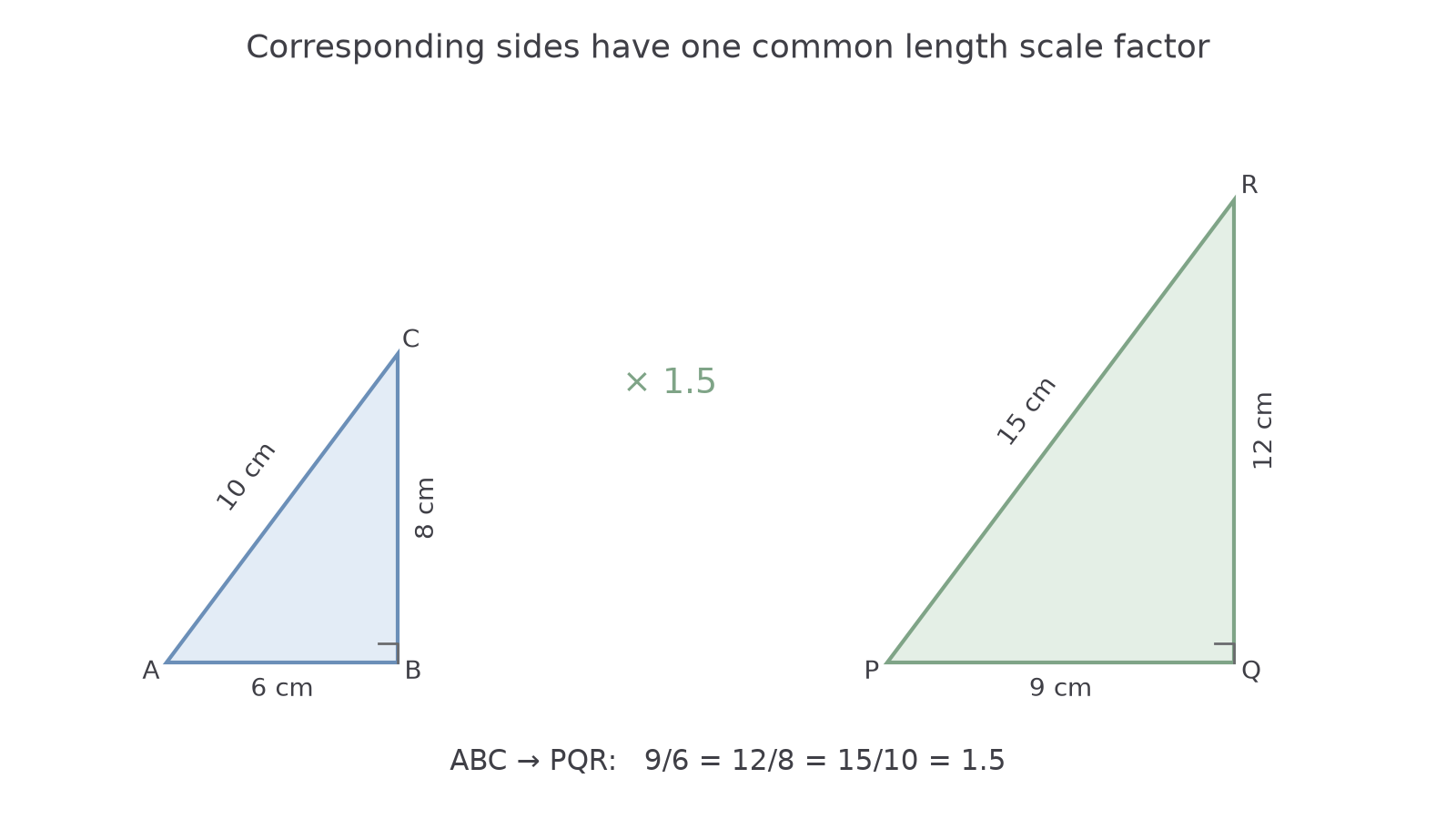
The similar triangles below show one factor applying to all three corresponding lengths.
[DIAGRAM: asset_name: Corresponding lengths in similar right triangles; asset_slug: 1ma1_m57_similar_triangles; caption: The same multiplier takes every smaller length to its corresponding larger length; description: A blue triangle ABC has sides AB 6 cm, BC 8 cm and AC 10 cm. A sage similar triangle PQR has sides PQ 9 cm, QR 12 cm and PR 15 cm. Matching vertices and right angles are labelled, with a caption showing scale factor 1.5 from ABC to PQR.]
Worked example 3: scaling towards the larger triangle
Question. Similar triangles and correspond in that order. , , , , all in centimetres. Find , and the larger perimeter.
Plan. Find the factor from to , then multiply each matching length.
Why this step? The stated vertex order fixes which sides correspond before any ratio is formed.
Answer. , , perimeter .
Check. , and each side ratio is .
Continue this lesson.
You’re previewing NovaLearn without an account. Create a free account to read the rest.
Create free account