A24, A25 - Quadratic and surd sequences
A24 extends sequence recognition to surd ratios and other rules. A25 develops quadratic nth terms. You will use differences, exact arithmetic and equations to find rules, test membership and recover unknown parameters.
Deducing a quadratic nth term (Higher)
The sequence grows too quickly for a linear rule. Can its differences reveal a direct formula for the hundredth term? Start by separating the square contribution from what remains.
You already know
An arithmetic sequence has a linear rule. To find its rule, use the constant difference as the coefficient of , then adjust the constant to match the first term.
First differences here are . Second differences are .
Quadratic sequence
A quadratic sequence has a rule , with , at consecutive integer positions. Its second differences are constant and nonzero.
The second difference of is 2 because , whose next difference is 2. Multiplying by scales this to . The linear part contributes a constant first difference and zero second difference; the constant disappears immediately.
Quadratic second difference
For at consecutive integer positions,
Not on the formula sheet: derive it from the differences of square numbers.
Once is known, subtract from the terms. The remainder is linear.
[DIAGRAM: asset_name: Separating quadratic and linear sequence parts; asset_slug: 1ma1_m35_quadratic_remainder; caption: Subtracting 2n squared leaves the linear sequence 4, 7, 10, 13, 16.; description: A three-row numerical diagram aligns positions 1 to 5, terms 6, 15, 28, 45, 66, squared contributions 2, 8, 18, 32, 50 in blue, and remainders 4, 7, 10, 13, 16 in sage. Labels identify the rule 2n squared + 3n + 1 and constant second difference 4.]
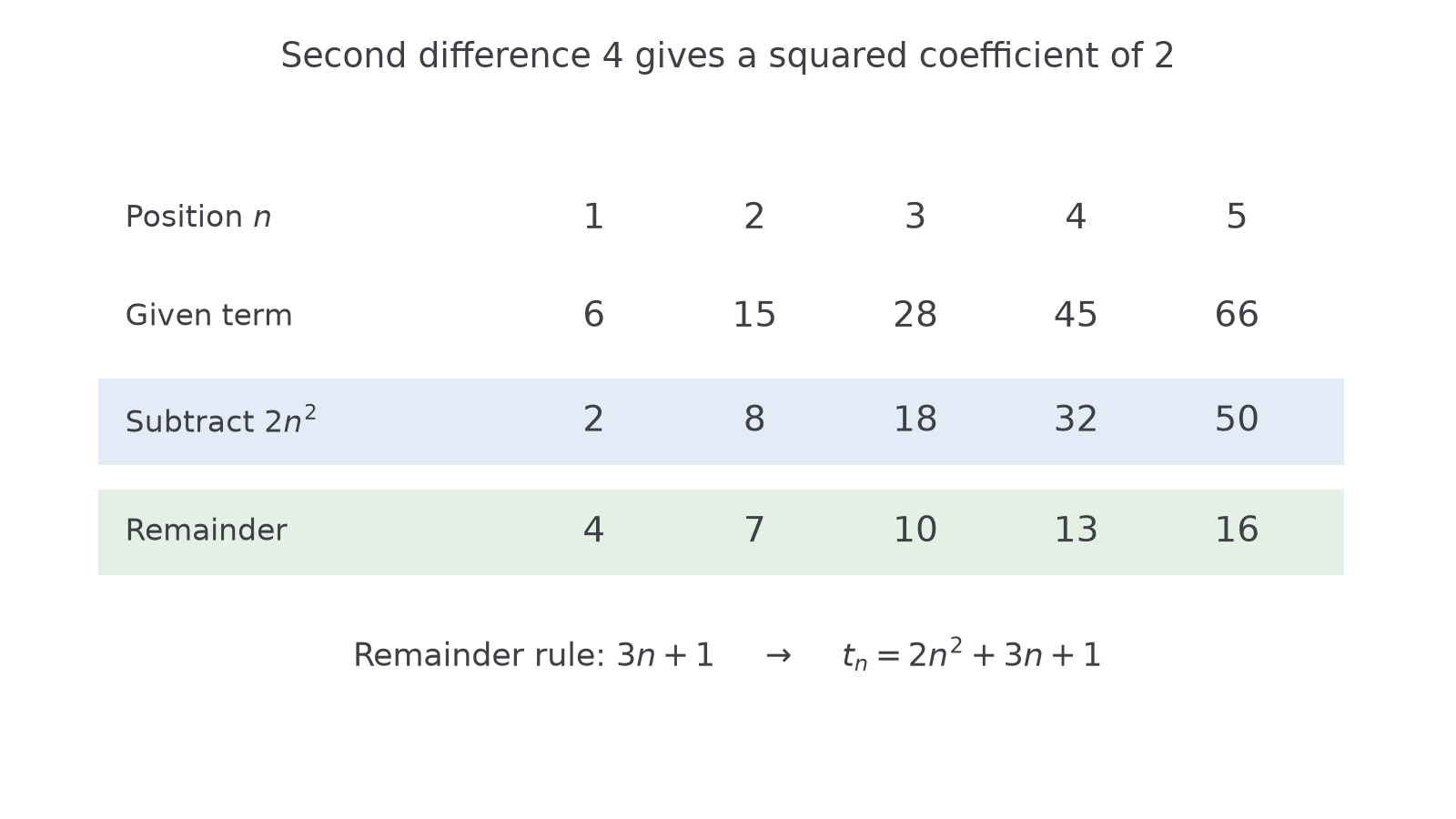
The diagram shows the two contributions in the opening sequence.
Worked example 1: removing the square contribution
Question. Find the nth term of the quadratic sequence , starting at position 1.
Plan. Halve the second difference, subtract that multiple of , then find the linear remainder.
Why subtract ? It removes the quadratic contribution, leaving a familiar linear sequence.
Answer. .
Check. , .
Change only the squared coefficient from 2 to , retaining the linear remainder . Now the second difference will be negative.
Worked example 2: a negative squared contribution
Question. Find the nth term of the quadratic sequence .
Plan. Use the negative second difference and subtract the negative square contribution.
Why add in the remainder row? Subtracting a negative contribution means adding it.
Answer. .
Check. , .
The same method gives for : adding leaves , whose rule is .
The method needs consecutive, equally spaced positions and a stated quadratic class. A short list alone does not uniquely determine an infinite continuation. Check your rule against every supplied term.
Watch out
Wrong: second difference 4 means . Right: it means , because the second difference is twice the coefficient. Also find the remainder: the squared part alone is rarely the whole rule.
Change only the squared coefficient from to , again keeping the same linear remainder.
Terms and membership of a quadratic sequence (Higher)
A position gives a term by substitution. A proposed term gives an equation for the position.
For a membership equation that does not factorise, use the quadratic formula from quadratic equations. On the formula sheet (2026 version; the 2027 sheet will have the same content).
For , the first terms are . Its tenth term is . Position 10 is the input; 130 is the output.
Worked example 3: a permitted position
Question. Is 54 a term of , for positive integer ?
Plan. Set the rule equal to 54 and check which roots are valid positions.
Why reject ? The sequence starts at position 1.
Answer. Yes, 54 is the sixth term.
Check. .
Change only the proposed term from 54 to 55. A nearby value need not occur.
Worked example 4: no integer position
Question. Is 55 a term of the same sequence?
Plan. Solve the membership equation and inspect the positions.
Why not round the root? A nearby integer position gives a different term.
Answer. No; neither root is a positive integer.
Check. The neighbouring terms are , . The sequence increases for positive , since .
Not every quadratic sequence increases forever. A negative leading coefficient eventually makes terms decrease, and two positive positions can give the same value. For example, gives 11 when , so or 7. If a tile model permits stages 1 to 5 only, just stage 1 is allowed.
A sequence is defined at integer positions, rather than every point on a parabola. Use a graph to guide the algebra, then check the position's domain.
Watch out
A positive root is not enough: the position must be an integer and must satisfy any contextual limit. Rejecting one root does not automatically reject the other.
Change only the proposed term again.
Surd ratios and other sequence rules (Higher)
A geometric progression can multiply by an exact surd. Simplifying its products reveals the pattern.
Geometric progression
A geometric progression multiplies by the same common ratio at every step. For nonzero terms, divide a term by its predecessor to find that ratio.
Starting at 2 and multiplying by gives . Rational and irrational terms alternate because two successive multiplications multiply by .
Continue this lesson.
You’re previewing NovaLearn without an account. Create a free account to read the rest.
Create free account