G9, G17, G18 - Circles, circumference, arcs and sectors
A radius fixes a circle's size, and a central angle fixes a fraction of that circle. You will identify circle features, calculate lengths and areas, recover missing values, and trace the correct boundary of a circular shape.
Lines and regions in a circle
A circular slice has radius and angle . How much ribbon would go all the way around it: just its curved edge, or something more?
First separate lines from regions. A circle consists of the points in a plane at a fixed distance from a fixed centre. That distance is its radius; a radius segment joins the centre to the circle. All radii of one circle are equal.
Circle lines
A chord is a line segment joining two points on a circle. A diameter is a chord through the centre. The circumference is the complete curved boundary, or its length. An arc is part of the circumference. A tangent is a straight line meeting a circle at just one point.
For example, a diameter of consists of two radii of . A chord above the centre is shorter than the diameter and is not a diameter. The relationship is not on the formula sheet: learn it.
Two endpoints usually divide the circumference into a shorter minor arc and a longer major arc. Their central angles add to . If the endpoints form a diameter, the two arcs are equal semicircles. A minor angle of leaves a major angle of ; these angles make a full turn, not a right angle.
Circle regions
A sector is the region bounded by two radii and an arc. A segment is the region between a chord and its arc. A semicircle is half a circular disc, bounded by a diameter and a semicircular arc.
A sector resembles a slice reaching the centre. A segment has one straight chord boundary and need not reach the centre. Drawing a chord across a sector does not make the whole sector a segment.
[DIAGRAM: asset_name: Circle vocabulary; asset_slug: 1ma1_m51_vocabulary; caption: A sector has two radius boundaries; a segment has a chord boundary.; description: Three panels use circles of equal radius. The first labels centre O, radius, diameter, chord, circumference and a tangent. The second shades a minor sector and identifies its arc and central angle. The third shades a minor segment between a chord and the minor arc, with the remaining major arc indicated.]
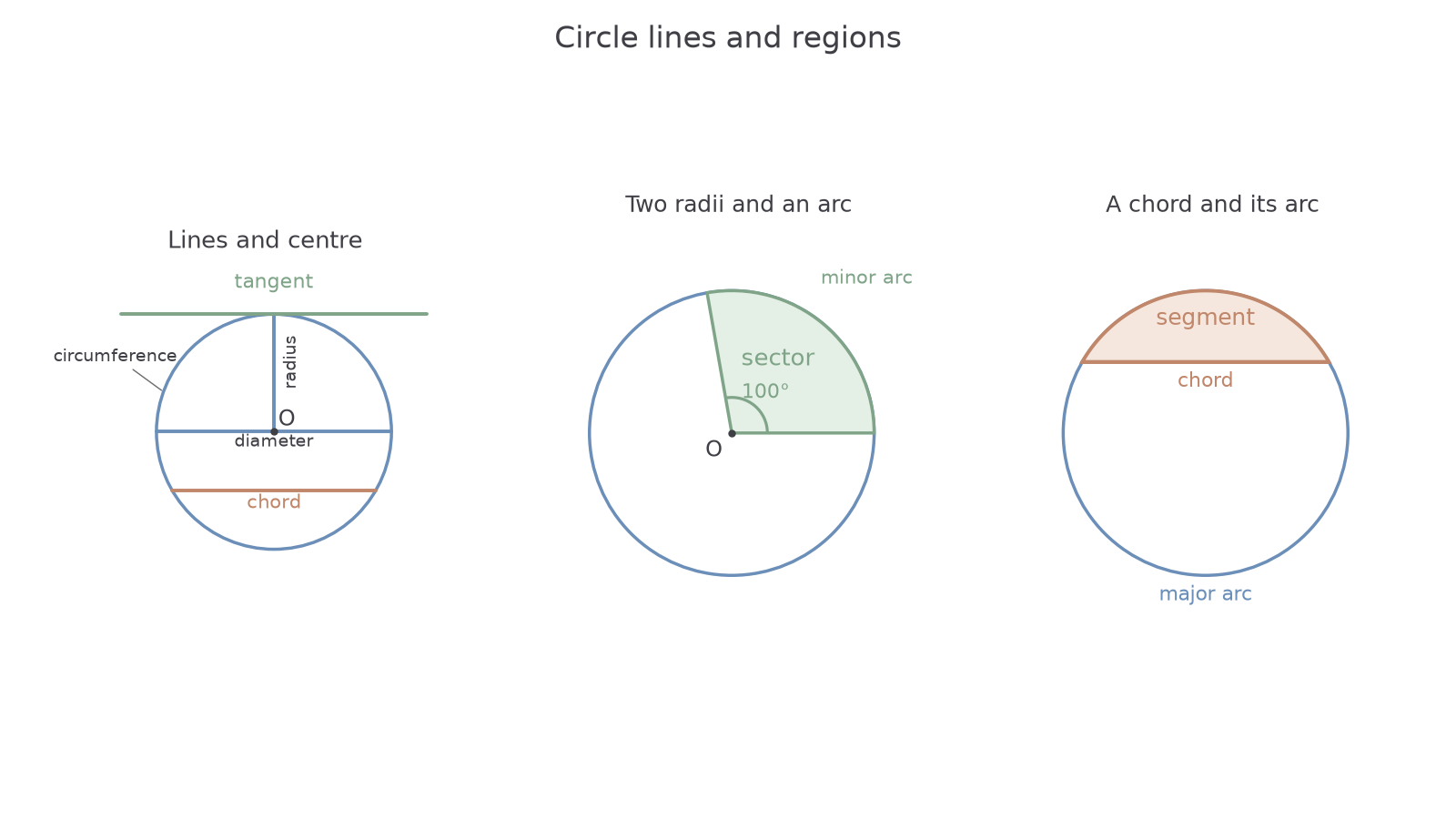
A line crossing the circle twice is not a tangent. The finite piece between its two intersection points is a chord. Use the stated endpoints and boundaries to name a feature, rather than judging its size or orientation.
Key idea
Name a region by its boundaries: two radii and an arc give a sector; a chord and an arc give a segment.
The next check asks you to use both the length relationship and the region's boundaries.
Circumference and area of a circle
Circumference measures the distance around a circle; area measures the amount of flat space inside it.
You already know
A diameter is twice a radius. Length uses units such as centimetres; area uses square units such as square centimetres. Squaring 6 gives .
Every circle has the same circumference-to-diameter ratio, , approximately . Keeping in an answer can give an exact value. A finite decimal such as 3.14 is only an approximation.
Circle circumference and area
For radius , diameter , circumference and area ,
Use the radius in the area formula, and square it before multiplying by .
On the formula sheet (2026 version; the 2027 sheet will have the same content).
Why does the area involve ? Cut a disc into many thin sectors and alternate their directions. The rearrangement approaches a rectangle of height and base equal to half the circumference, . Its area approaches . Thin sectors make a better approximation than a few wide ones.
Worked example 1: from radius to length and area
Question. A circle has radius . Find its circumference and area exactly.
Plan. Use the same radius in both formulae, squaring it only for area.
Why this step? Circumference counts lengths, while area needs the product of two lengths.
Answer. and .
Check. The diameter is 12, so . The area is less than the enclosing -by- square.
The next example keeps the same circle but changes the information supplied: circumference replaces radius. Recover the radius before calculating area.
Worked example 2: working back from circumference
Question. A circle has circumference . Find its radius and area.
Plan. Undo multiplication by , then use the radius in the area formula.
Why this step? Circumference gives after division by , rather than giving the radius directly.
Answer. Radius , area .
Check. Substituting returns the given circumference .
Area can also be used backwards. If , then
Take the positive square root because a physical radius is positive. These inverse relationships are not separate printed formulae: derive them from the circle formulae.
Watch out
Wrong: diameter gives area . That squares the diameter. Right: halve it first to get radius 6, then calculate .
Doubling a radius doubles circumference but quadruples area: radius 3 gives and , while radius 6 gives and . For decimals, use the calculator's key and round only the final result. In your turn, only the supplied circumference changes.
Arc lengths and central angles
An arc occupies the same fraction of the circumference as its central angle occupies of a full turn.
For radius , the full circumference is . A turn is one third of , so the corresponding arc is one third of .
Arc length
For radius and corresponding central angle in degrees,
Use the angle belonging to the required arc.
Not on the formula sheet: derive it from the circle circumference and the fraction of a full turn.
This measures the curved route between endpoints. A chord is the straight route between them and generally has a different length.
Worked example 3: a minor arc
Question. A circle has radius . Find the minor arc corresponding to .
Plan. Find the full circumference and take the angle's fraction.
Why this step? Equal central turns cut equal lengths along the same circle.
Answer. .
Check. Three such arcs make , the full circumference.
The next example changes only the requested arc, from minor to major. The radius and the marked minor angle stay the same.
Worked example 4: the remaining major arc
Question. Two radii of a radius- circle enclose . Find the major arc between their endpoints.
Plan. Find the remaining angle, then its fraction of the circumference.
Why this step? The given labels the shorter arc, so using it directly would answer a different question.
Answer. .
Check. Minor plus major is .
For a missing angle, reverse the fraction:
An arc of on a radius- circle occupies of it, so . For a missing radius, substitute first: gives . Both methods derive from the arc-length relationship; neither is separately on the formula sheet.
Continue this lesson.
You’re previewing NovaLearn without an account. Create a free account to read the rest.
Create free account