N10, N12 - Fractions, decimals and percentage operators
Fractions, decimals and percentages are different ways to describe the same proportion. N10 connects terminating decimals with exact fractions; N12 uses fractions and percentages as operators, both to find a part and to recover its whole.
Terminating decimals as exact fractions
A jug contains litres, and this is of its capacity. Can you find the full capacity without rounding? First turn the decimal into an exact fraction.
You already know
A fraction represents division. Multiplying or dividing its numerator and denominator by the same non-zero number preserves its value.
A terminating decimal ends after finitely many decimal places. Its final place tells you the denominator: tenths use ten, hundredths use a hundred, and so on. Leading zeros matter: , not .
Worked example 1: decimal to fraction and back
Question. Write as a fraction in simplest form, then check by conversion back.
Plan. Use the thousandths column and simplify.
Why? The denominator counts the size of each place, rather than the number of non-zero digits.
Answer. .
Check. .
Change only the whole-number part, from zero to one. The fraction will now be improper.
Worked example 2: a value above one
Question. Write as a fraction in simplest form and check it.
Plan. Keep all the digits over a thousand before simplifying.
Why? A decimal above one needs a numerator larger than its denominator.
Answer. , or .
Check. The fraction exceeds Example 1 by exactly one.
Signs and trailing zeros behave normally: , and . To convert in the other direction, use division or an equivalent power-of-ten denominator: .
Here is a useful surprise: in simplest form, a fraction terminates exactly when its positive denominator contains only prime factors two and five. Powers of ten contain only those primes. For instance, , while a remaining factor three prevents a power-of-ten denominator. Simplify first: terminates.
Watch out
Keep the sign and count every decimal place. Wrong: . Right: .
Change only the whole-number part again.
Percentages and equivalent proportions
Per cent means “per hundred”. So ; the percentage symbol is part of the value.
Percentage
A percentage describes an amount per hundred of a reference whole. is one whole; is wholes.
Divide the percentage number by a hundred to find its decimal. Reverse this by multiplying a decimal by a hundred and attaching the percentage sign. Fractions can go through decimals too: .
Worked example 3: equivalent forms of a percentage
Question. Write as a decimal and a fraction in simplest form.
Plan. Divide by a hundred, then express the decimal as thousandths.
Why? Less than one per cent must be less than of the whole.
Answer. and .
Check. , giving again.
Change only the percentage to . The same conversion now produces more than one whole.
Worked example 4: more than a whole
Question. Write as a decimal and a fraction in simplest form.
Plan. Divide by a hundred and simplify the resulting fraction.
Why? A percentage above a hundred represents more than the reference whole.
Answer. and .
Check. .
The reference matters. A container can have of another container's capacity, but a subset cannot contain of the members of its own whole. Common equivalents include , , and .
To compare proportions, use a common form: . Comparing the printed numerals alone ignores their meaning.
Watch out
Wrong: . Right: . A percentage number must be divided by a hundred.
Change only the percentage in the second example.
Taking a fraction and recovering the whole
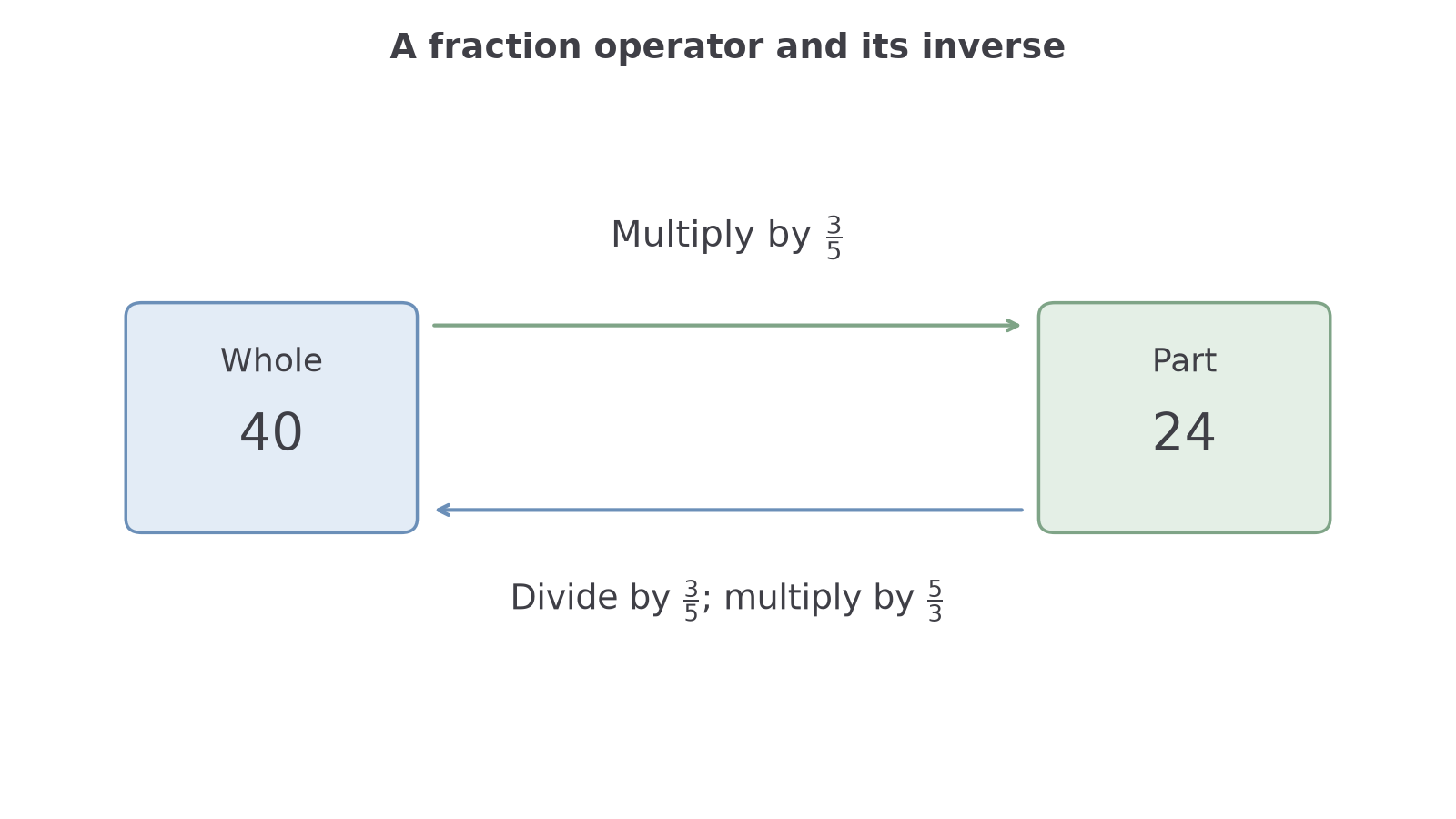
An operator acts on a quantity. Taking of means splitting forty into five equal parts, then taking three: .
Fraction operator
Taking of a quantity means multiplying the quantity by , with . “Of” asks for multiplication here.
To recover the whole, undo that operation by dividing by the fraction, or multiplying by its reciprocal.
[DIAGRAM: asset_name: A fraction operator and its inverse; asset_slug: 1ma1_m08_fraction_operator; caption: Multiplying by three fifths takes 40 to 24; multiplying by five thirds recovers 40.; description: A left box labelled whole 40 and a right box labelled part 24 are linked by a forward arrow labelled multiply by 3 over 5 and a return arrow labelled divide by 3 over 5, equivalent to multiply by 5 over 3.]
Worked example 5: finding a part and undoing it
Question. Find of . Show how this part recovers the original length.
Plan. Divide by four and multiply by three; reverse those steps to recover the whole.
Why? The known part contains three quarters, so divide it by three to find one quarter.
Answer. The part is ; its whole is .
Check. , with the same unit.
Change only the fraction to . This time the operator enlarges the quantity.
Worked example 6: an improper fraction operator
Question. Find of and recover the original length from it.
Plan. Take five quarters, then divide by that same fraction.
Why? “Part” need not mean smaller when the fraction exceeds one.
Answer. , recovering .
Check. .
If of a tank's capacity is litres, one eighth is litres, so capacity is litres. For the opening jug, litres exactly.
Watch out
If of a whole is , multiplying by repeats the operation. Recover the whole with .
Change only the length in the improper-fraction example.
Percentages as multipliers
A percentage operator is the same idea with a fraction out of a hundred. For of , calculate . Alternatively add , and : .
Percentage operator
Use the stated reference quantity . To recover from a non-zero percentage part, divide by .
Not on the formula sheet: learn it.
If of eighty counters are removed, the remaining is . The removed and remaining add to the original eighty. Above a hundred per cent works too: of is .
Worked example 7: finding and reversing a percentage
Question. Find of , then recover the whole from that part.
Plan. Convert the percentage to a multiplier and reverse by division.
Why? The percentage always acts on the reference whole, not automatically on the last number written.
Answer. The part is ; its whole is .
Check. Ten per cent is sixty, so five per cent is thirty.
Change only the percentage from to . The part should be ten times smaller.
Worked example 8: less than one per cent
Question. Find of , then recover the whole from that part.
Plan. Divide the percentage number by a hundred before multiplying.
Why? is one half of one per cent, not one half of the whole.
Answer. The part is ; its whole is .
Check. One per cent of six hundred is six; half of six is three.
Recovery works for any stated non-zero percentage: if of a mass is , the whole is . Check . A percentage alone cannot tell you an amount: of fifty and of two hundred are different quantities.
Watch out
Wrong: if of a mass is , the whole is . This applies the operator twice. Right: undo it with .
Change only the whole in Example 8.
Quick Recap
- Place value converts terminating decimals to exact fractions; simplify the result.
- Per cent means per hundred, including percentages below one or above a hundred.
- Multiply by a fraction or percentage multiplier to find its part.
- Divide by the same non-zero operator to recover the reference whole.
The opening jug has capacity exactly litres, or litres.