G1, G4 - Geometrical language, triangles and quadrilaterals
A square is still a square when you turn it onto a corner. You will use precise geometrical language and diagram marks, recognise triangles and quadrilaterals from their properties, and turn written descriptions into drawings.
Points, lines and geometrical notation
If a square is drawn like a diamond, has its shape changed? Its position has changed, but its equal sides and right angles have not. Geometry lets you describe those facts precisely.
You already know
A number describes a measurement only when you know what is measured. A side length such as and an angle such as describe different things.
A point is a position with no length or width. Two distinct points determine a straight line, which continues indefinitely both ways. A line segment has two endpoints; a ray has one endpoint and continues one way. names the segment joining and , or its length in a calculation. A plane is a flat surface extending indefinitely.
A vertex is a corner; its plural is vertices. An edge of a solid is where two faces meet. A cube has 8 vertices and 12 edges: a crossing in a perspective drawing is not automatically another vertex.
Parallel and perpendicular
Parallel lines lie in the same plane and never meet, however far you extend them. Perpendicular lines meet at a right angle, . Write and .
Matching arrow marks show parallel sides; matching ticks show equal lengths. A small square shows a right angle. These marks give information even when the sketch is not to scale. An arrow at a line's end instead tells you that the line continues.
In , the middle letter of gives its vertex, . Its arms are and ; names the same angle. Lower-case side letters lie opposite the matching capitals: , , . This convention still works when the triangle is turned.
[DIAGRAM: asset_name: Triangle notation and geometrical marks; asset_slug: 1ma1_m45_notation; caption: The middle letter identifies an angle vertex, while lower-case side labels lie opposite matching capital vertices.; description: A triangle ABC has side a on BC, b on AC and c on AB, with angle ABC marked at B. Separate examples show matching parallel arrows, equal-length ticks and a right-angle square.]
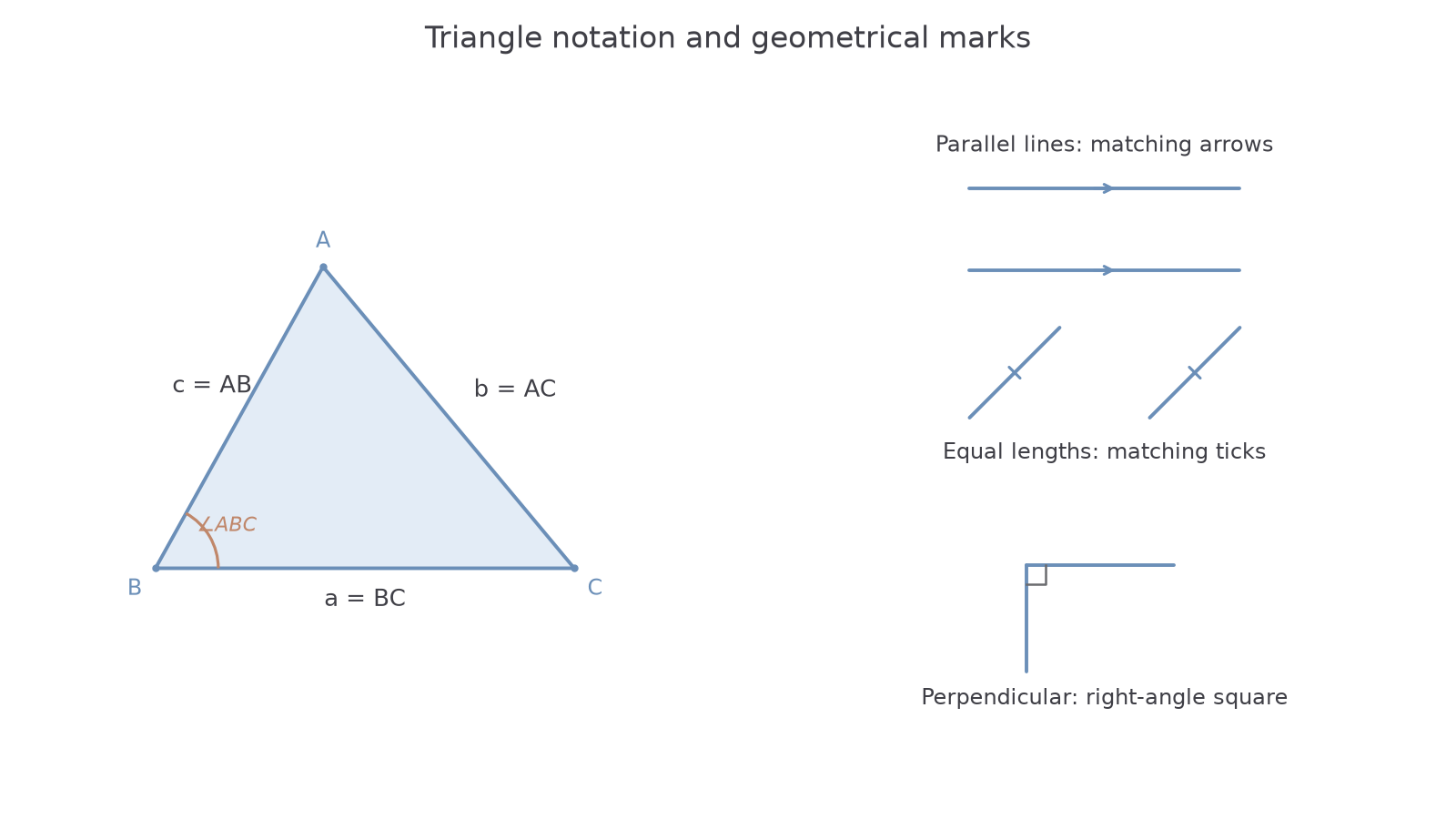
For instance, “ and lies on ” tells you to mark two equal sides meeting at . It does not tell you that is the midpoint. Keep given facts separate from things that merely look plausible.
Key idea
Read labels and marks before judging the picture. A shape's orientation does not change its properties.
Try reading the middle letter and the opposite-side convention separately.
Special triangles and plane figures
A triangle can have two useful descriptions at once: a right-angled isosceles triangle has both a right angle and two equal sides.
An equilateral triangle has three equal sides and three equal angles, each . An isosceles triangle has two equal sides; the angles opposite them, its base angles, are equal. A scalene triangle has three different side lengths. Equal sides imply equal opposite angles; the congruence proof comes in the lesson on geometrical arguments.
An acute-angled triangle has all angles below . A right-angled triangle has one angle of ; the opposite side, the hypotenuse, is longest. An obtuse-angled triangle has one angle above . Two obtuse angles would already exceed a triangle's total.
Triangle angle sum
For every triangle in a plane,
Not on the formula sheet: learn it.
The next lesson derives this result. Here it helps turn a shape definition into an angle calculation.
Worked example 1: equal base angles
Question. and . Find the other two angles.
Plan. Subtract the apex angle, then share the remaining angle equally.
Why divide by two? The equal sides are opposite the two base angles, so those angles share the remainder equally.
Answer. Both base angles are .
Check. .
Change only the apex angle from to . The equal-side information, and therefore the method, stays the same.
Worked example 2: a different apex angle
Question. and . Find the base angles.
Plan. Remove the apex angle from , then halve.
Why not halve ? It is the known apex angle, not the total of the two unknown angles.
Answer. Each base angle is .
Check. .
If a base angle is given instead, use it twice: base angles of leave apex angle .
A polygon is a closed plane shape made of straight sides. Triangles have 3 sides, quadrilaterals 4, pentagons 5, hexagons 6, heptagons 7, octagons 8, nonagons 9 and decagons 10. A circle is a plane figure but not a polygon. A convex polygon has every interior angle below ; a concave polygon has an inward corner with a reflex interior angle.
Watch out
Wrong: “, so the angles at and are equal.” Match angles to the sides opposite them. The equal angles are at and ; is the apex.
Now change only the apex angle again.
Quadrilateral definitions and consequences
Definitions give a reliable way to recognise a quadrilateral, including when its diagonals or angles are the useful clues.
A parallelogram has both pairs of opposite sides parallel. A diagonal cuts it into two matching triangles: alternate angles agree and the diagonal is shared. This explains its equal opposite sides. Opposite angles are equal, adjacent angles total , and its diagonals bisect one another, meeting at each diagonal's midpoint. They need not be equal or perpendicular.
A rectangle is a parallelogram with four right angles. Its diagonals bisect one another and are equal: the right triangles built from a length, a width and a diagonal match. Four equal sides are not required.
A rhombus is a parallelogram with four equal sides. Its diagonals bisect each other at right angles and bisect its vertex angles. To see why, let them meet at in . Triangles and have , and common . Matching these triangles gives equal adjacent angles at , so each is , and equal angles at . Repeat at the other vertices. The diagonals need not be equal.
A square is both a rectangle and a rhombus. It has four equal sides and four right angles, so it has both sets of diagonal properties. These quadrilateral properties are not on the formula sheet: learn them.
Continue this lesson.
You’re previewing NovaLearn without an account. Create a free account to read the rest.
Create free account