A17, A21 - Linear equations and mathematical models
A17 uses algebra and graph intersections to solve linear equations. A21 turns quantities and number procedures into equations, then interprets the answers. You will keep equality balanced, handle brackets and fractions, and check that a solution makes sense.
Equality and inverse operations
A bill is £27, including £3 delivery and £4 for each identical box. How many boxes were bought? We need an unknown that makes the total correct, rather than a guess that happens to look reasonable.
Solution of an equation
A solution is a value of the unknown that makes the original equality true. Solving means finding every such value.
An equation is like a balanced pair of quantities. Adding or subtracting the same amount on both sides preserves equality. So does multiplying or dividing both sides by the same non-zero number. Changing one side alone generally changes the solution.
A linear equation has the unknown only to the first power after simplification. A familiar form is . When , inverse operations isolate .
Worked example 1: undo two operations
Question. Solve .
Plan. Undo addition first, then multiplication.
Why this step? The expression multiplies first and adds second, so undo those operations in reverse order.
Answer. .
Check. , matching the original right side.
Change only the right side, from 20 to . The inverse operations stay the same.
Worked example 2: a negative solution
Question. Solve .
Plan. Subtract 5 from both sides, then divide by 3.
Why this step? The sign of the right side does not change the balance rule.
Answer. .
Check. .
A negative answer is allowed unless a context excludes it. A fractional coefficient works too:
Checking gives . Division by zero is never an allowed solving step.
Watch out
From , the line adds 5 on the right while removing it on the left. Subtract 5 from both sides to get .
State the value of at the end. Stopping at has not finished solving.
Brackets, fractions and both sides
Simplify first, then collect unknown terms on one side and constants on the other. Each “move” is really an equal operation on both sides.
For , multiply both terms inside the bracket:
Both original sides then equal 33. The bracket protects the order of the calculation.
Numerical denominators can be cleared by multiplying every term by a common multiple. This makes collecting the unknown easier.
Worked example 3: a fraction and unknowns on both sides
Question. Solve .
Plan. Multiply the whole equality by 3, then collect terms.
Why this step? Multiplying by 3 must affect the entire right side, including .
Answer. .
Check. and .
Change only the final constant on the right from to . A fractional solution is perfectly valid.
Worked example 4: a fractional solution
Question. Solve .
Plan. Clear the denominator in exactly the same way.
Why this step? A non-integer answer is not evidence of a mistake. Check it in the original equation.
Answer. .
Check. The left side is ; the right side is .
With several denominators, use a common multiple. For
multiplying every term by 6 gives . Expanding gives , then . Substitution gives . This is multiplication of complete terms, not arbitrary removal of fraction bars.
Sometimes the unknown cancels. In , simplification gives , true for every real . In , it gives , so there is no solution. A true identity does not force .
Watch out
The line misses a term. Multiplying the entire right side gives .
An unknown in a denominator needs a restriction against zero; the examples here have fixed, non-zero numerical denominators.
Solutions as graph intersections
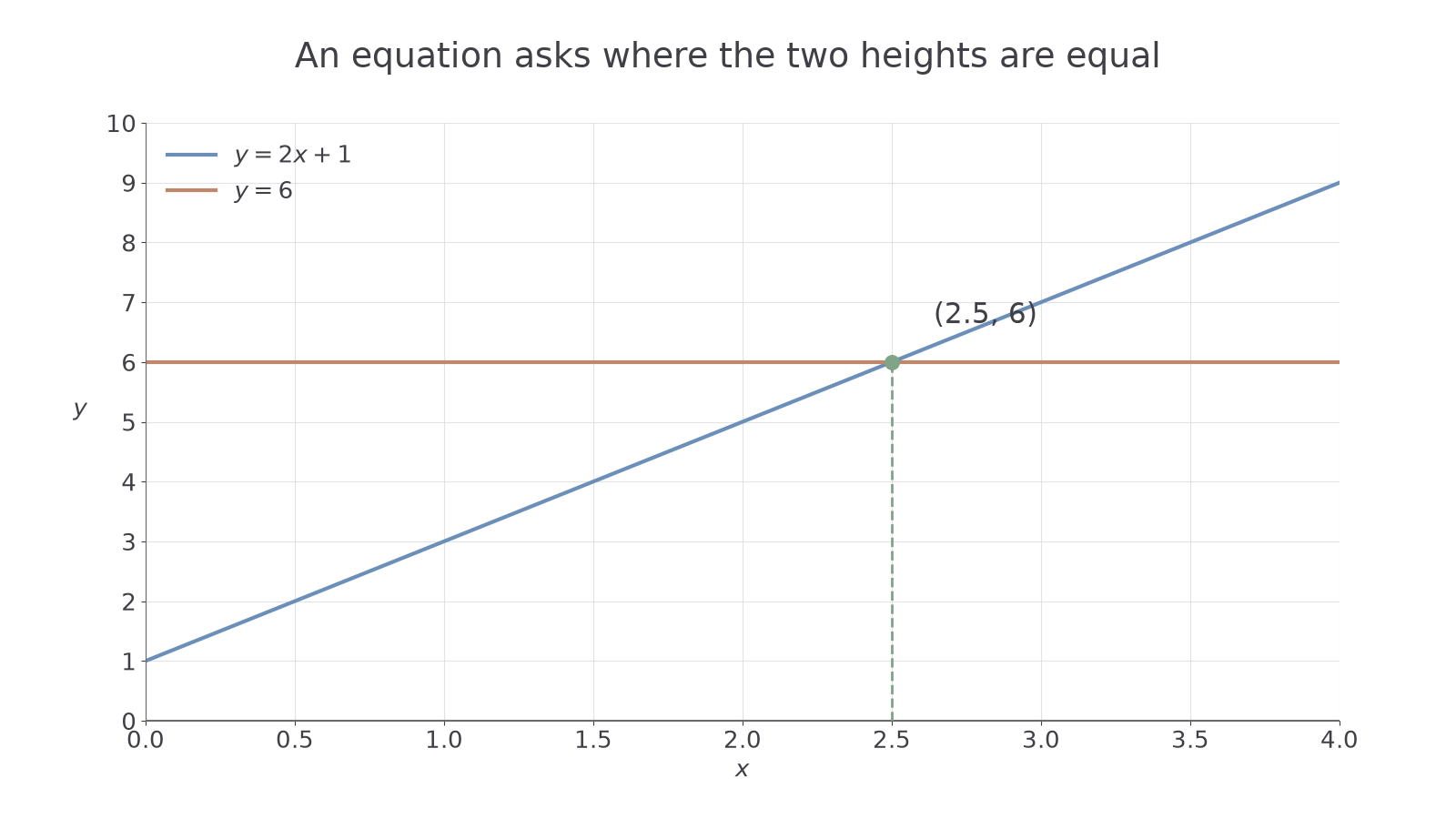
The two sides of an equation can be drawn as two heights. At an intersection, they have equal heights for the same input, so its horizontal coordinate solves the equation.
For , draw and on the same axes. To construct the sloping line, calculate points such as ; two determine the line and a third checks the plotting. Use regular scales and a ruler. Draw the horizontal line through height 6, then read the intersection down to the -axis.
[DIAGRAM: asset_name: A linear equation as two equal heights; asset_slug: 1ma1_m28_linear_solution; caption: The lines meet at (2.5, 6), so the equation has solution x = 2.5.; description: Coordinate axes show y = 2x + 1 in blue and y = 6 in clay, with a sage intersection at (2.5, 6) and a vertical reading guide to x = 2.5.]
Continue this lesson.
You’re previewing NovaLearn without an account. Create a free account to read the rest.
Create free account